Photographs & Artifacts
Documents, souvenirs, and records that sit alongside the diary and letters: some official, some personal, some still not fully explained.
Photographs
 1 / 2
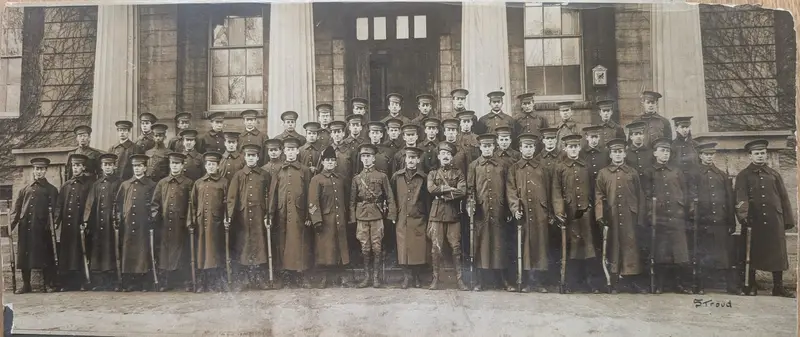
1 / 2 The McGill C.O.T.C., 1912
November 1912: the original print, signed in the corner by the photographer, Stroud. Robertson stands in the rear rank, third from the left.
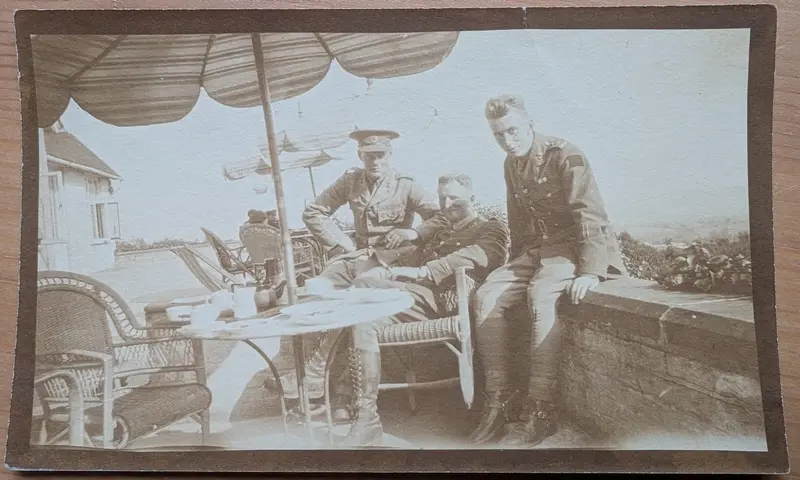
Robertson and Two Officers, 1917
Robertson is the one on the right, sitting on the wall. Found tucked inside the pages of the 1917 diary. No names, date, or location are recorded on the back: possibly the photograph he mentions sending Doris in an undated fall 1917 letter ("a snap of myself and a couple of the sapper-johnnies"), though that isn't confirmed.
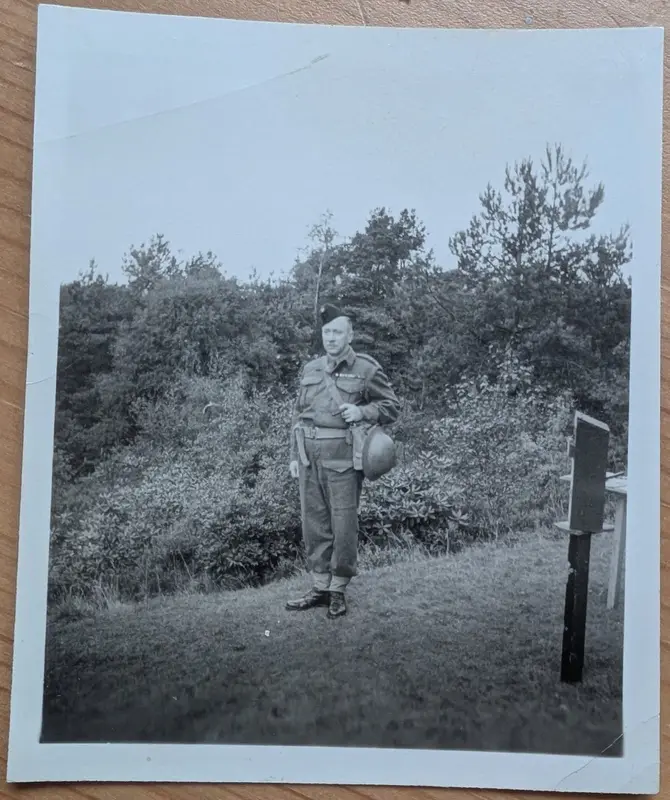
Later in Life
Also found tucked inside the diary rather than filed separately. Robertson is visibly older here, photographed in a garden.
 1 / 5
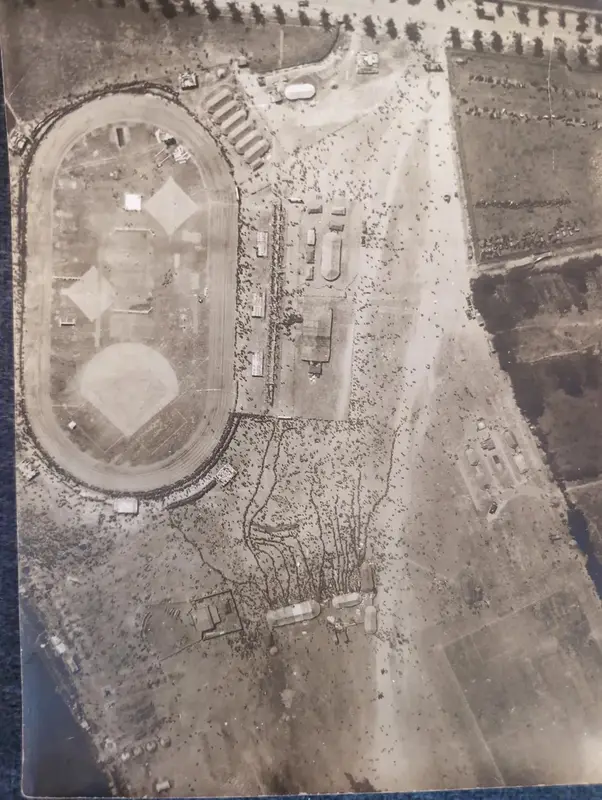
1 / 5 Dominion Day, Tincques, 1918
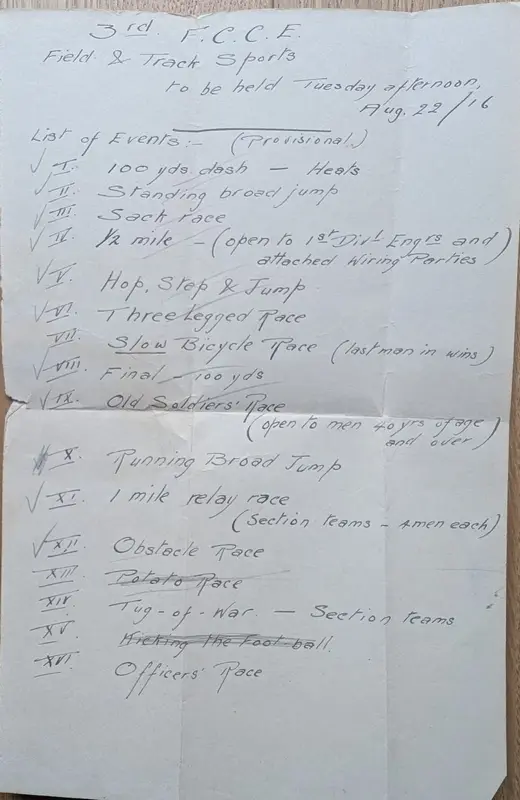
The Canadian Corps sports day, July 1, 1918. The ground (grandstand, oval track and all) had been laid out and built the week before by Robertson's own unit. This aerial view, with the crowds filling the infield, is almost certainly the work of Major Raymond Collishaw, the flying ace who gave an exhibition at the event and is credited in the official programme with photographing it.
 1 / 2
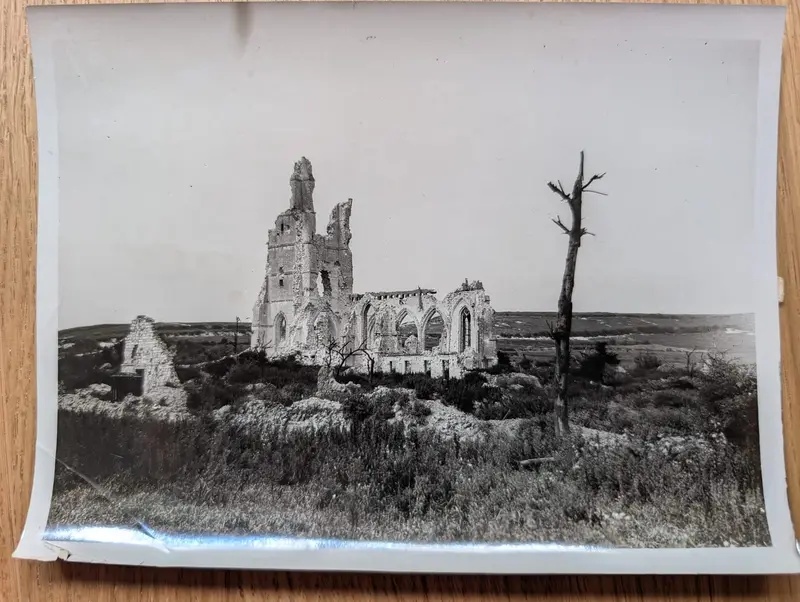
1 / 2 Two Official Photographs
"A ruined church between the lines" (IWM negative C. 2137). The official caption gives no location: only that the church stood in no-man's-land.
Press & Records
 1 / 6
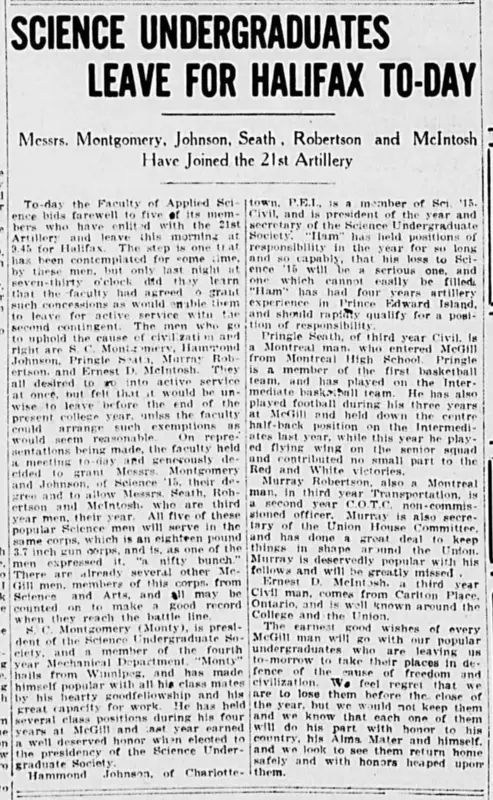
1 / 6 The McGill Daily
February 17, 1915: "Science Undergraduates Leave for Halifax To-day," the student newspaper's announcement that Robertson and four classmates (Montgomery, Johnson, Seath, and McIntosh) had enlisted with the 21st Artillery, just two days after the diary itself begins. It confirms real detail behind the diary's opening entries: Robertson was a third-year Transportation student, already a second-year C.O.T.C. non-commissioned officer, and secretary of the Union House Committee: "deservedly popular with his fellows," in the paper's own words.
 1 / 2
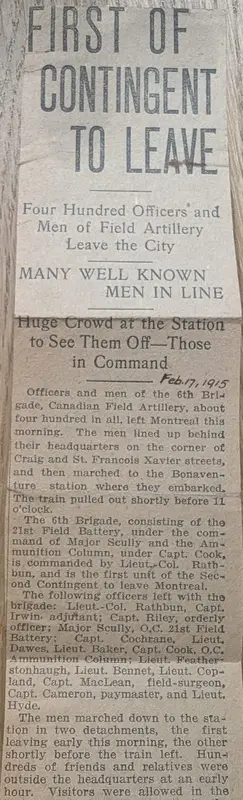
1 / 2 The Contingent Leaves Montreal
"First of Contingent to Leave." The 21st Field Battery under Major Scully, the ammunition column under Capt. Cook, Lieut.-Col. Rathbun commanding, about four hundred men forming up behind their Craig Street headquarters and marching to Bonaventure station, the train out "shortly before 11 o'clock."
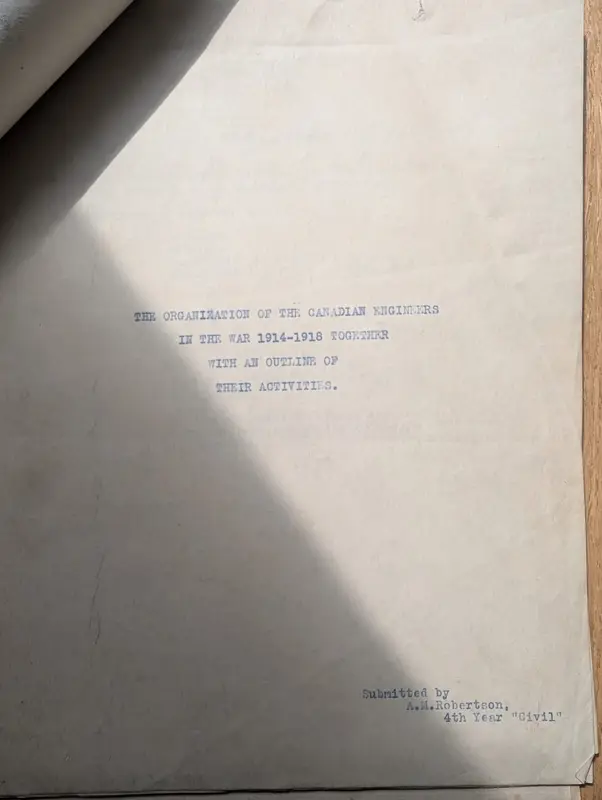
His 1921 Paper on the Canadian Engineers
Robertson's own retrospective account of how the Canadian Engineers were organized and what they did, written as a 4th-year Civil Engineering student at McGill in 1921, the one place he sets out to explain his war rather than record it. Hand-drawn organization charts, selected pages, and a 1923 letter of corrections from a fellow officer are gathered on their own page.
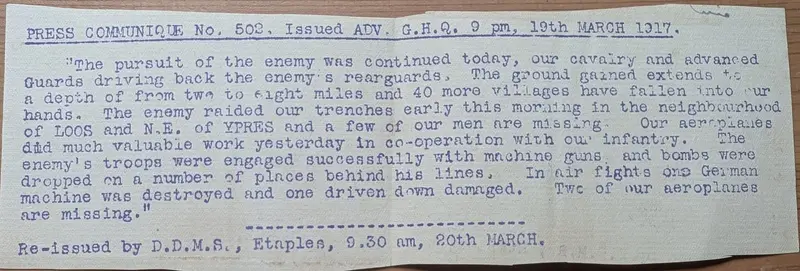
Press Communique No. 502, March 19, 1917
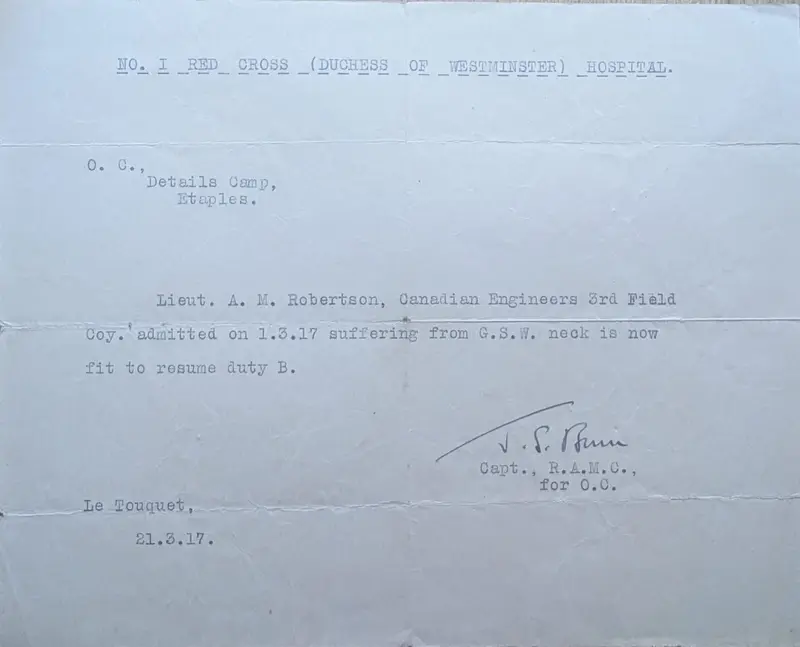
Found tucked in the pages of the diary, dated the same day as the entry itself. Issued from Advanced G.H.Q. at 9 pm and re-issued the next morning by the medical services at Etaples, it reports British forces pursuing a retreating enemy and gaining ground "to a depth of from two to eight miles." Robertson's own entry for the day, recovering from his neck wound, is four words: "We seem to be winning."
 1 / 3
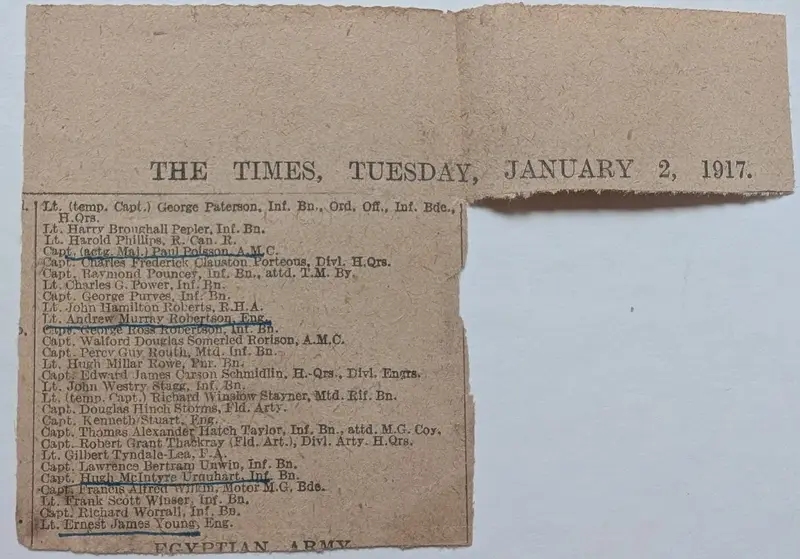
1 / 3 The 1917 New Year Honours
The Times, January 2, 1917. "Lt. Andrew Murray Robertson, Eng." is underlined in blue: the same list he reads about, with visible surprise, in his diary entry for January 4, 1917.
 1 / 2
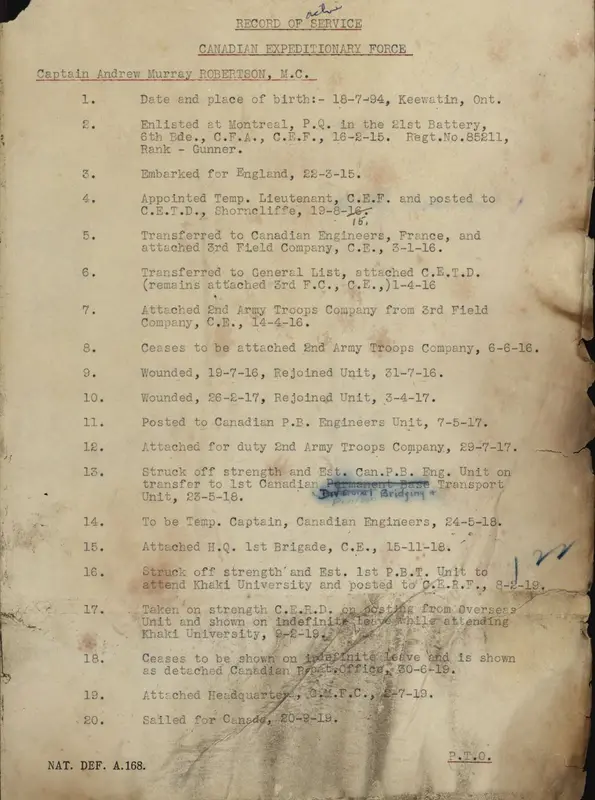
1 / 2 Official Record of Service
Two official summaries of his war, kept together. The multi-page Record of Service is the detailed ledger: twenty numbered lines from his enlistment as a gunner in the 21st Battery to "Sailed for Canada, 20-9-19." The one-page Certificate of Service, handed to him at demobilization, sets the same career on a single printed form: enlisted February 16, 1915, commissioned into the Canadian Engineers that August, the string of engineer units, two wounds and the Military Cross, struck off the strength on September 30, 1919. After the diary itself falls silent the ledger carries the story on: posted to attend Khaki University (an education program for Canadian soldiers awaiting repatriation) from February 8, 1919, and sailing for Canada that September.
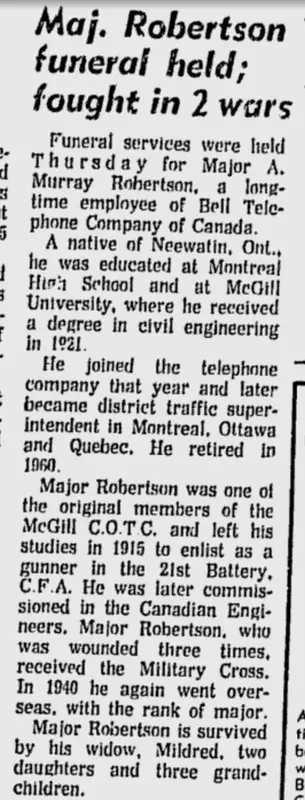
Obituary
Major A. Murray Robertson: career at Bell Telephone Company of Canada after the war, a return to service in the Second World War, and the Military Cross earned in the First.
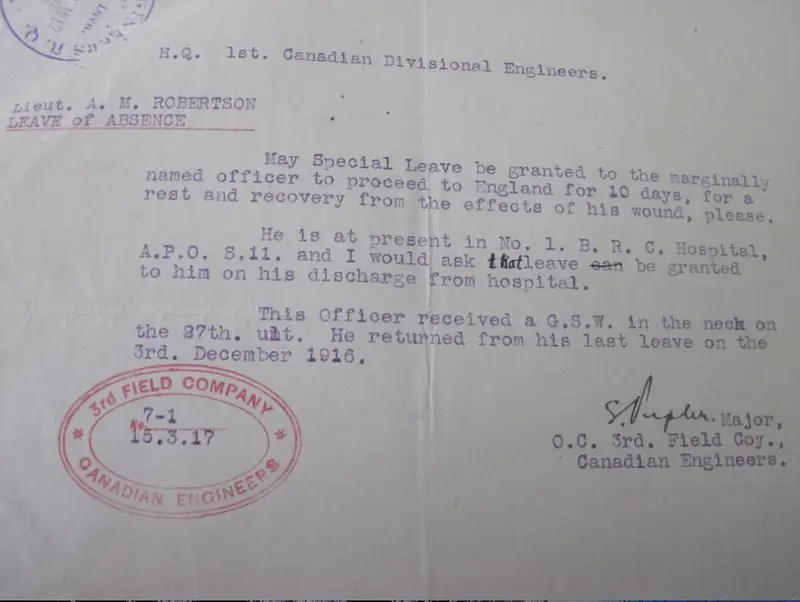
Leave Request, March 1917
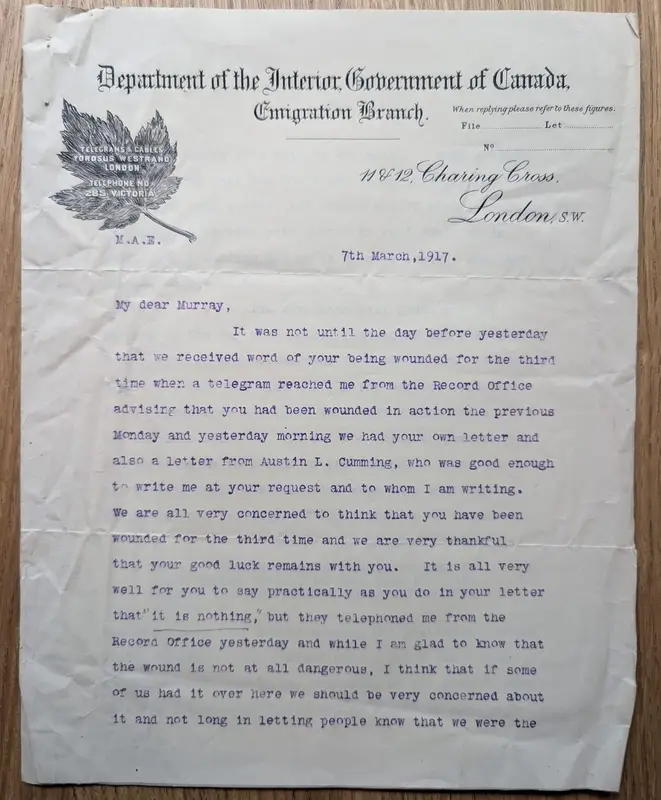
Signed by Major E. Pepler (the same officer likely behind Murray's Military Cross recommendation) requesting ten days' special leave for "rest and recovery" after Murray was shot through the neck on February 26, 1917 (this document rounds it to "the 27th ult."; his own letter and his official Record of Service both confirm the 26th). Dated March 15, 1917, the same day as his letter describing the wound to Doris.
Maps
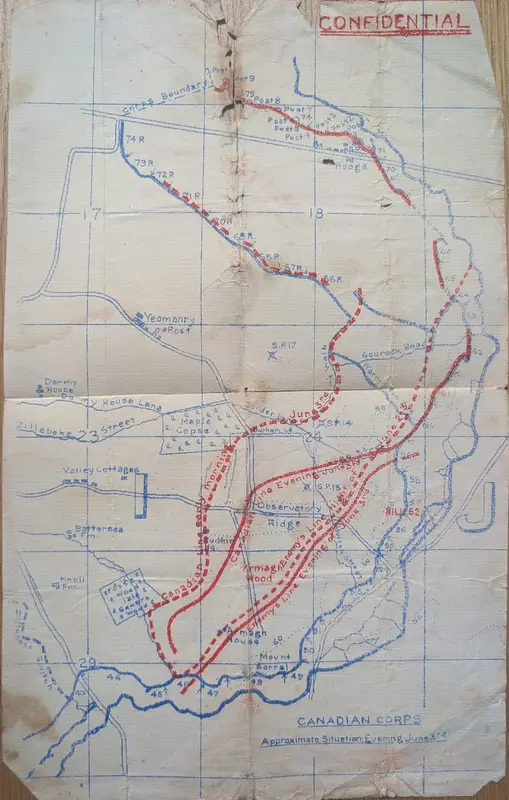
Situation Map, Mount Sorrel
Marked "CONFIDENTIAL." The printed blue base is the southern Ypres salient: Hooge, Zillebeke, Sanctuary Wood, Maple Copse, Observatory Ridge, Armagh Wood, Mount Sorrel, Hill 62. Overprinted in red: the Canadian front line early on June 3, 1916, the line still held that evening after the Germans took the high ground, and the enemy's line at nightfall. It is the operational picture behind Robertson's long combined diary entry for June 3–4: a night he spent hauling wire and material forward, "swiping waggons" and keeping the parties "going till daylight." He left for England on the 5th with the battle still on: "Hate to be leaving at this time."
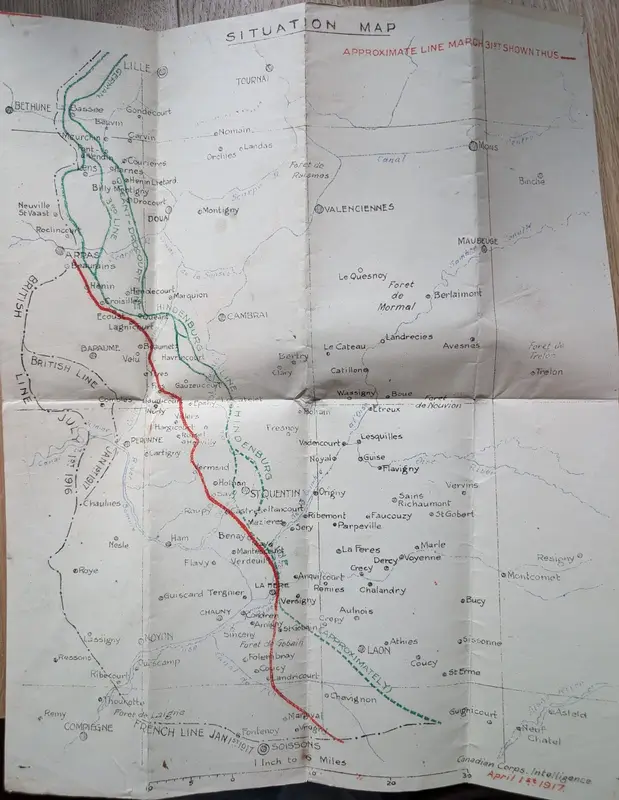 1 / 2
1 / 2 Situation Maps, Spring 1917
March 31, 1917: the front line (red) against the Hindenburg Line the Germans had just withdrawn to (green), the same withdrawal Robertson's diary tracks in its own March 18 entry. His own sector, Arras and Vimy, sits at the top left.
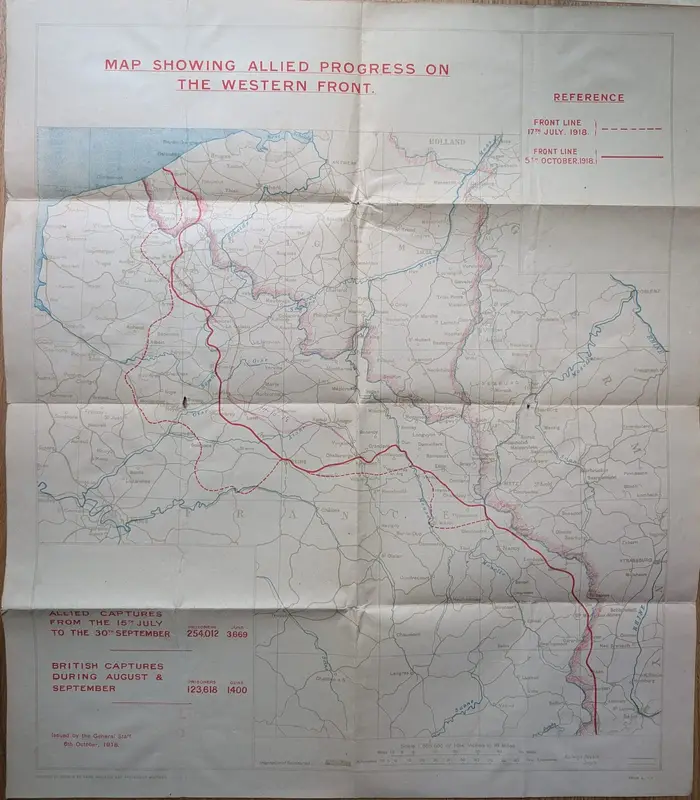
Map Showing Allied Progress on the Western Front, October 1918
Issued by the General Staff, October 6, 1918, plotting the front line on July 17 against October 5: the Hundred Days Offensive compressed into one map, with Allied prisoner and gun tallies printed at bottom left (254,012 prisoners and 3,669 guns between July 15 and September 30 alone). Covers the same weeks as the diary's own rapid advance through the Douai villages and the fall of Lille, Douai, and Ostend.
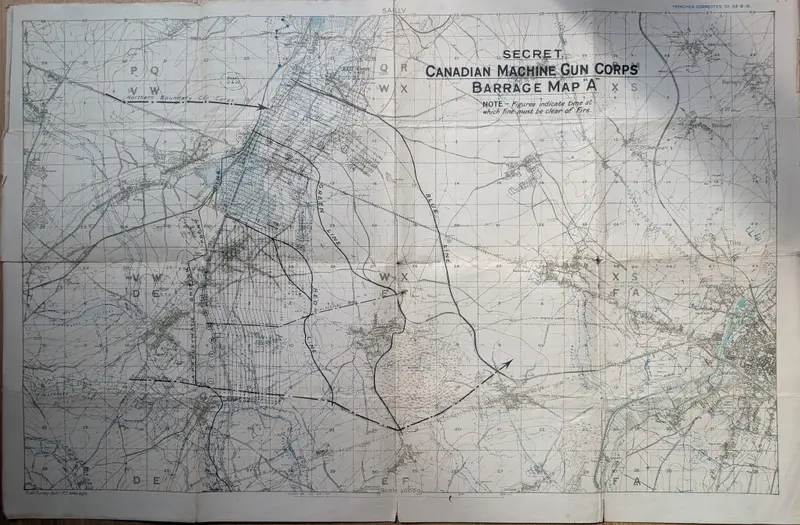 1 / 2
1 / 2 Barrage Map "A," September 1918
The machine-gun barrage supporting the attack, a "Secret" map.
Engineering Drawings
 1 / 2
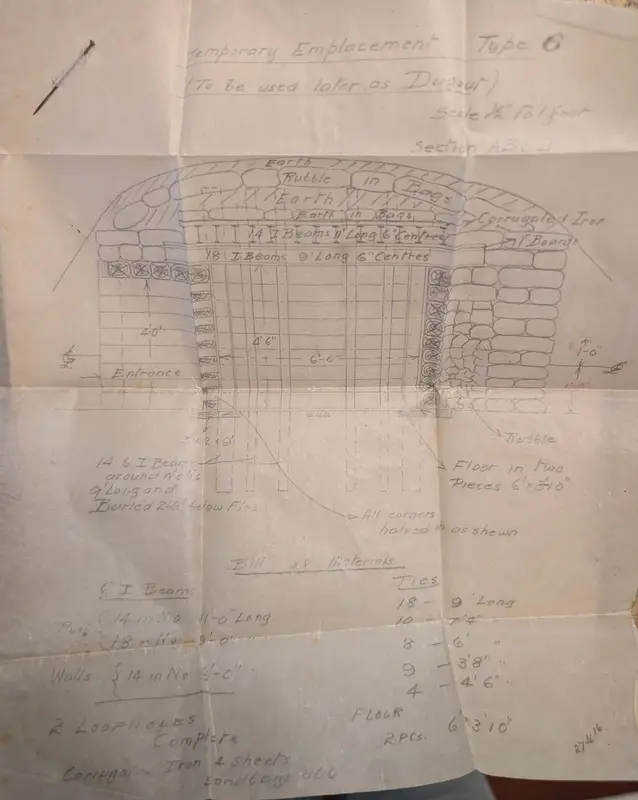
1 / 2 Temporary Emplacement, Type 6
The design, with a full bill of materials worked out beneath the drawing.
 1 / 3
1 / 3 Field Sketches
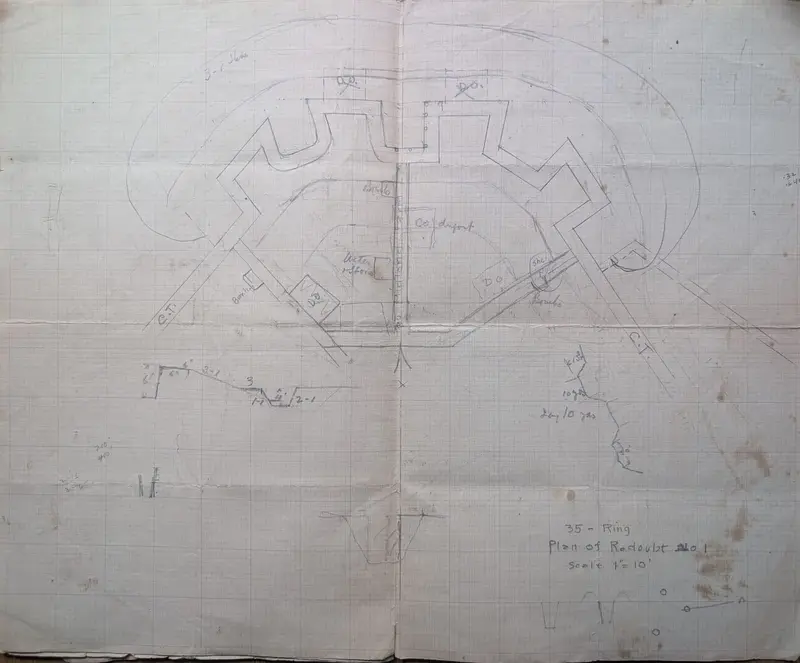
"35 – Ring. Plan of Redoubt No. 1. Scale 1″ = 10′." A defended strongpoint laid out on graph paper (fire bays, communication trenches, a bombing store, the C.O.'s dugout, a water store, the wire) with trench profiles alongside.
Ephemera
Keepsakes & personal
 1 / 2
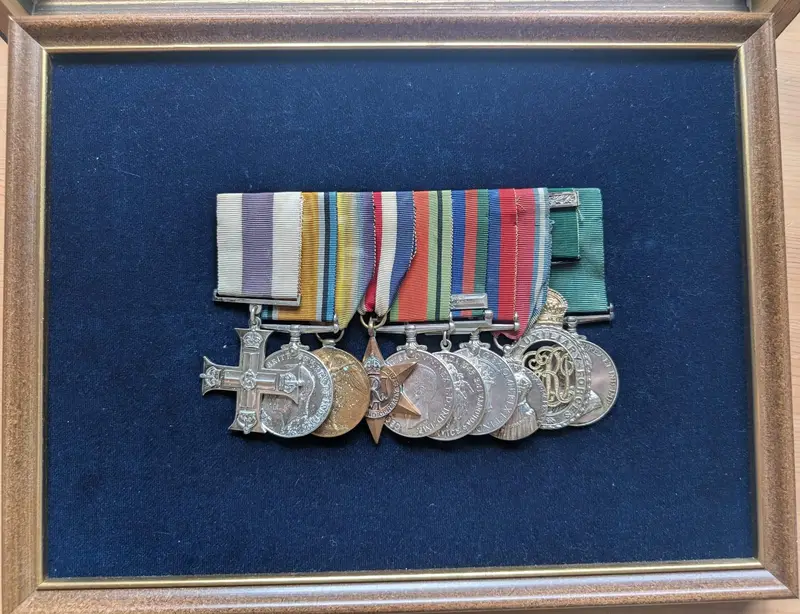
1 / 2 His Medals
Ten medals on one bar, spanning both world wars: the Military Cross, British War Medal, Victory Medal, France and Germany Star, Defence Medal, Canadian Volunteer Service Medal, War Medal 1939–1945, King George VI Coronation Medal (1937), and the Colonial Auxiliary Forces Officers' Decoration and Long Service Medal.
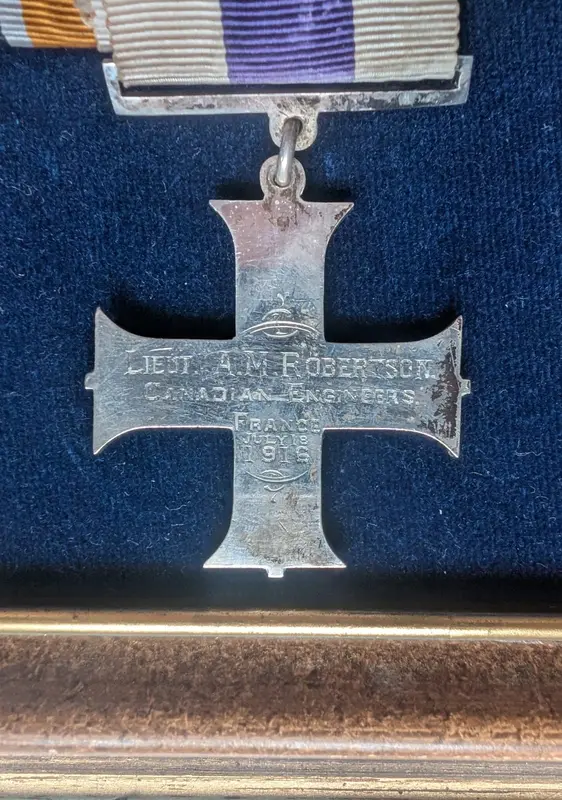
The Military Cross, Engraved
The reverse of the Military Cross, engraved "LIEUT. A.M. ROBERTSON. CANADIAN ENGINEERS. FRANCE JULY 18 1916": dating it to his service with the 3rd Field Company on the Western Front that summer, and, as it happens, to his 22nd birthday.
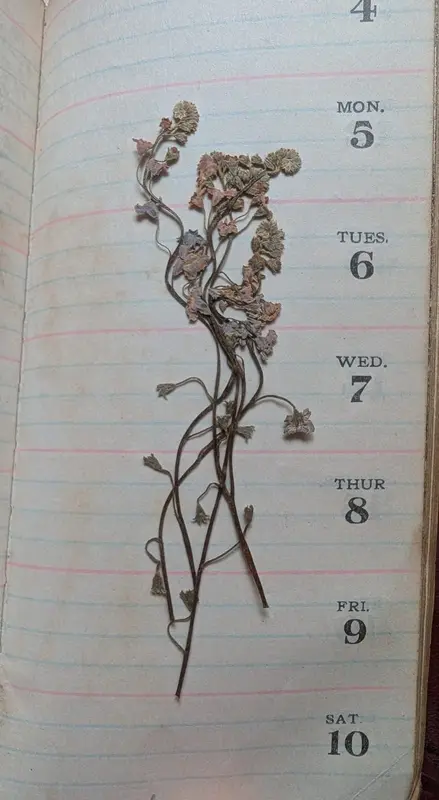
Pressed Flowers
Found pressed between the pages of the second 1915 diary, with no accompanying note.
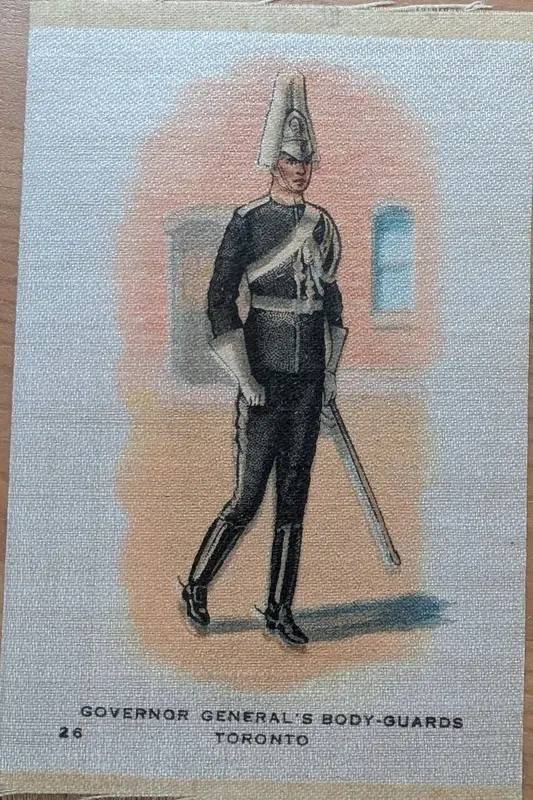
Silk Card: Governor General's Body-Guards
A silk cigarette card (No. 26 in an Imperial Tobacco Company series from 1914), depicting the uniform of the Governor General's Body-Guards, Toronto. These were printed on small pieces of silk rather than card stock and packaged one to a cigarette pack, a popular collectible of the era, often sewn into cushions or scrapbooks once a set was complete. Found loose in the pages of the 1917 diary.
 1 / 2
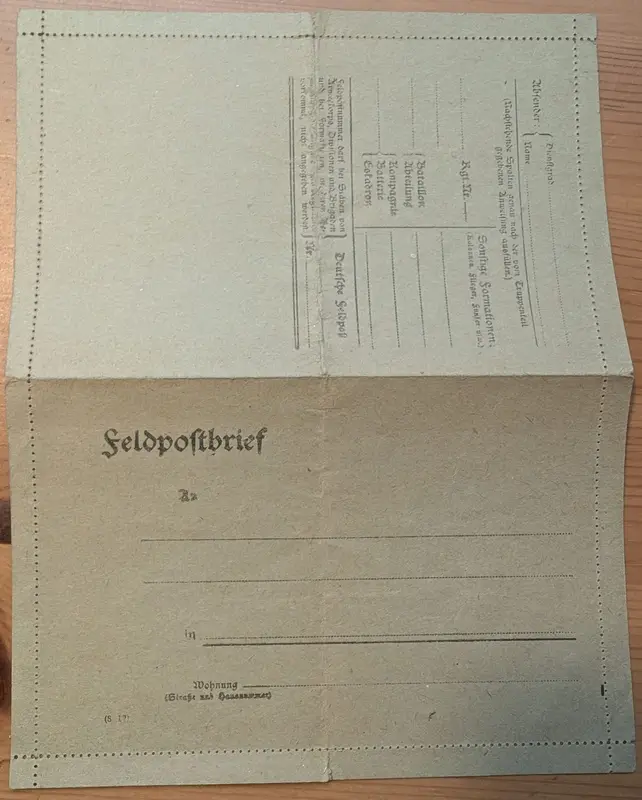
1 / 2 German ("Hun") Stationery
A piece of captured or souvenired German notepaper, kept among his papers, with a note in Murray's own hand on the inside: "Here is some hun stationary I pinched out of a dugout the other day." Undated, it isn't yet known which letter, if any, first mentions it.
 1 / 4
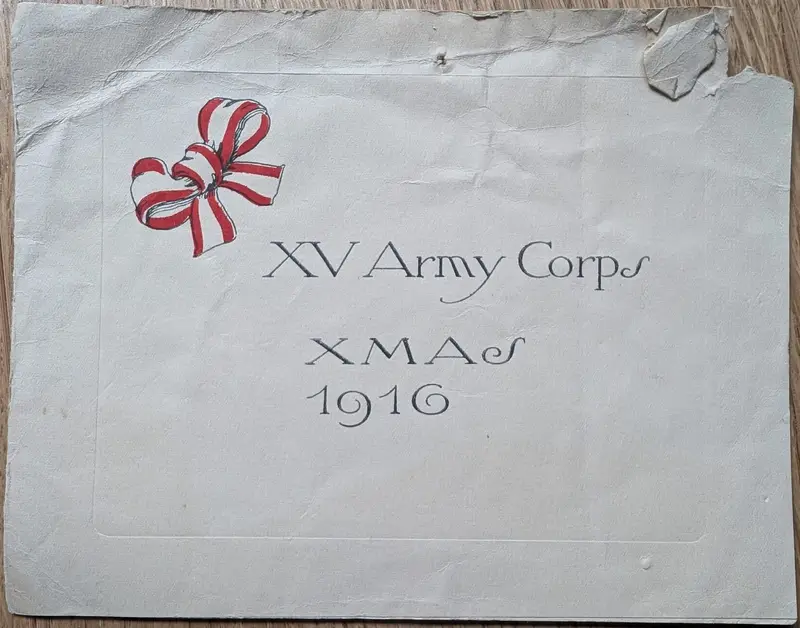
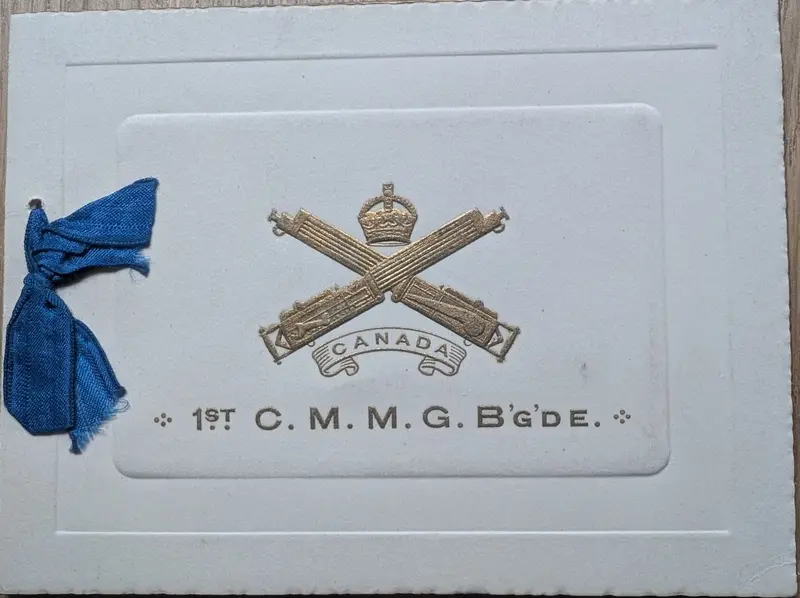
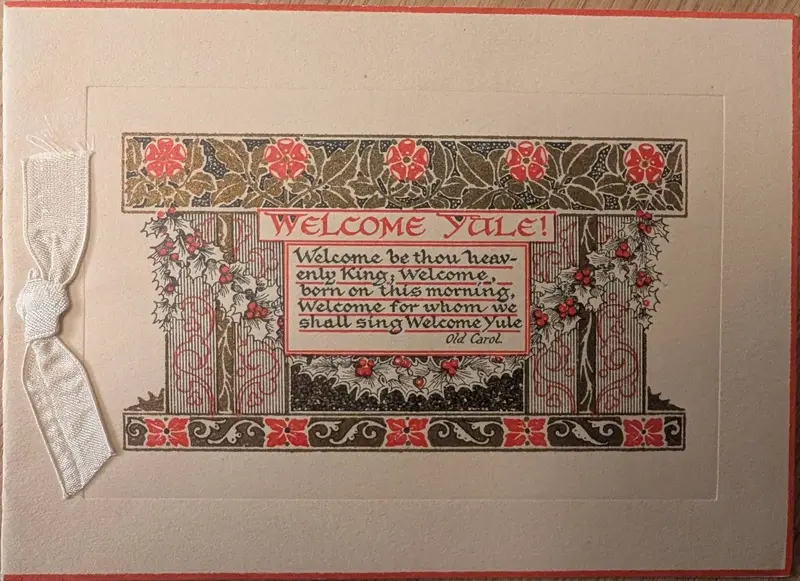
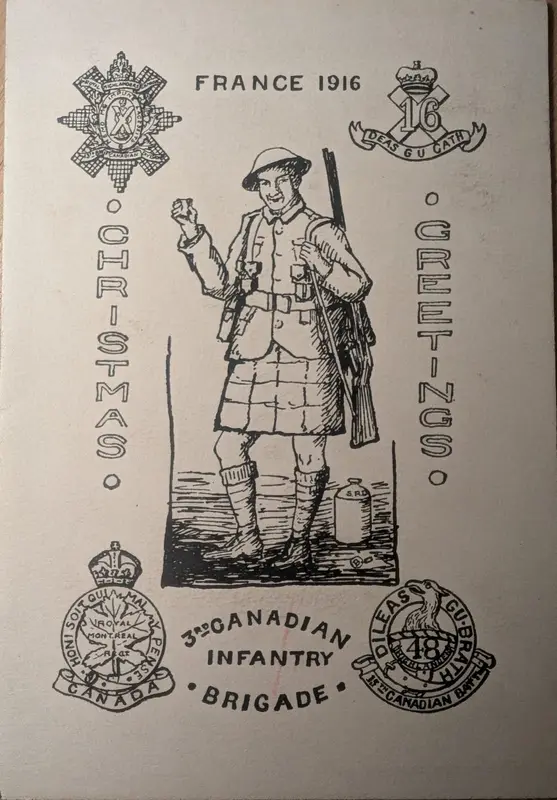
1 / 4 Christmas Card, XV Army Corps, 1916
A Christmas card from the British XV Army Corps, dated December 20, 1916 and addressed "To 'Red' & friends of the 2nd Field Coy." "Red" was Robertson's own nickname among fellow officers: confirmed in his own words in a January 17, 1918 letter to Doris: "I am known to most people as 'Red' – even the men in my section called me that." The "2nd Field Coy" doesn't match his actual unit, the 3rd Field Company, Canadian Engineers, and the sender's signature (read, as best it can be made out, as "Tomburrow") isn't otherwise identified. Illustrated by an artist signed "O.A.B.," and printed, like the two cards below, by Devambez of Paris.
 1 / 2
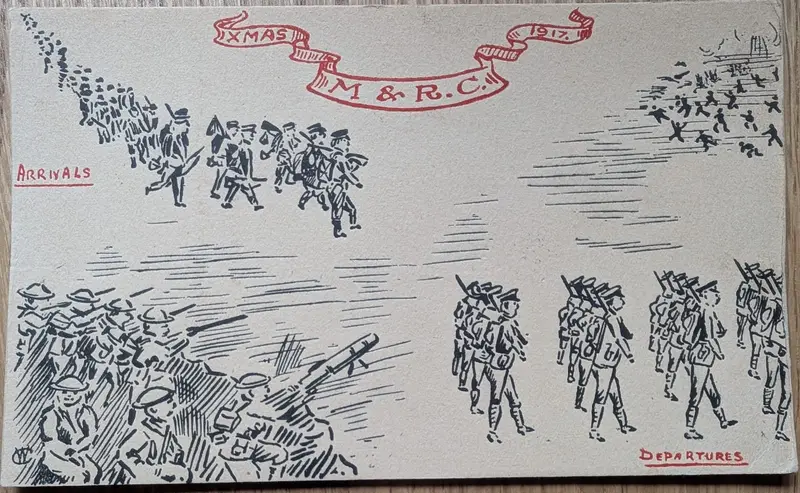
1 / 2 Christmas Card, 1917 ("M & R.C.")
A blank, never-filled-in Christmas card marked "M & R.C.," the abbreviation isn't confirmed. Both the "to" and "from" lines on the back were left empty.
 1 / 3
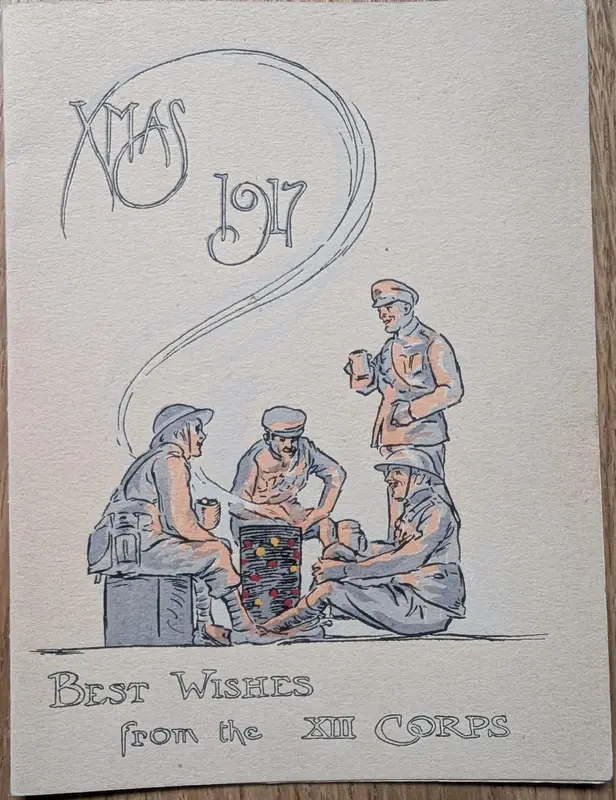
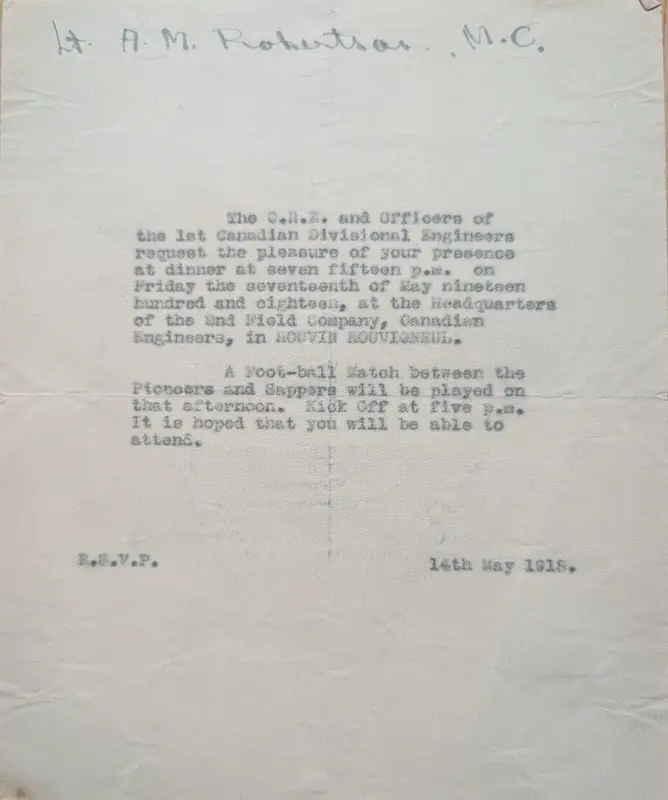
1 / 3 Christmas Card, XIII Corps, 1917
Another blank, unfilled card, this one "from the XIII Corps," a formation Robertson's own diary mentions twice in 1918 as a neighboring unit (its Troops Supply Column), though this particular card carries no name to confirm who it was meant for. Dated inside for December 25, 1917; illustrated by C. Floyd. Like the other two cards here, printed by Devambez of Paris.
Money & receipts
Statement of Expenses, 1916
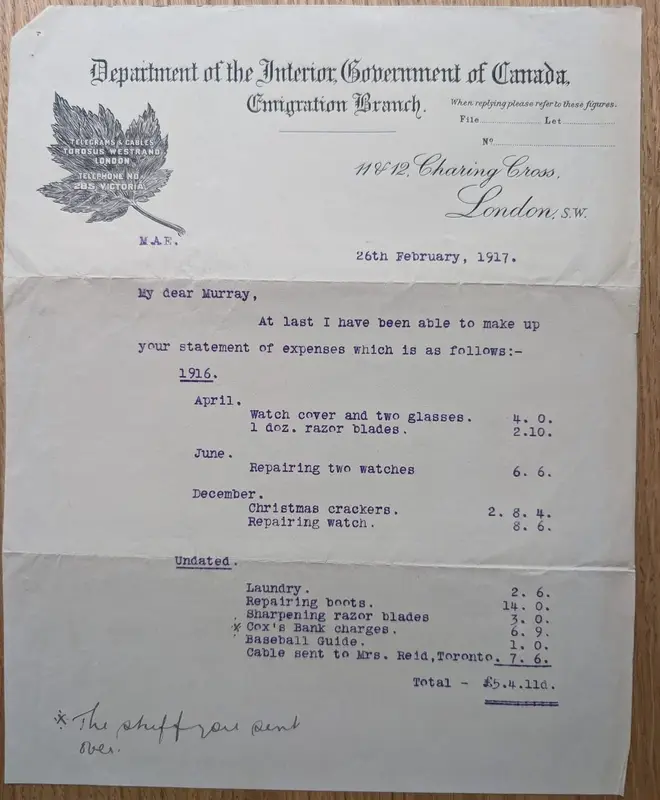
Drawn up on February 26, 1917 by Robertson's cousin Charley Allen, who handled his affairs in London, working from the Canadian Government Offices at 11 & 12 Charing Cross: the address a fall 1917 letter gives as "c/o C.A. Allen." It lists small sums laid out on his behalf through 1916: a watch cover and two glasses, a dozen razor blades, repairs to two watches in June, "Christmas crackers" at £2.8.4 in December, boot repairs, laundry, Cox's Bank charges, a "Baseball Guide" at a shilling, and a cable to Mrs. Reid in Toronto. Total, £5.4.11.
Lafayette Photographer's Receipt, 1917
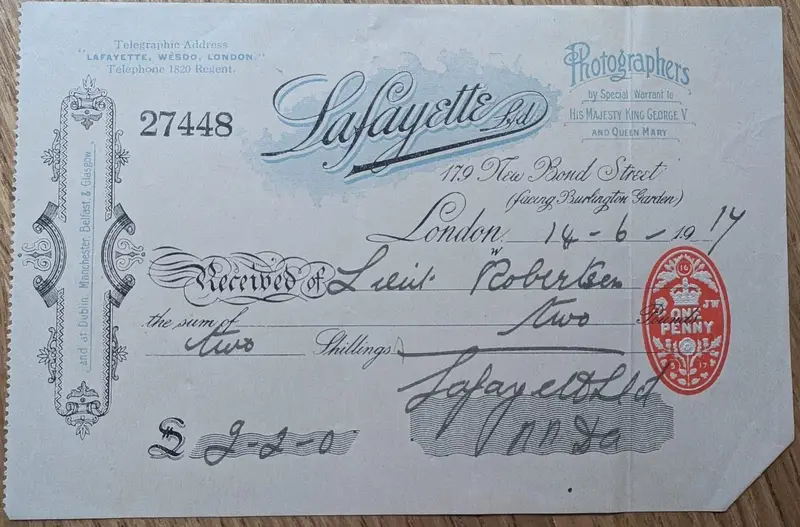
June 14, 1917 (the day after the Buckingham Palace investiture) two guineas (£2.2.0) paid to Lafayette Ltd of 179 New Bond Street, "Photographers by Special Warrant" to the King and Queen. A sitting at a studio of that standing the day after the ceremony points to a formal Military Cross portrait, though no print of one has turned up in the family's papers.
Streatham Hill Lodge Receipt, 1917
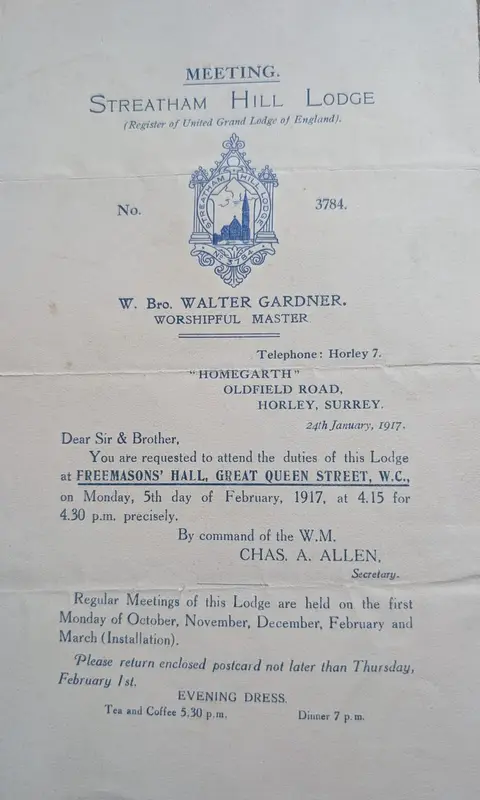
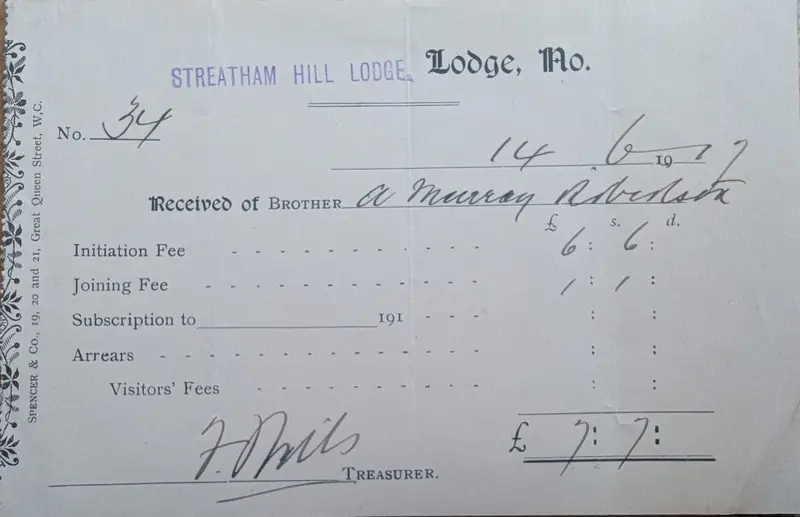
June 14, 1917 (the day after the investiture, on the same leave) "Received of Brother A. Murray Robertson" the initiation fee of six guineas and a joining fee of one guinea, £7.7.0 in all. Robertson was initiated into Freemasonry at the Streatham Hill Lodge. The March 1917 letter about his wound had already reported the Lodge "looking forward to the time when they will have the honour and privilege of admitting you as a member."
Officer's Advance Book, 1917
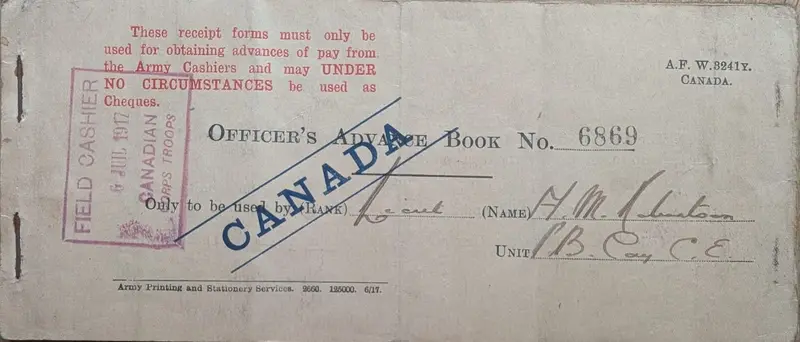
The cover of Robertson's book of pay-advance forms ("must only be used for obtaining advances of pay from the Army Cashiers and may UNDER NO CIRCUMSTANCES be used as Cheques") stamped by the Field Cashier, Canadian Corps Troops, on July 6, 1917. An officer in the field drew cash against forms like these rather than by cheque.
 1 / 12
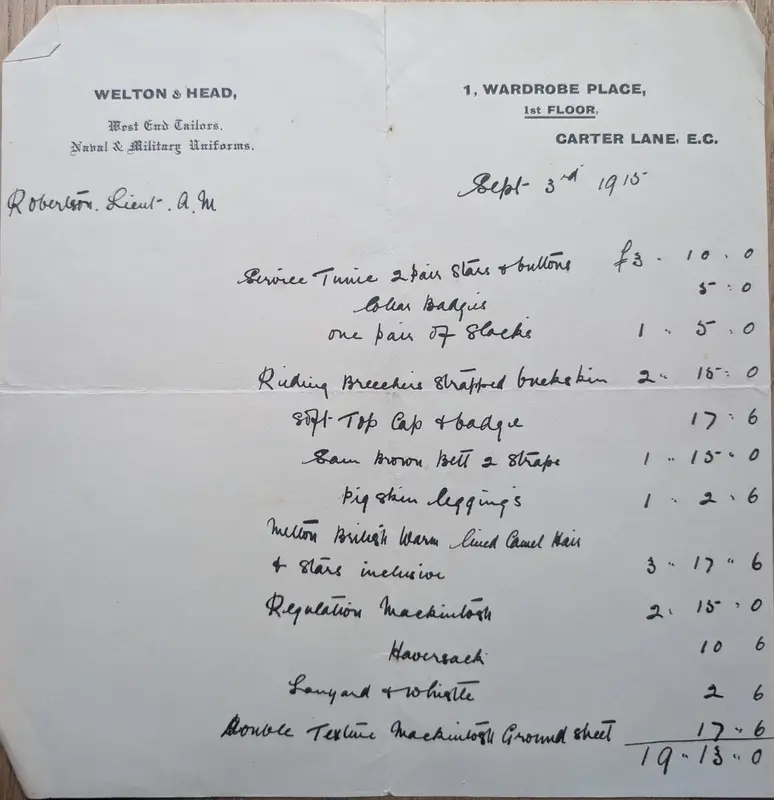
 His Military Tailors
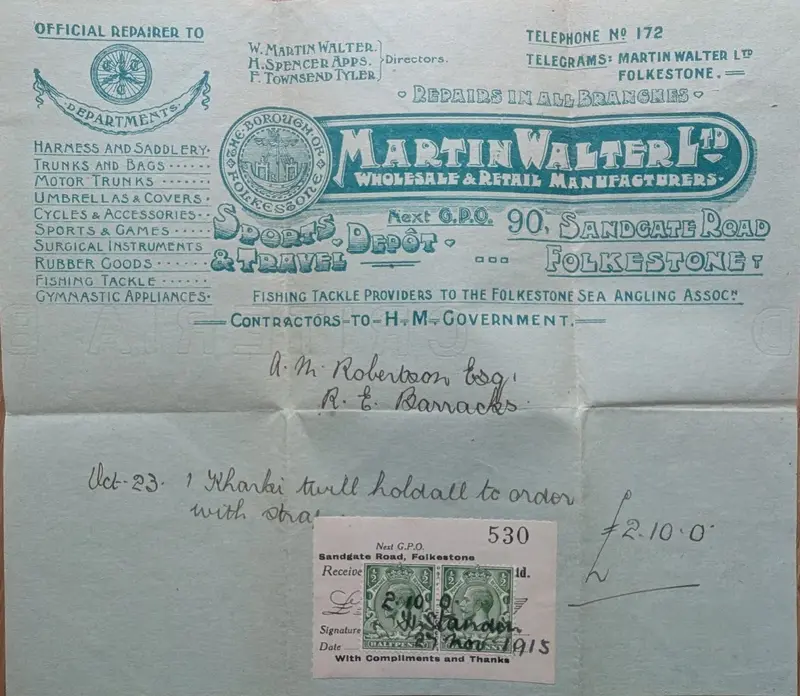
September 3, 1915, the new officer's outfit, itemised: service tunic with two pairs of stars, riding breeches in strapped buckskin, a Sam Browne belt, a Wolseley valise, a camp bath and washstand, a camel-hair sleeping bag. He had reported to the depot as a gunner eleven days earlier.
A Military Cross Brooch
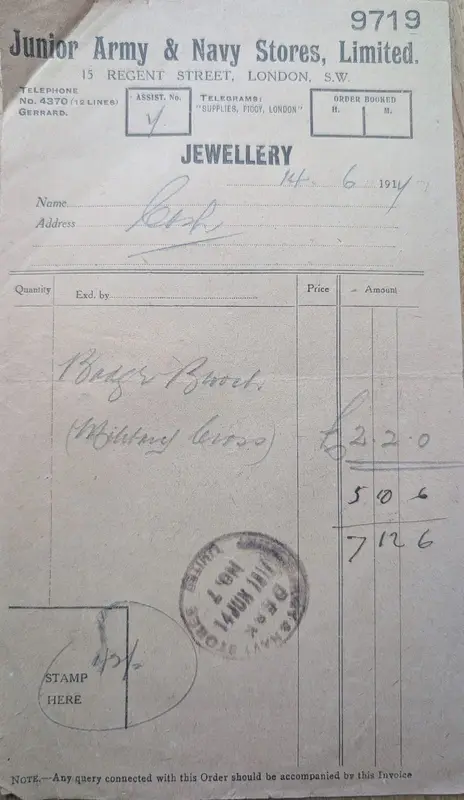
Junior Army & Navy Stores, 15 Regent Street: June 14, 1917. "1 Badge Brooch (Military Cross)": £2 2s. The day before, he had been to Buckingham Palace for the decoration itself.
 1 / 11
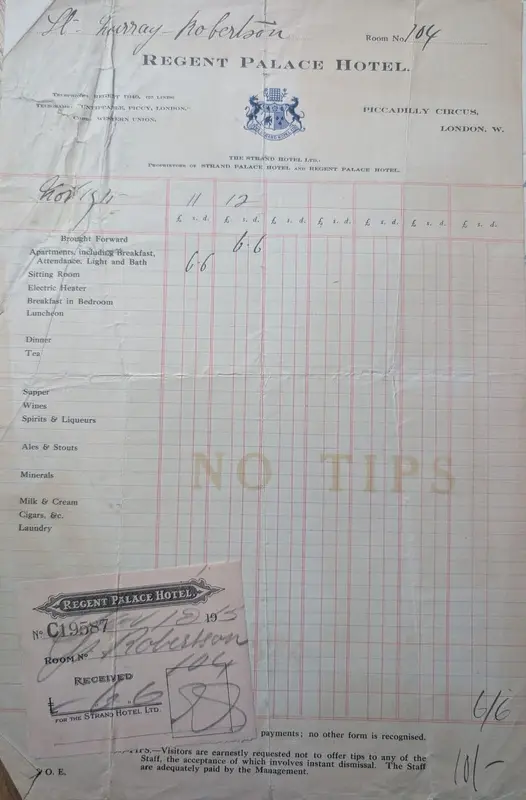
 Hotel Bills
Regent Palace Hotel, Piccadilly Circus: November 11–12, 1915, room 104, 6s. 6d. a night. A weekend in London during his training months.
 1 / 3
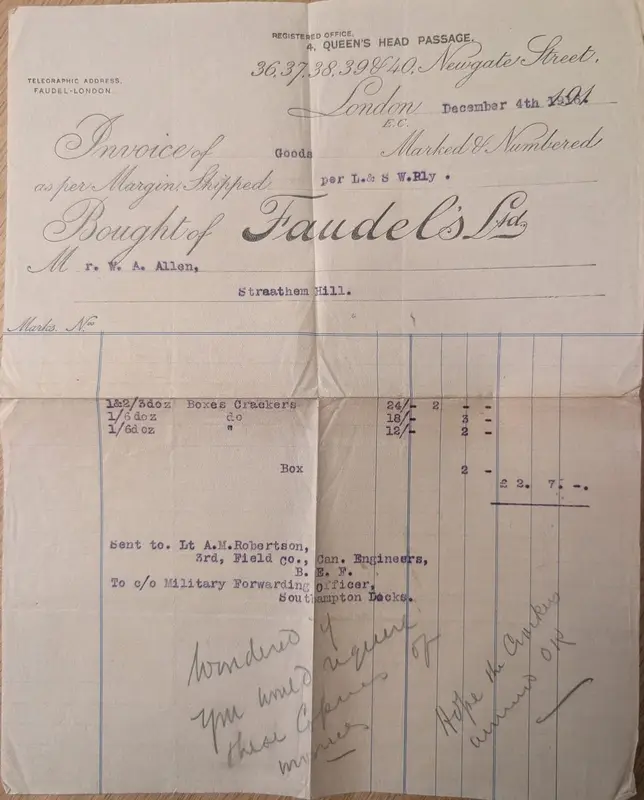
1 / 3 A Christmas Parcel from Streatham, 1916
Faudel's Ltd of Newgate Street, December 4, 1916: £2 7s. of "Boxes Crackers," bought by a Mr. W. A. Allen of Streatham Hill and "Sent to Lt A. M. Robertson, 3rd Field Co., Can. Engineers, B.E.F., c/o Military Forwarding Officer, Southampton Docks." Across the foot, in Robertson's pencil: "Wondered if you would require these expenses… Hope the crackers arrive OK."
Travel, leave & leisure
 1 / 6
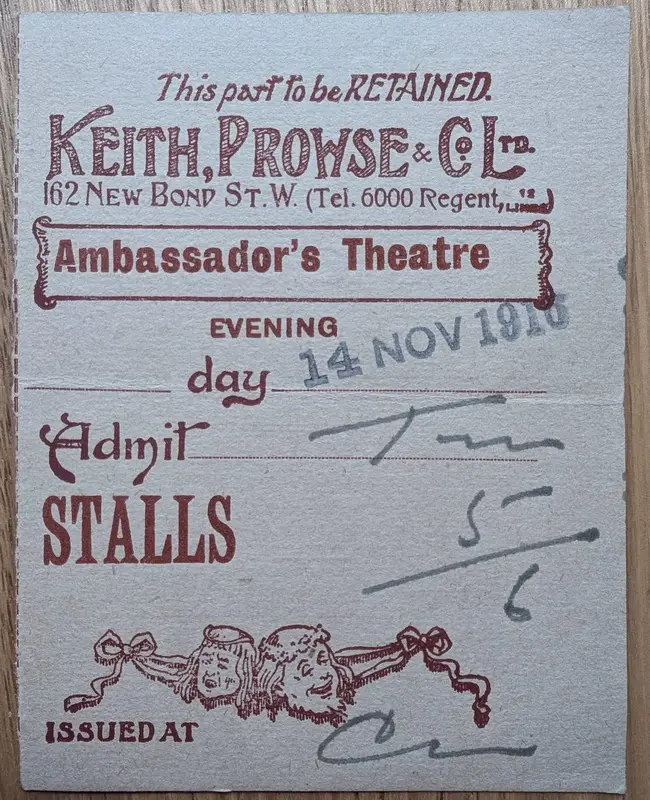
1 / 6 Theatre Ticket Stubs
Ambassador's Theatre, evening of November 14, 1916: stalls, 5s. 6d. Robertson had come down from the Vimy front the day before, on his first leave since reaching France.
Pullman Car Bill, June 1917
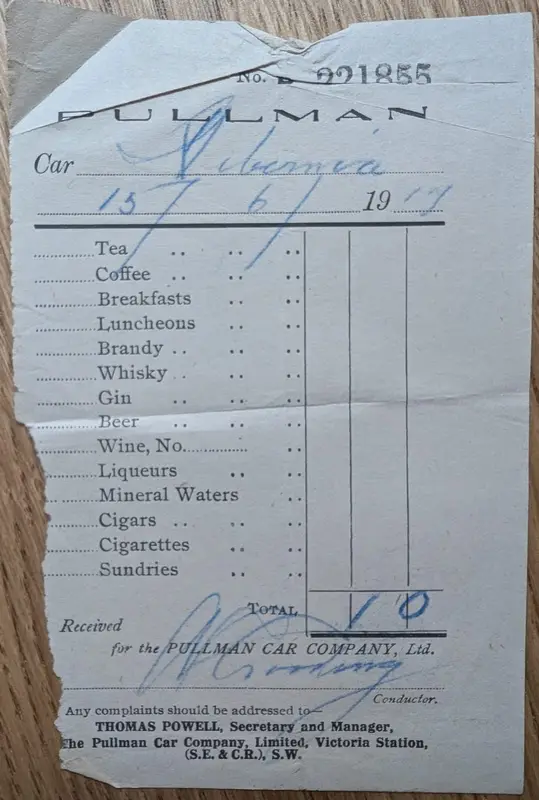
A refreshment bill from the Pullman car Hibernia, run out of Victoria Station on the South Eastern & Chatham line to the Channel ports: Robertson's journey back to France at the end of his June 1917 leave. The printed list of teas, luncheons and spirits is struck through; the total is a single shilling.
 1 / 5
1 / 5 Passes
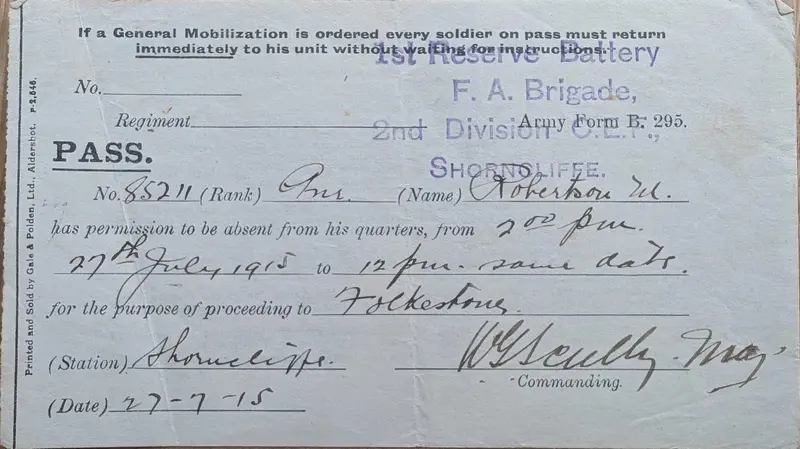
July 27, 1915, his earliest surviving pass: an afternoon and evening out of Shorncliffe camp to neighbouring Folkestone, made out to "No. 85211 (Rank) Gnr," and signed by Major W. G. Scully, his battery commander, the same officer who had sworn him into the service at Moncton that February. Three weeks before his commission.
 1 / 3
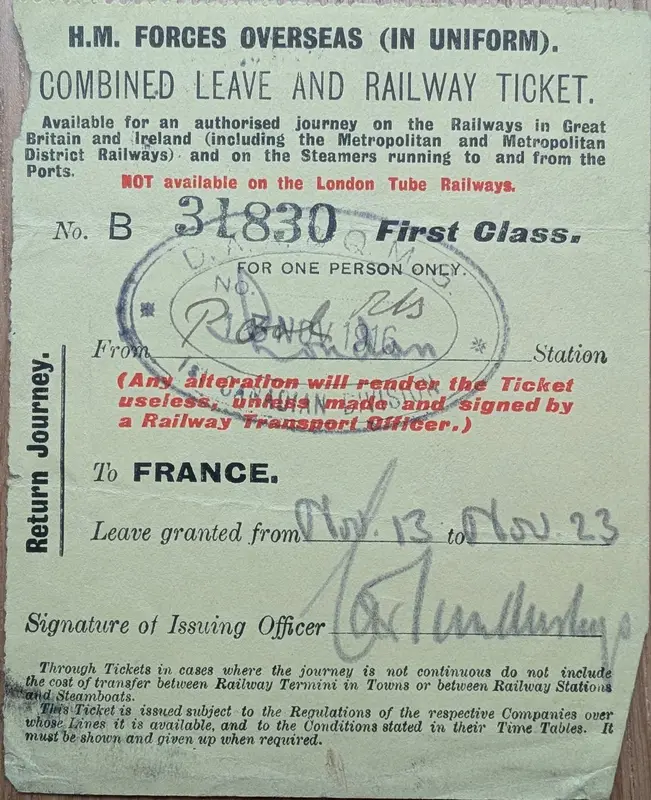
1 / 3 Leave and Railway Tickets
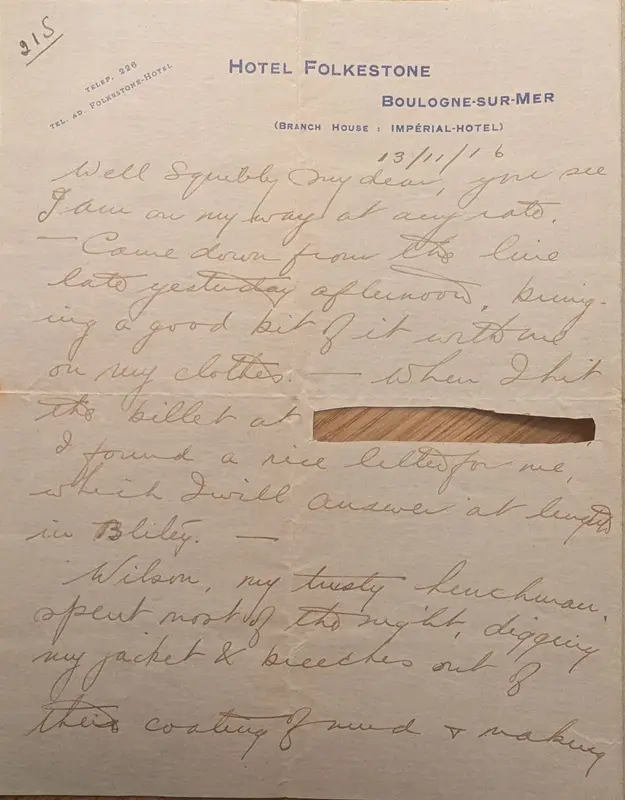
"H.M. Forces Overseas (in uniform). Combined Leave and Railway Ticket": first class, for one person, "To FRANCE." Leave granted from November 13 to 23, 1916; the theatre stubs from that fortnight are elsewhere in the Gallery.
 1 / 5
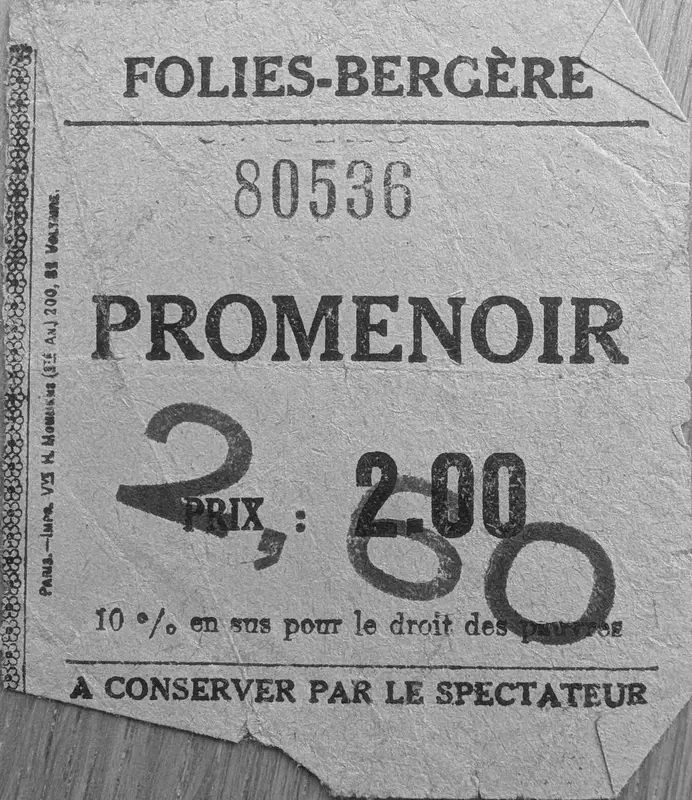
1 / 5 Tickets Kept in France
Folies-Bergère, Paris: a “promenoir” (standing promenade) ticket, 2 francs plus the ten-per-cent poor-relief levy. One of his Paris leaves: October 1917, February 1918, or August 1918.
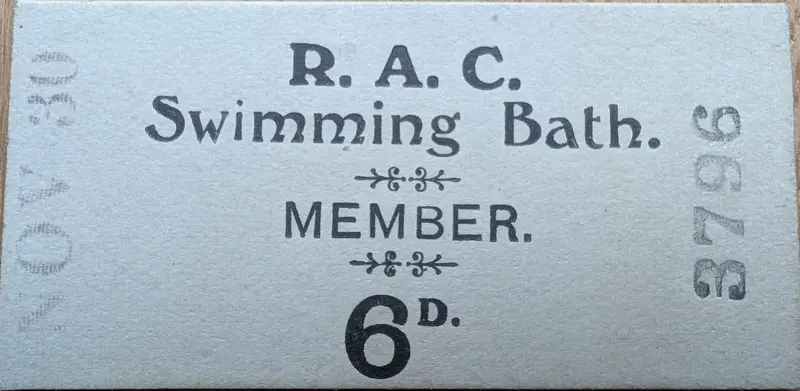
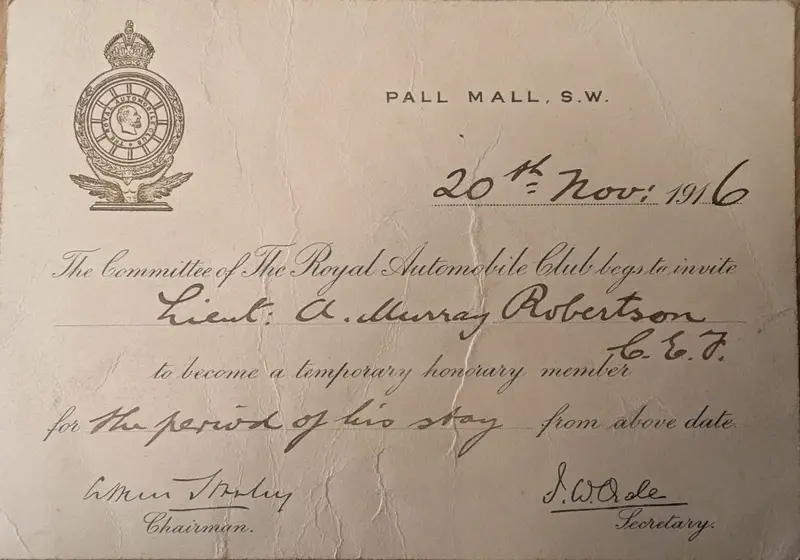
R.A.C. Swimming Bath Ticket
"R.A.C. Swimming Bath. Member. 6d." The Royal Automobile Club's Pall Mall clubhouse had a large basement pool; officers on leave were routinely given temporary membership of the Pall Mall clubs. Undated.
 1 / 4
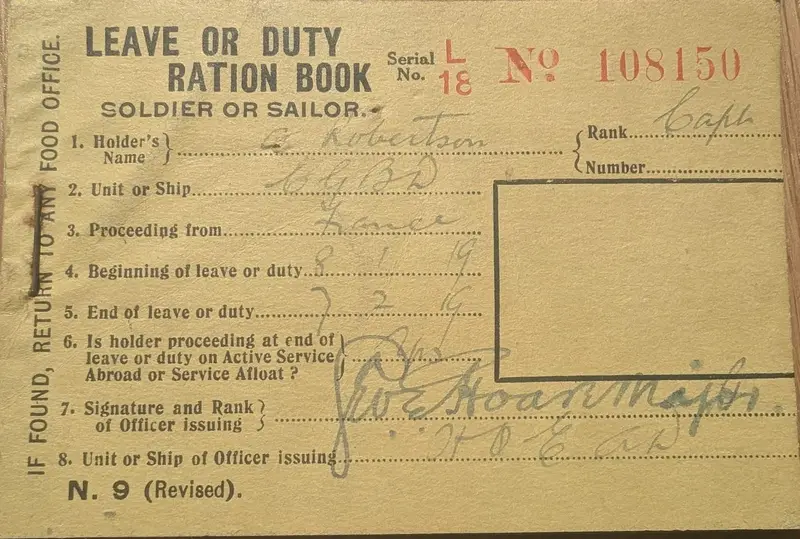
1 / 4 A Ration Book for Leave
The cover: holder, unit ("C.G.B.D.," the Canadian General Base Depot), "Proceeding from France," and the leave dates: 8.1.19 to 7.2.19.
Field message traffic
 1 / 2
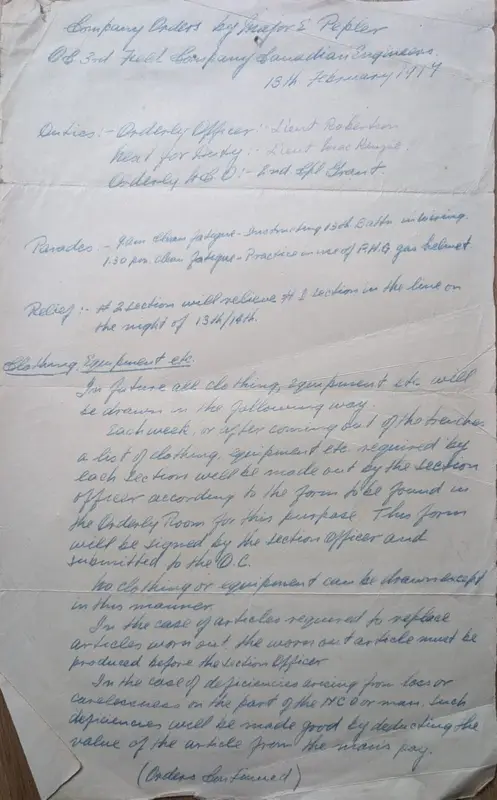
1 / 2 Company Orders, 1917
February 13, 1917: "Company Orders by Major E. Pepler," handwritten. Robertson is orderly officer; the day's work is instructing the 13th Battalion in wiring and gas-helmet practice, and No. 2 Section relieves No. 1 in the line that night. Nine days before he was wounded.
 1 / 2
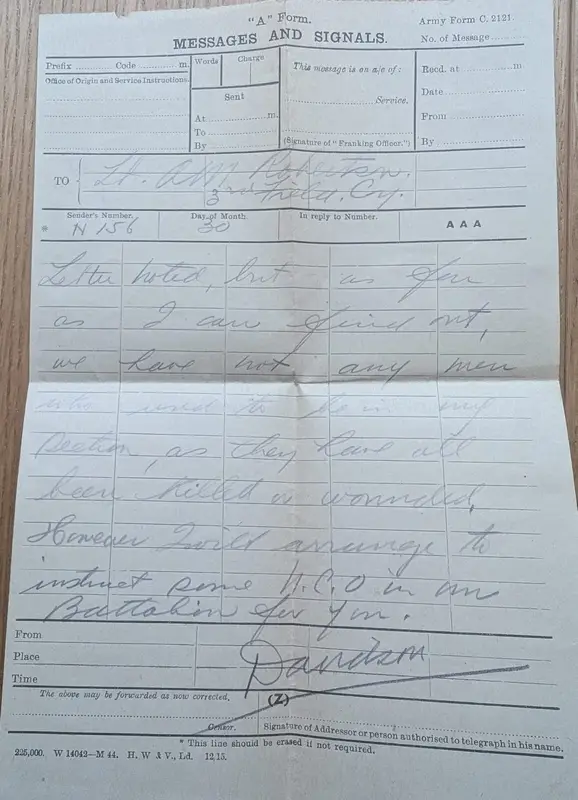
1 / 2 "All Been Killed or Wounded"
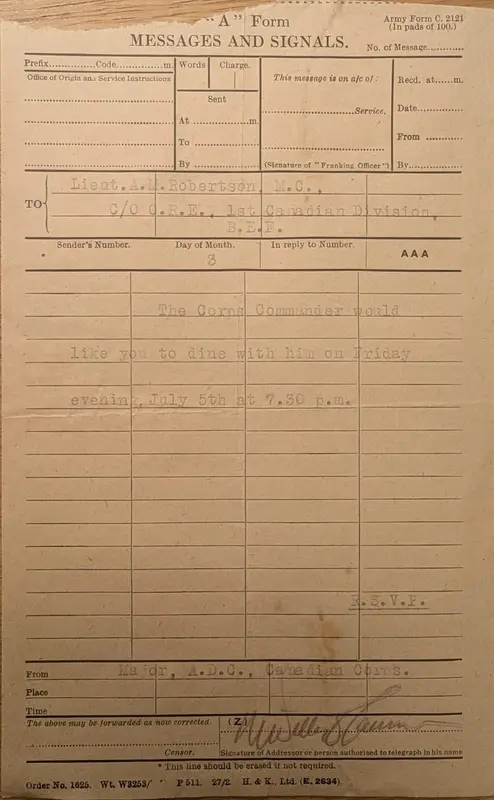
Army Form C. 2121, to "Lt. A. M. Robertson, 3rd Field Cy." The reply, in pencil: "Letter noted, but as far as I can find out, we have not any men who used to be in any Section, as they have all been killed or wounded. However I will arrange to instruct some N.C.O. … for you." Undated beyond "day of month: 30."
 1 / 2
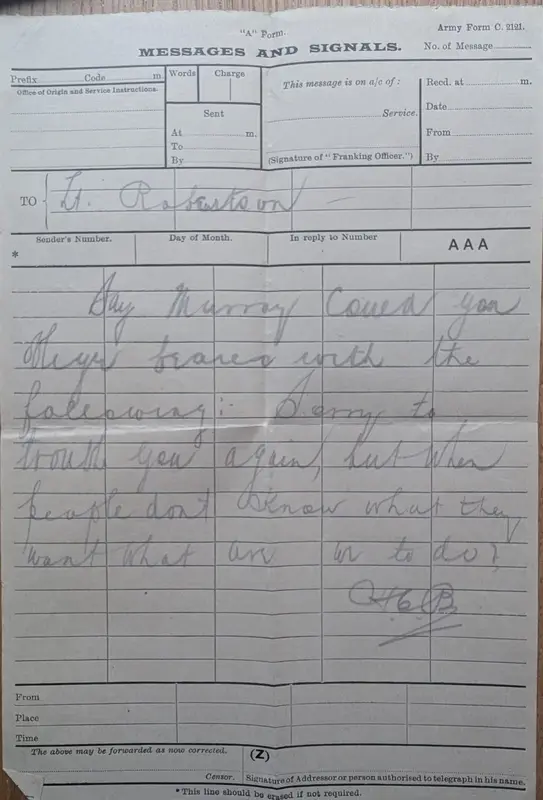
1 / 2 "What Are We to Do?"
Army Form C.2121, to Lt. Robertson, February 1916: "Say Murray, could you [oblige me] … Sorry to trouble you again, but when people don't know what they want, what are we to do?"
 1 / 4
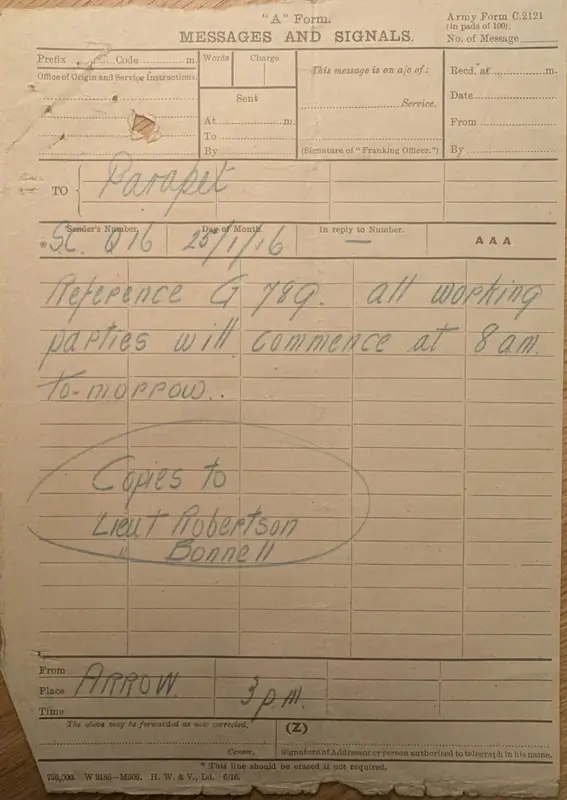
1 / 4 Field Messages
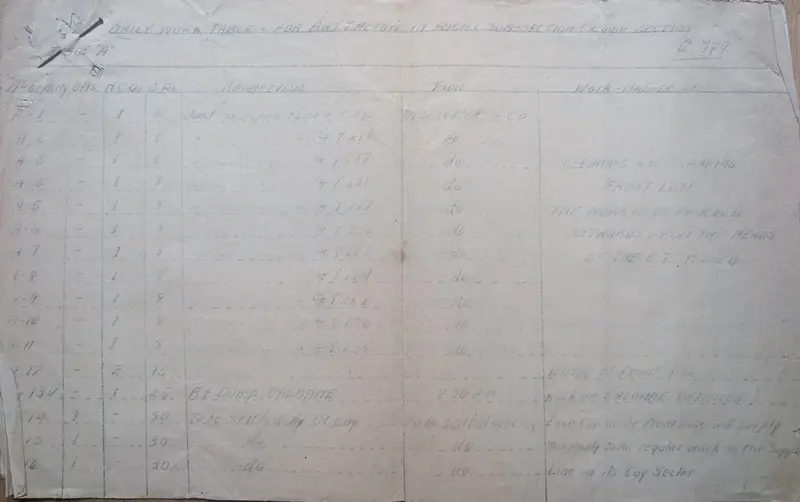
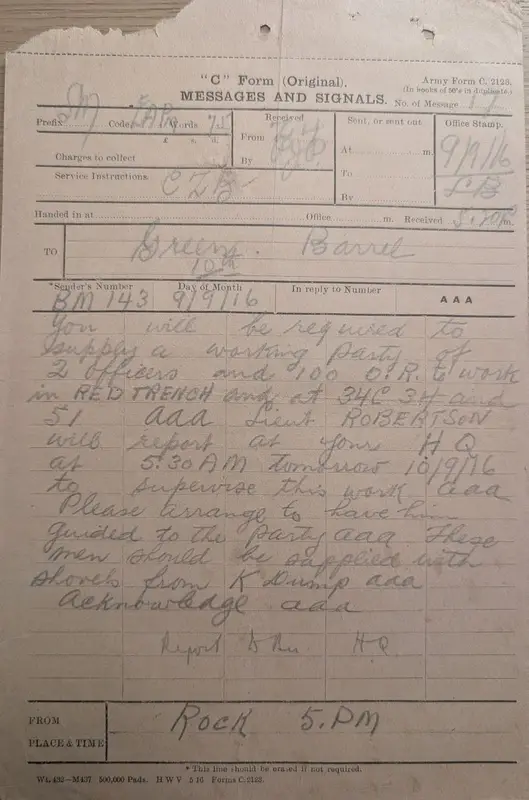
January 25, 1916, from the Wulverghem sector: "Reference G.789. All working parties will commence at 8 a.m. to-morrow. Copies to Lieut Robertson, Lieut Bonnell."
Other Diary Pages
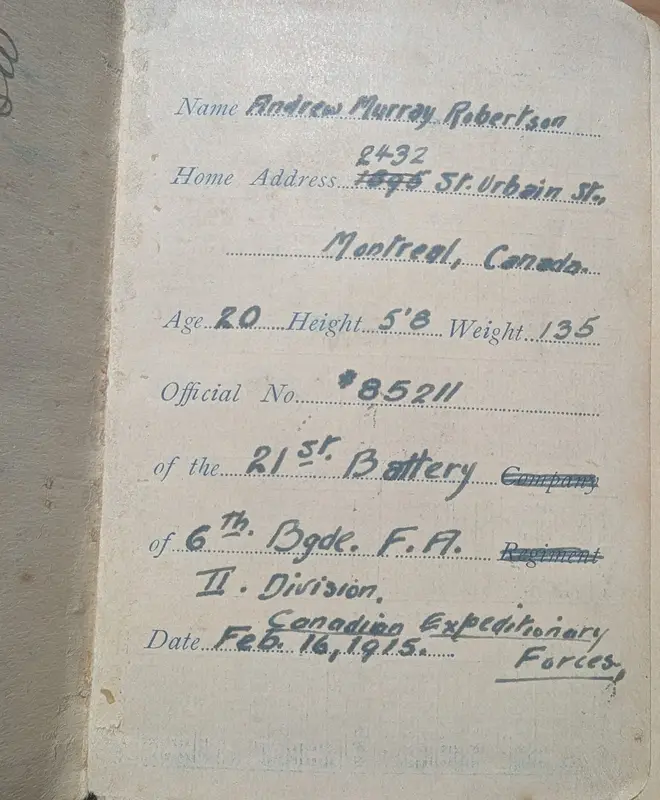
First Page of the 1915 Diary
Name, home address, age, height, weight, and regimental number: the standard opening page of the diary itself, filled out the day he was sworn in.
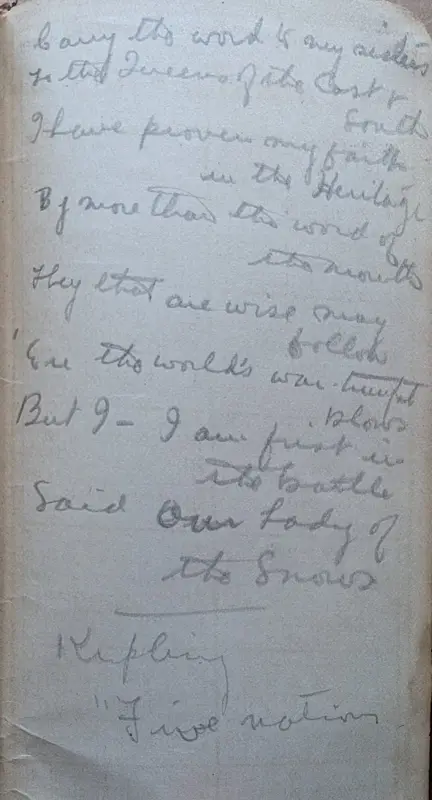
Kipling, Copied Out by Hand
"Our Lady of the Snows" was Kipling's 1897 poem written in the voice of Canada itself, prompted by Canada's move that year to grant preferential tariffs to British goods: Canada addressing Britain and its fellow Dominions on loyalty to the Empire. Robertson copied out the poem's closing stanza by hand into the second 1915 diary, labeling it "Kipling" and "The Five Nations," the 1903 collection where the poem was later reprinted: "Carry the word to my sisters — / To the Queens of the East and the South. / I have proven faith in the Heritage / By more than the word of the mouth. / They that are wise may follow / Ere the world's war-trumpet blows, / But I — I am first in the battle,' / Said our Lady of the Snows."
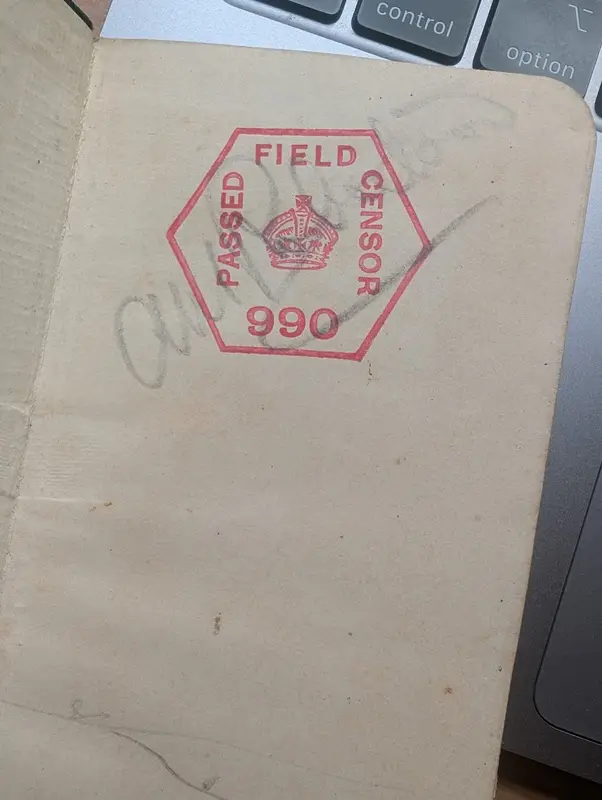
Passed Field Censor
A censor's stamp inside the 1916 diary itself, rather than on a letter: unusual, since diaries weren't normally submitted for censorship. Why this stamp ended up here isn't known.
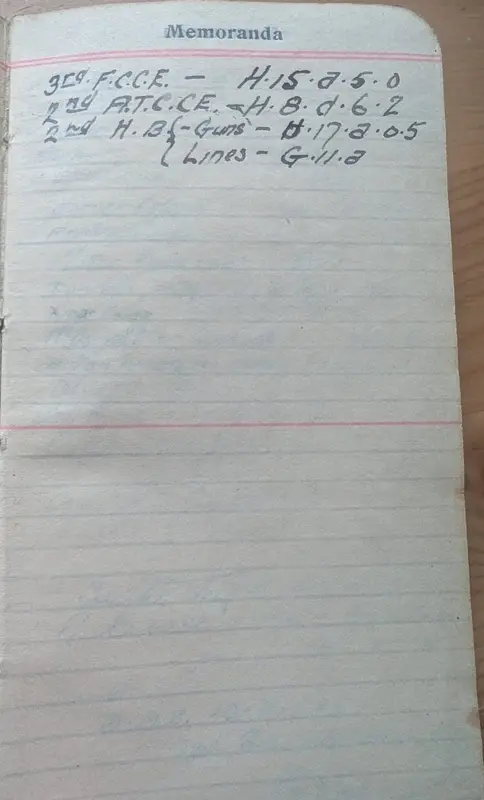 1 / 5
1 / 5 Memoranda and Lists
Trench-map grid references for several units' positions: the 3rd Field Company, 2nd Army Troops Company, and the 2nd Heavy Battery's guns and horse lines.