September 1918

No entries recorded: September 1–8, 1918 (8 days)
The leave that opened in the last week of August ran on into September, the Masonic meeting on the 6th, then the crossing back. The diary resumes on September 9: the unit's war diary has him arriving back in camp about seven that evening, after a Savy stop on the way, and finding his unit in a trench-side bivouac not far from Hendecourt.
Diary scan, September 9, 1918 (Monday)
Original page · click to enlarge

September 9, 1918 (Monday)

Boulogne – Unit

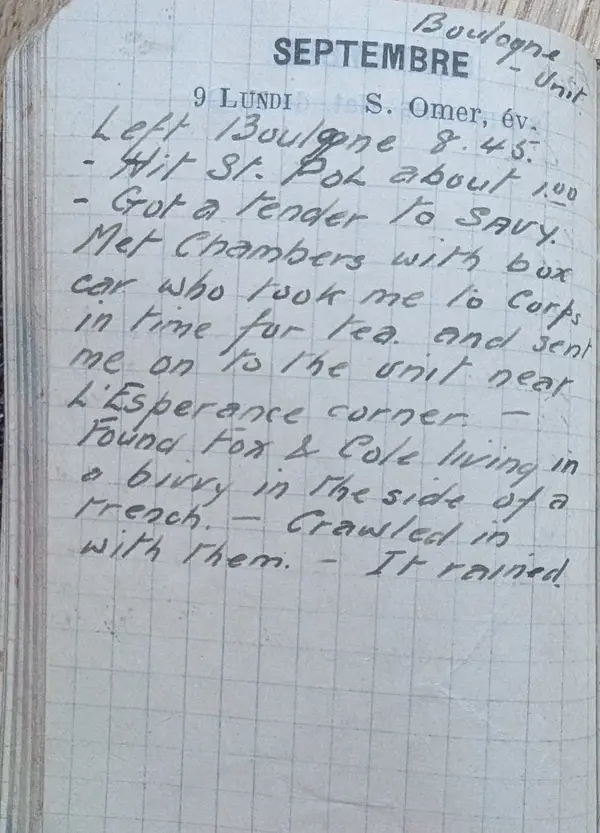
Left Boulogne 8.45. – Hit St. POL about 1.00 – Got a tender to SAVY. Met Chambers with box car who took me to Corps in time for tea and sent me on to the unit near L’Esperance corner. – Found Fox & Cole living in a bivvy in the side of a trench. – Crawled in with them. – It rained.

Diary scan, September 10, 1918 (Tuesday)
Original page · click to enlarge

September 10, 1918 (Tuesday)

Fair

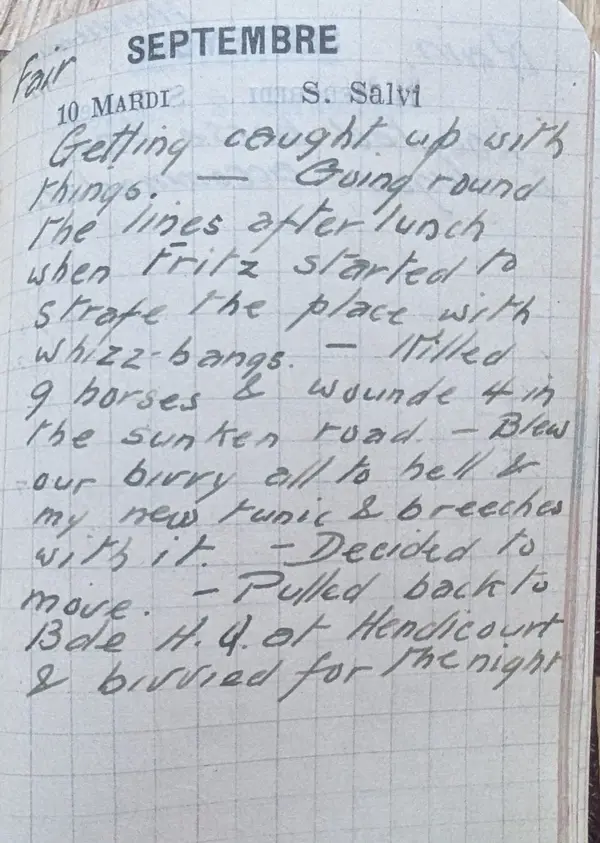
Getting caught up with things. – Going round the lines after lunch when Fritz started to strafe the place with whizz-bangs. – Killed 9 horses & wounde 4 in the sunken road. – Blew our bivvy all to hell & my new tunic & breeches with it. – Decided to move. – Pulled back to Bde H.Q. at Hendicourt & bivvied for the night.

Where Things Stand

Nine Horses, and a Return to the War

September 10, 1918

Two weeks after a Paris hotel bath and a London tailor's, Robertson is back in the sunken road: a Fritz strafe of whizz-bangs kills nine horses and wounds four more, then blows his own bivvy, and the new tunic and breeches he'd just brought back from leave, "all to hell." A letter to Doris written a month later adds the detail the diary leaves out: he'd stepped out of the bivvy only five minutes before the shell landed on it, "a miss is as good as a mile." The same letter returns to the horses: "Lost some of my best horses which is a bally nuisance and you sort of get attached to a good team." He'd counted this cost before, "twenty-three dead horse" on a single ride, April 3, 1917.

Read the letter to Doris →"Twenty-three dead horse," April 3, 1917 →
Diary scan, September 11, 1918 (Wednesday)
Original page · click to enlarge

September 11, 1918 (Wednesday)

Rain. Hendicourt

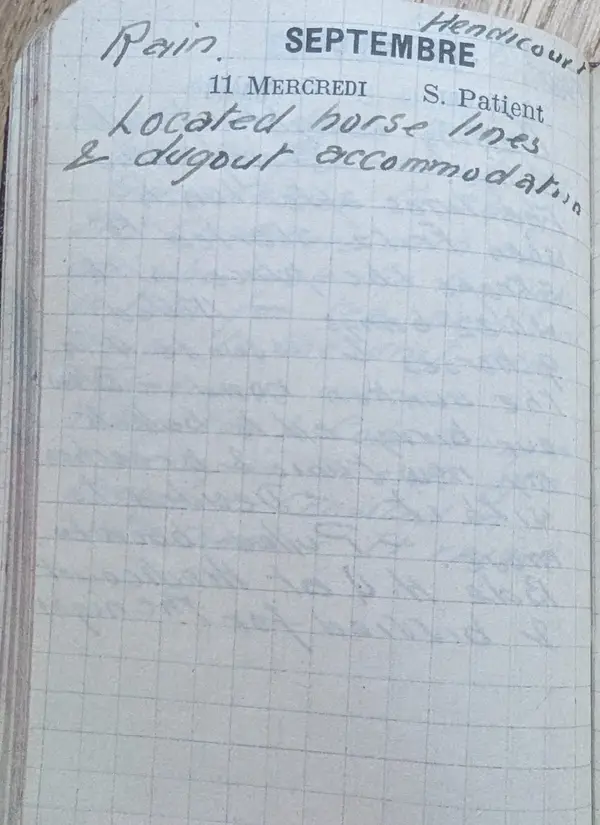
Located horse lines & dugout accommodation

No entries recorded: September 12–30, 1918 (19 days)
This 35-day silence falls across one of the most consequential stretches of the whole war: the Battle of the Canal du Nord (September 27 – October 1), Robertson's own Canadian Corps among the units that breached the Hindenburg Line there, at a cost of more than 10,000 casualties in five days, followed by the continued Hundred Days advance that was making the war's end increasingly clear. His private diary is silent for these weeks, but the unit's own war diary, which he wrote and signed as its officer commanding, is not: on September 27 he led one of two convoys of bridging wagons up to the canal, and his report on the days after it survives (see the document below). What also survives is the paper his brigade was drawing up as the silence began: the engineer plan for the Canal du Nord crossing, a draft, an air-photo appreciation of the German wire, and the Very Secret instruction itself, all issued in the days just after his last entry. His own letter written toward the end of the silence explains it: "For the last month or so have hardly been located in one place for any length of time... Things have been moving right along."