No entries recorded: October 1–16, 1918 (16 days)
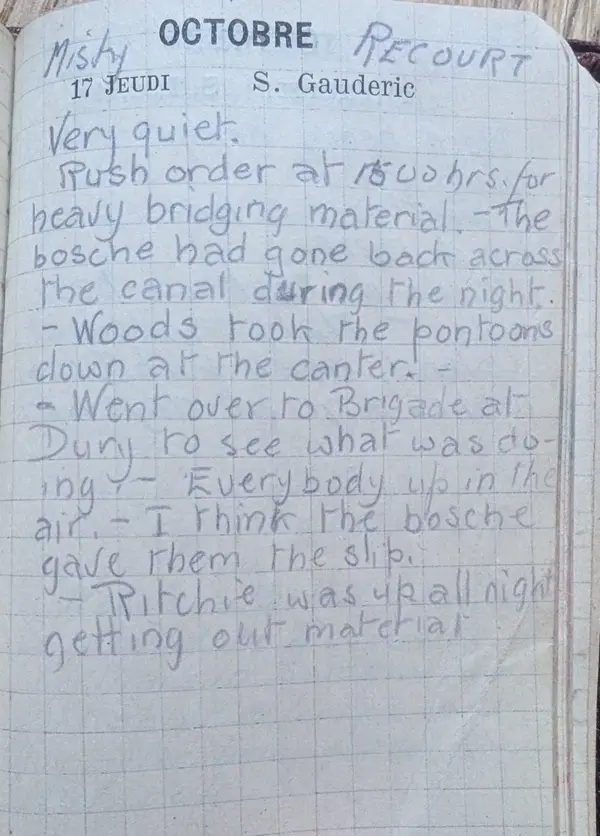
Diary scan, October 17, 1918 (Thursday)
Original page · click to enlarge

October 17, 1918 (Thursday)

Misty RECOURT

Very quiet.

Rush order at 1500 hrs. for heavy bridging material. – The bosch had gone back across the canal during the night. – Woods took the pontoons down at the canter. –

– Went over to Brigade at Dury to see what was doing. – Everybody up in the air. – I think the bosch gave them the slip.

– Ritchie was up all night getting out material.
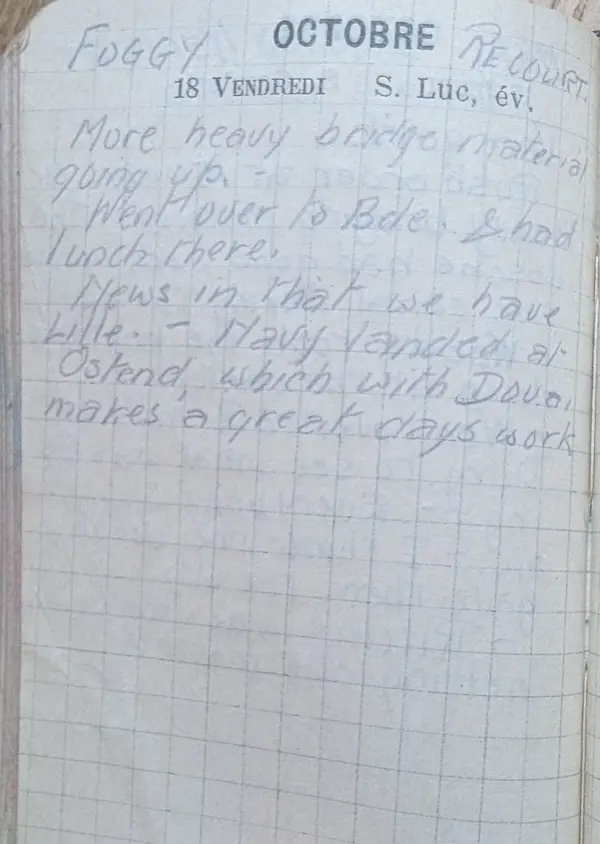
Diary scan, October 18, 1918 (Friday)
Original page · click to enlarge

October 18, 1918 (Friday)

FOGGY RECOURT

More heavy bridge material going up. –

Went over to Bde & had lunch there.

News in that we have Lille. – Navy landed at Ostend which with DOUAI makes a great days work.

Historical Context

Lille, Douai, and Ostend Fall

October 17–18, 1918

Three major Allied gains arrive in one entry, and all three happened the same day, October 17. British troops entered Lille, a major French industrial city, and one of the very first to fall in the whole war, held by Germany almost continuously since October 1914. The same day, Douai, occupied since October 1, 1914, was finally retaken, and Allied forces entered Ostend without opposition, closing out the story Robertson had already read about twice before (the April raid meant to block the harbour, and the May report that the block had been finished by scuttling the Vindictive there) with the port simply given up outright. "A great days work," as Robertson puts it, undersells it: three symbolically loaded pieces of German-held territory, some held for almost the entire war, changing hands within hours of each other.

Lille →Douai →The Ostend/Zeebrugge raid, April 25, 1918 →
Diary scan, October 19, 1918 (Saturday)
Original page · click to enlarge

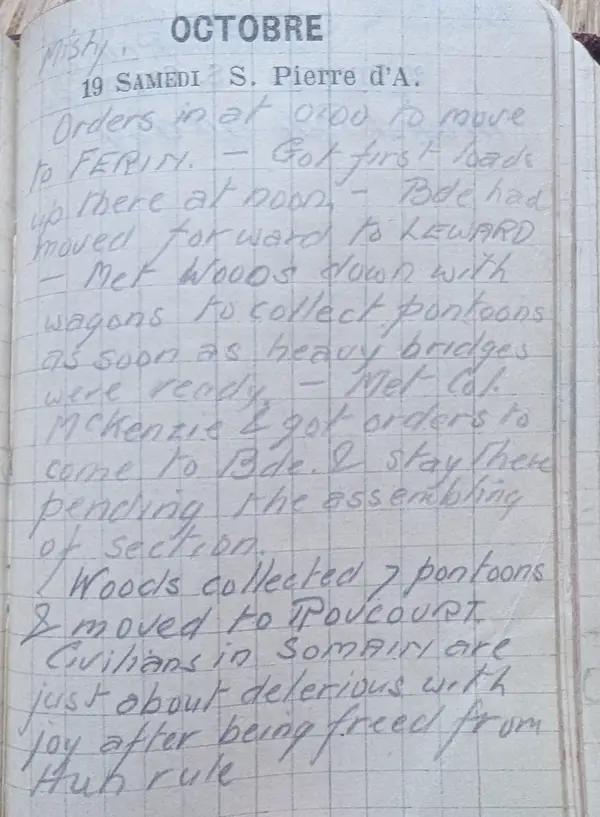
October 19, 1918 (Saturday)

Misty.

Orders in at 0.00 to move to FERIN. – Got first loads up there at noon. – Bde had moved forward to LEWARD – Met Woods down with wagons to collect pontoons as soon as heavy bridges were ready. – Met Col. McKenzie & got orders to come to Bde. & sat there pending the assembling of section.

Woods collected 7 pontoons & moved to ROUCOURT. Civilians in SOMAIN are just about delerious with joy after being freed from Hun rule.

Where Things Stand

"Just About Delirious with Joy"

October 19, 1918

Four years of diary entries have been almost entirely about logistics, casualties, weather, and Robertson's own moods, the war as it lands on him. This line is a rare exception: "Civilians in SOMAIN are just about delerious with joy after being freed from Hun rule." It's uncharacteristically vivid, emotional language, one of the only moments in four years where he directly records what the war's turning tide looks like from the other side of it, not what it costs him, but what it means to someone else.

Somain →
Diary scan, October 20, 1918 (Sunday)
Original page · click to enlarge

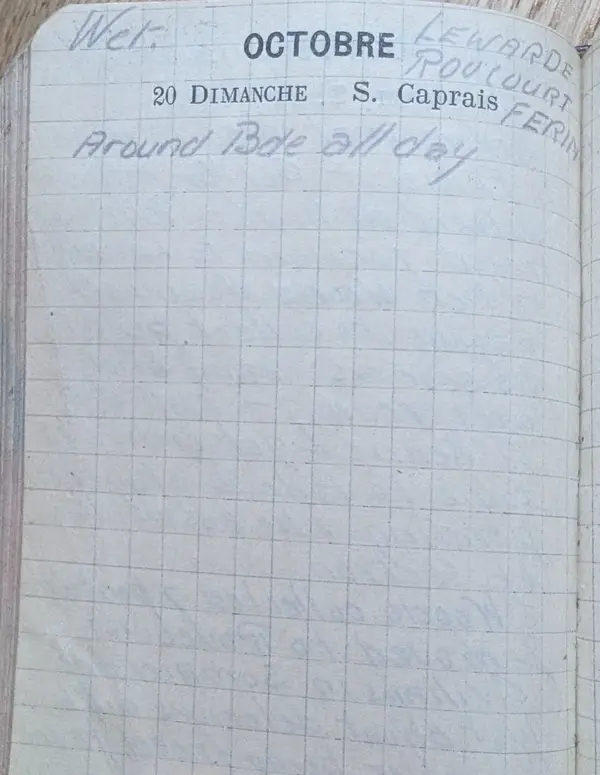
October 20, 1918 (Sunday)

Wet. LEWARDE, ROUCOURT, FERIN

Around Bde all day

Diary scan, October 21, 1918 (Monday)
Original page · click to enlarge

October 21, 1918 (Monday)

DECHY

Diary scan, October 22, 1918 (Tuesday)
Original page · click to enlarge

October 22, 1918 (Tuesday)

AUBERCHICOURT

Where Things Stand

Six Places, Six Days

October 17–22, 1918

Récourt (Oct 17) → Dury (Oct 17) → Férin (Oct 19) → Lewarde and Roucourt (Oct 19–20) → Dechy (Oct 21) → Auberchicourt (Oct 22), six named places in six days, all within about 15 kilometres of Douai, a striking contrast to the static, months-long positions that defined 1916 and 1917, where a diary entry might reuse the same handful of place names for a year at a stretch.

No entries recorded: October 23–31, 1918 (9 days)