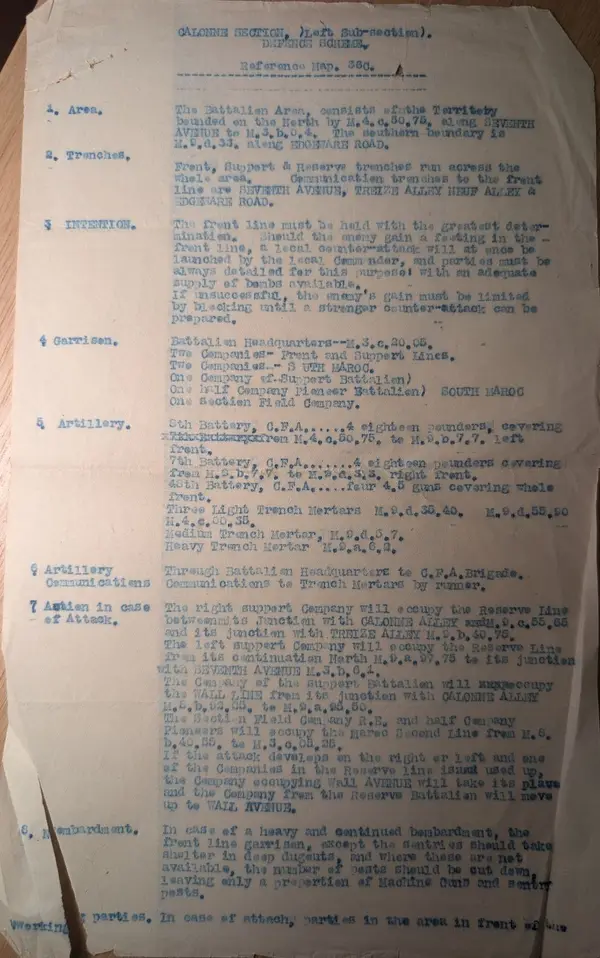
Calonne Section (Left Sub-section). Defence Scheme. Reference Map 36C.
1. Area. The Battalion Area consists of the territory bounded on the north by M.4.c.50.75, along Seventh Avenue to M.3.b.0.4. The southern boundary is M.9.d.33, along Edgeware Road.
2. Trenches. Front, Support and Reserve trenches run across the whole area. Communication trenches to the front line are Seventh Avenue, Treize Alley, Neuf Alley and Edgeware Road.
3. Intention. The front line must be held with the greatest determination. Should the enemy gain a footing in the front line, a local counter-attack will at once be launched by the local Commander, and parties must always be detailed for this purpose with an adequate supply of bombs available. If unsuccessful, the enemy's gain must be limited by blocking until a stronger counter-attack can be prepared.
4. Garrison. Battalion Headquarters — M.3.c.20.05. Two companies — front and support lines. Two companies — South Maroc. One company of support battalion, one half company Pioneer Battalion — South Maroc. One section Field Company.
5. Artillery. 8th Battery, C.F.A. — four eighteen-pounders covering from M.4.c.50.75 to M.9.b.7.7, left front. 7th Battery, C.F.A. — four eighteen-pounders covering from M.9.b.7.7 to M.9.d.3.3, right front. 48th Battery, C.F.A. — four 4.5 guns covering the whole front. Three light trench mortars, one medium, one heavy.
6. Artillery Communications. Through Battalion Headquarters to C.F.A. Brigade. Communications to trench mortars by runner.
7. Action in case of Attack. The right support company will occupy the Reserve Line between its junction with Calonne Alley and its junction with Treize Alley. The left support company will occupy the Reserve Line from its continuation north to its junction with Seventh Avenue. The company of the support battalion will occupy the Wall Line from its junction with Calonne Alley. The Section, Field Company R.E., and half company Pioneers will occupy the Maroc Second Line. If the attack develops on the right or left and one of the companies in the Reserve line is used up, the company occupying Wall Avenue will take its place and the company from the Reserve Battalion will move up to Wall Avenue.
8. Bombardment. In case of a heavy and continued bombardment, the front line garrison, except the sentries, should take shelter in deep dugouts; and where these are not available, the number of posts should be cut down, leaving only a proportion of machine guns and sentry posts.
9. Working parties. In case of attack, parties in the area in front of [the line] …