Writings

The Organization of the Canadian Engineers

The diary and the letters were written as the war went on. This is a paper Robertson wrote afterward, at McGill in 1921, for his final year of civil engineering: how the Canadian Engineers were organized and what their work involved. He had been commissioned into them in July 1915 and served through to the end of the war.

In January 1923 a friend from the war, J.L. Melville, sent the paper back with corrections. Melville had been the Canadian Corps’ bridging officer and knew the subject firsthand. His eight notes are placed beside the pages they refer to; the paper comes first, page by page, then the letter.

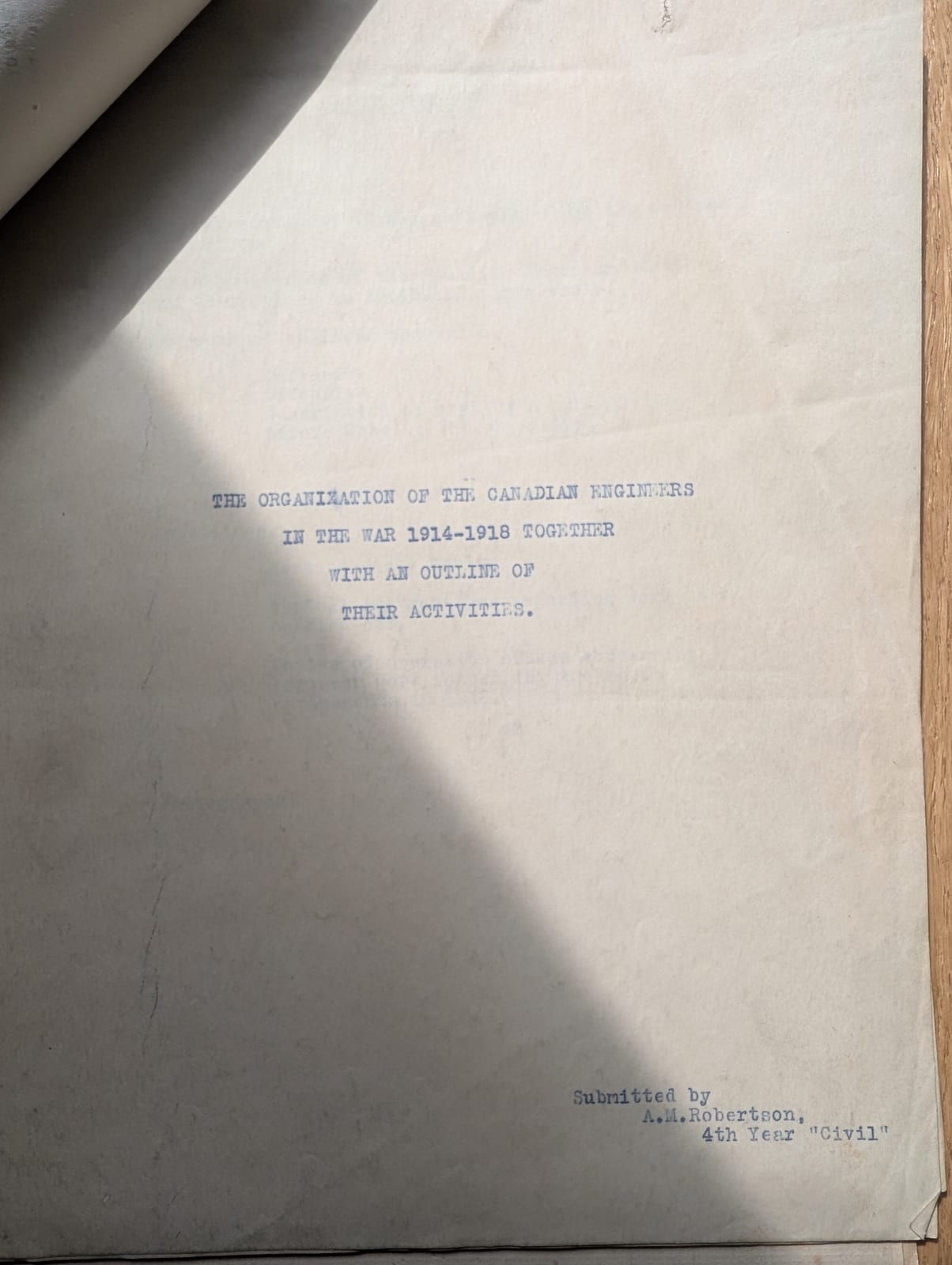
Title page
Title page
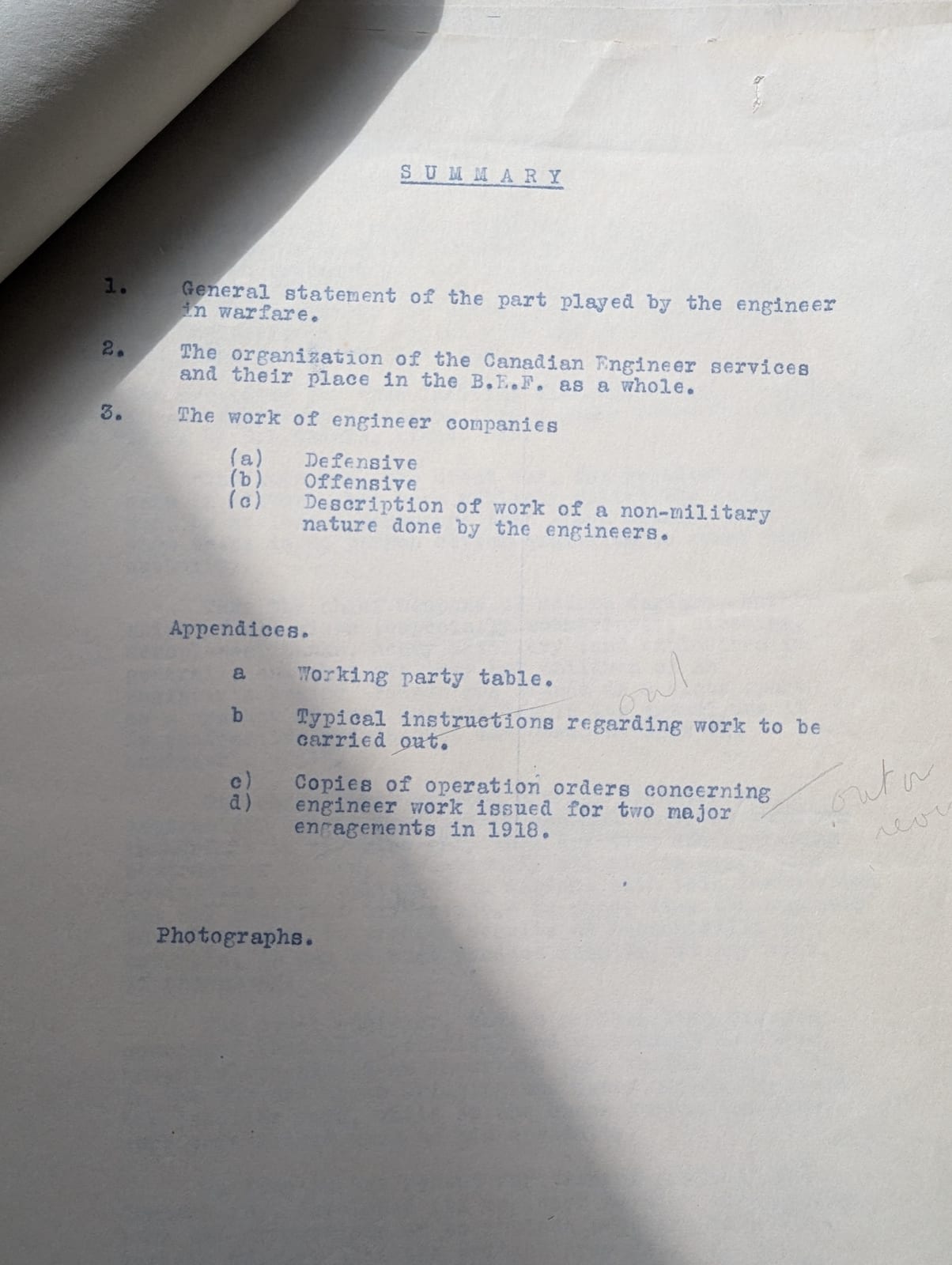
Summary
Summary page
Click to enlarge
The paper

“The Organization of the Canadian Engineers in the War 1914–1918”

Robertson wrote this in 1921, in his final year of civil engineering at McGill, two years after coming home from the war. It is his own account of the organization he had served in since his commission in July 1915: how the Canadian Engineers were structured, what the field companies and the Corps Troops actually did, and how the whole system was rebuilt in the spring of 1918.

His one-page summary lays out the plan: a general statement on the engineer in warfare, the organization of the Canadian Engineer services, the work of engineer companies in defence and in attack, and a closing section on work “of a non-military nature.” The pages that follow are shown here in order.

Page 1: Engineering Work in General
Click to enlarge
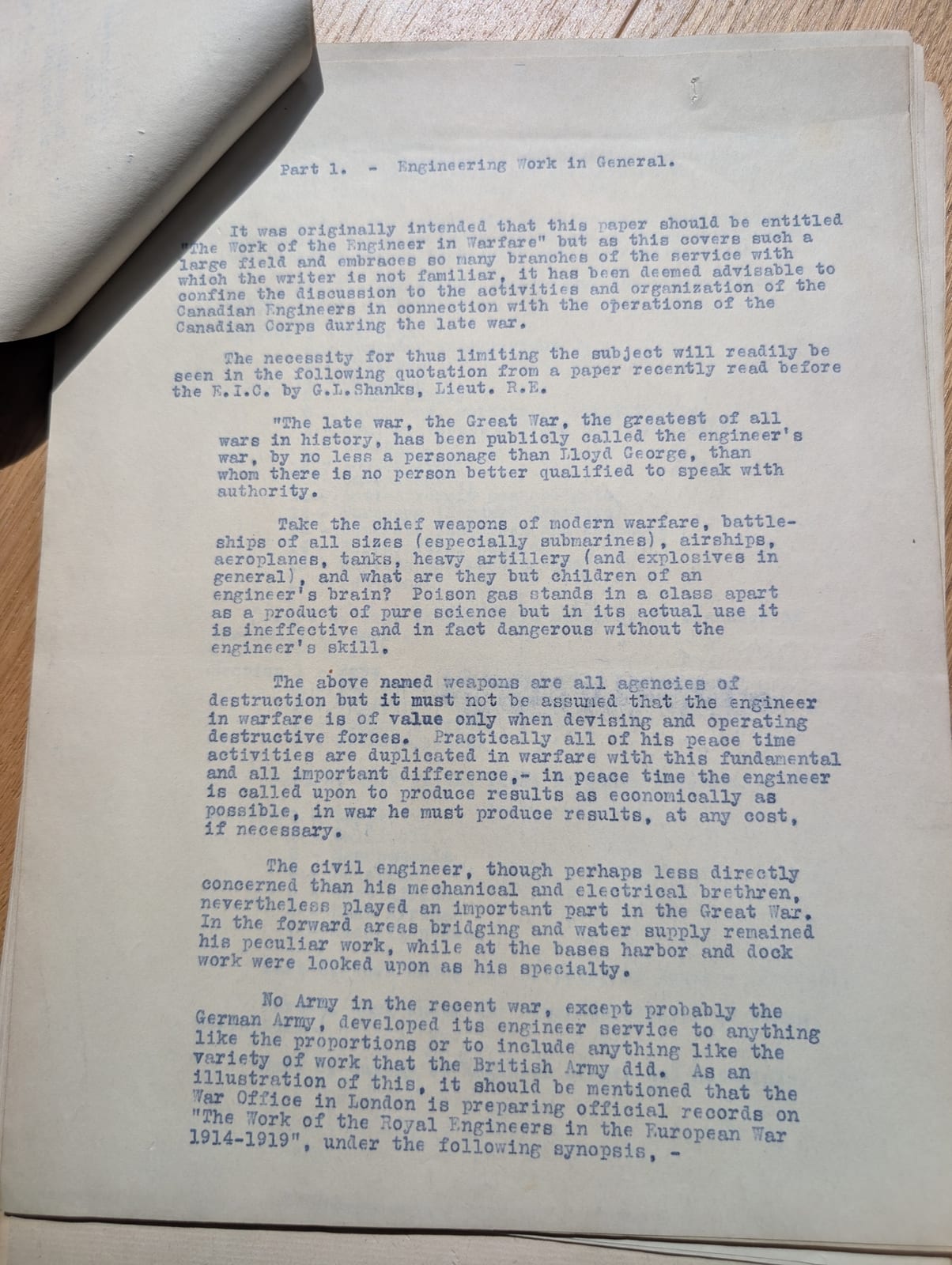
Page 1

The engineer’s war

Part 1 opens with a disclaimer. He had meant to write on “The Work of the Engineer in Warfare,” but that covered too large a field and too many branches he did not know, so he narrowed it to the Canadian Engineers and the operations of the Canadian Corps.

To make the case for the subject he quotes a paper read before the Engineering Institute of Canada: the war called “the engineer’s war” by Lloyd George, its modern weapons all “children of an engineer’s brain.” Then he draws the line he will actually work within: in the forward area, bridging and water supply are the civil engineer’s own peculiar work.

“The late war … has been publicly called the engineer’s war, by no less a personage than Lloyd George.” · page 1, quoting a paper by Lieut. G.L. Shanks, R.E.
Page 2: the Royal Engineers official-history synopsis
Click to enlarge
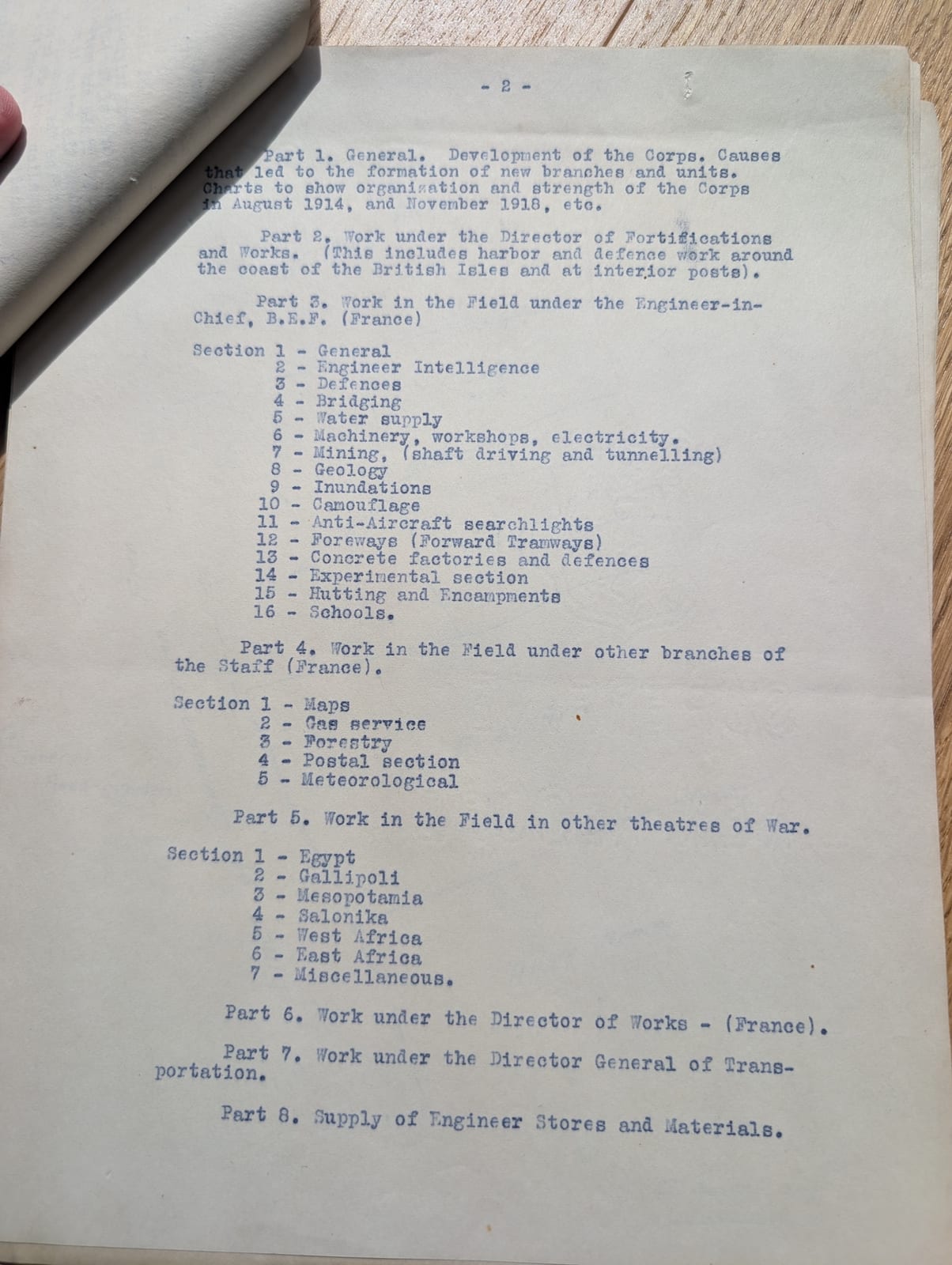
Page 2

The scale of the thing

The whole of page 2 is a borrowed table of contents. The War Office was then preparing official records on “The Work of the Royal Engineers in the European War 1914–1919,” and Robertson reproduces its synopsis in full: eight parts, running from fortifications and bridging through mining, geology, inundations, camouflage, anti-aircraft searchlights, forestry, the postal and meteorological services, and campaigns in Egypt, Gallipoli, Mesopotamia, Salonika, and East and West Africa.

He includes it to show the size of the field he is about to narrow: “what a great field was covered by engineering activity,” in the line he takes from it.

Page 3: Part 2, Organization
Click to enlarge
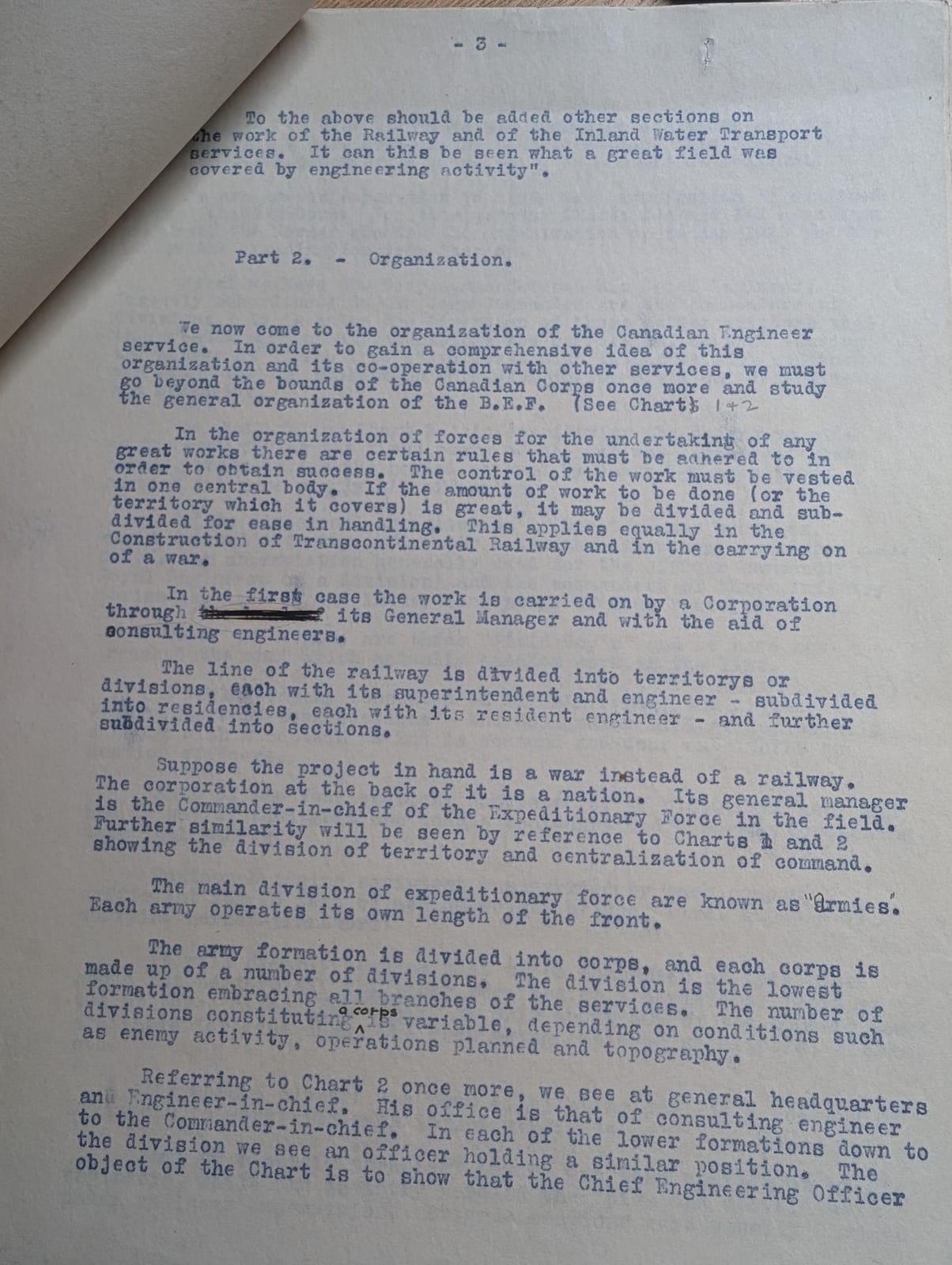
Page 3

A war run like a railway

Part 2 begins the real argument. To explain how an army organizes engineering work, Robertson reaches for the example he knew best as a transportation student: building a transcontinental railway. One central body holds control; the work is divided by territory into divisions, residencies and sections, each with its own engineer.

A war works the same way, he says: the nation is the corporation, the Commander-in-Chief its general manager, the front divided among Armies, each Army into Corps, each Corps into Divisions, “the lowest formation embracing all branches of the services.” Charts 1 and 2 put the same structure into diagram form.

Page 4: the composition of a field company
Click to enlarge
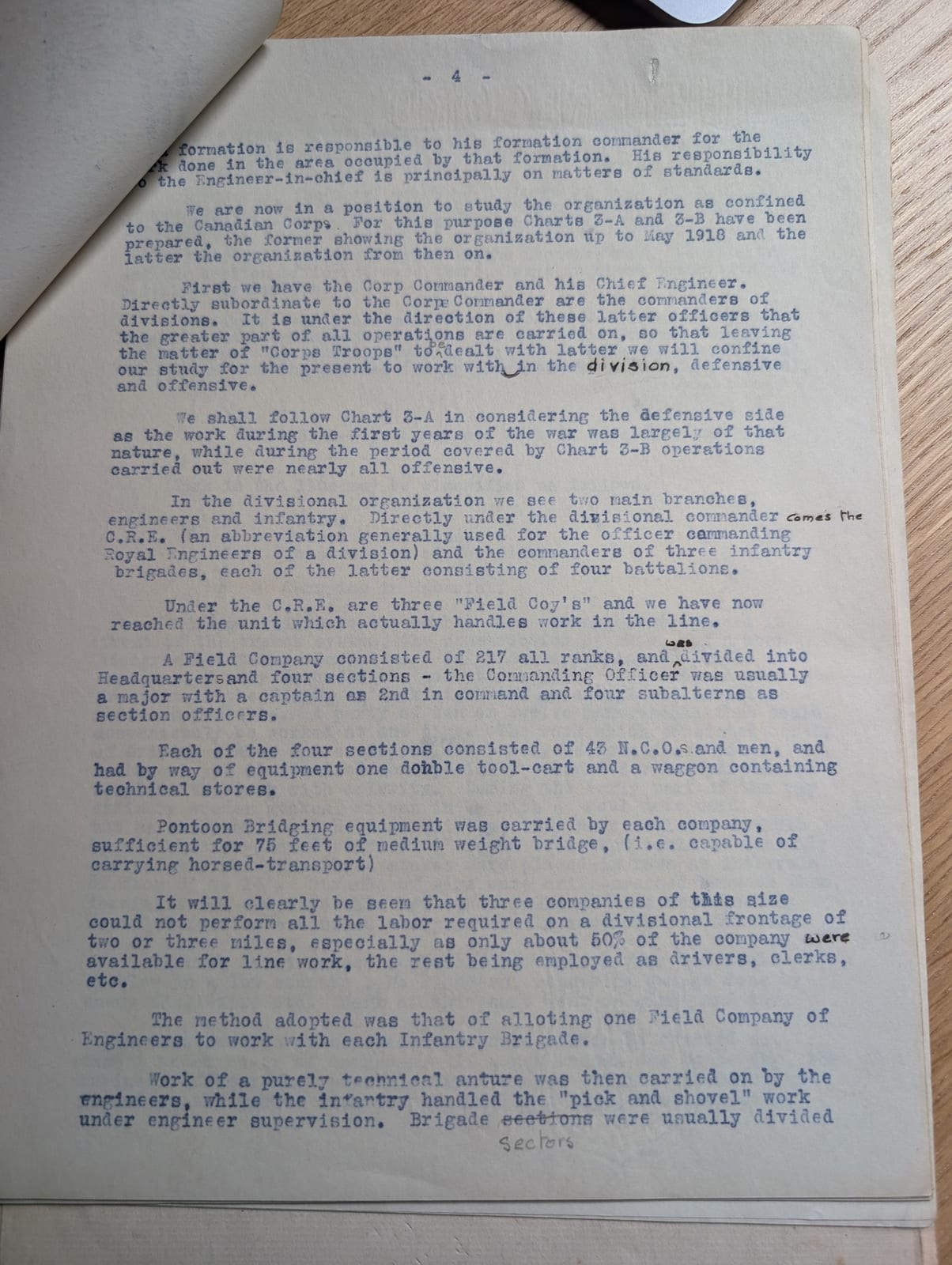
Page 4

One field company

Down at the working level sits the field company: 217 all ranks, a major in command with a captain as second, four subalterns each running a section of 43 men with a tool-cart and a wagon of stores. Each company also carried enough pontoon equipment for 75 feet of bridge.

Three such companies, Robertson notes, could not do all the labour on a two- or three-mile divisional front: only about half the company was even available for line work, the rest being drivers and clerks. So one company was attached to each infantry brigade: the engineers did the skilled work, the infantry the “pick and shovel” work under their supervision. Page 9 explains how that arrangement broke down.

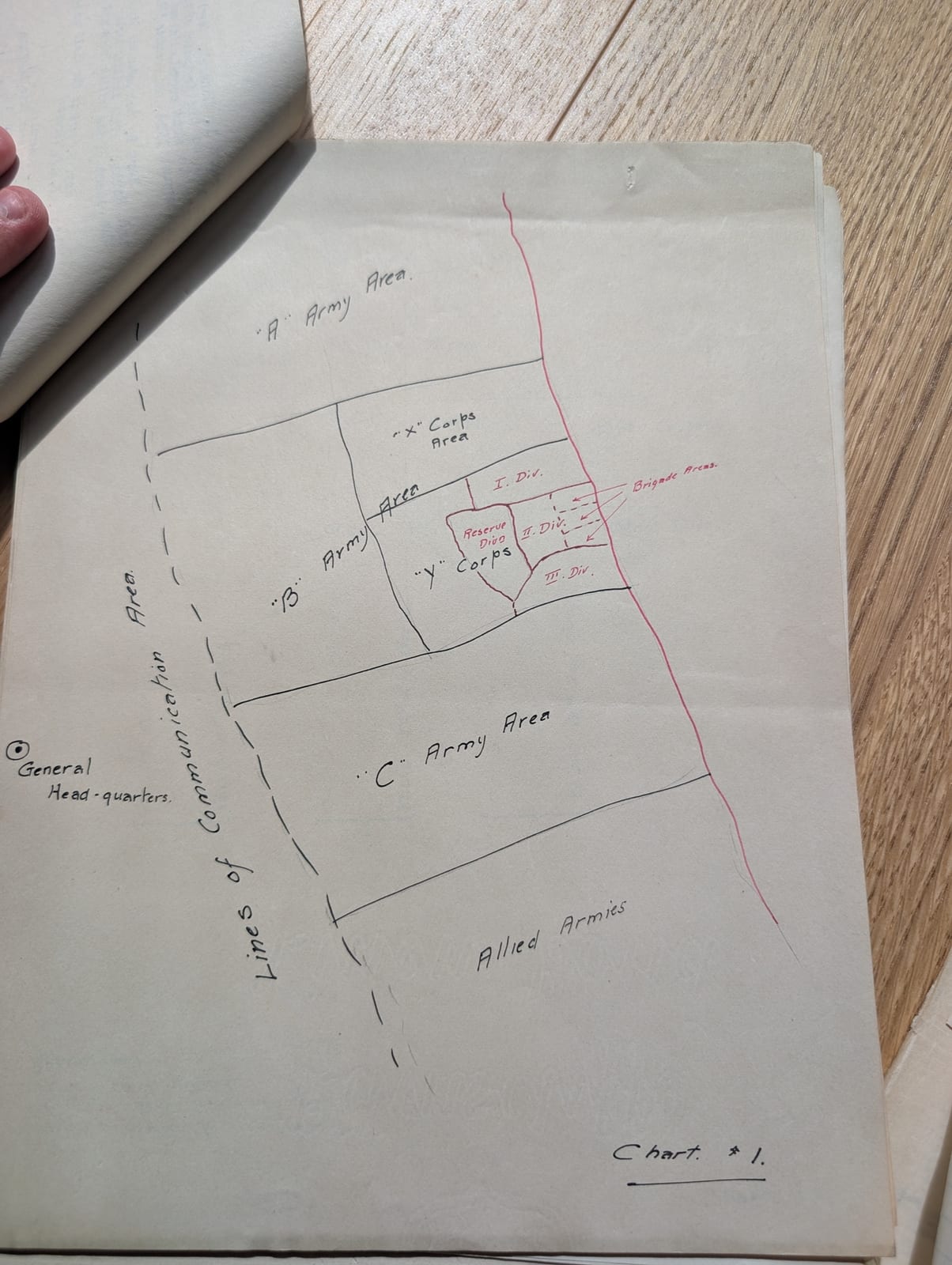
Chart 1: general organization of the B.E.F.
Click to enlarge
Chart 1

Where an engineer sat in the machine

The first of three hand-drawn charts. It lays out the whole British Expeditionary Force as a set of nested zones running from the rear forward: General Headquarters, the Lines of Communication, then Army, Corps, Divisional and Brigade areas, and the front line itself picked out in red.

It is the picture behind Robertson’s railway analogy on page 3: one central authority, the work divided and subdivided by territory so it can be handled.

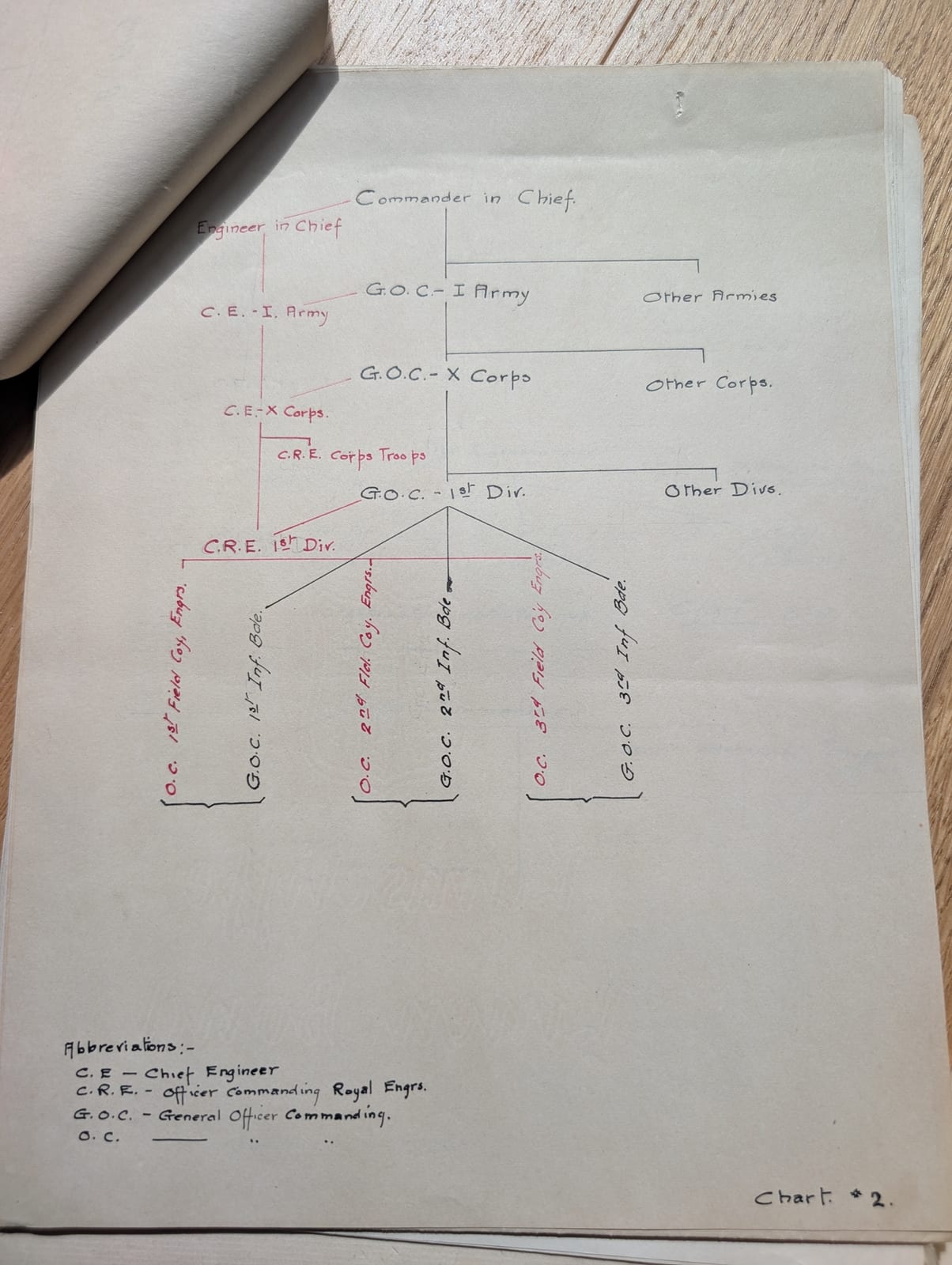
Chart 2: command hierarchy with the engineer chain alongside
Click to enlarge
Chart 2

Two chains of command, side by side

Black is the line of command: Commander-in-Chief down through Army, Corps, Division and Brigade. Red is the engineer chain drawn alongside it: Engineer-in-Chief, Chief Engineer of an Army, Chief Engineer of a Corps, C.R.E. of a Division, and at the bottom the three field companies, “the unit,” he writes, “which actually handles work in the line.”

That bottom red box is where Robertson himself was: a section officer in the 3rd Field Company, Canadian Engineers. The key at the foot of the chart spells out the abbreviations that fill the diary: C.E. for Chief Engineer, C.R.E. for the officer commanding a division’s Royal Engineers, G.O.C. for general officer commanding, O.C. for officer commanding.

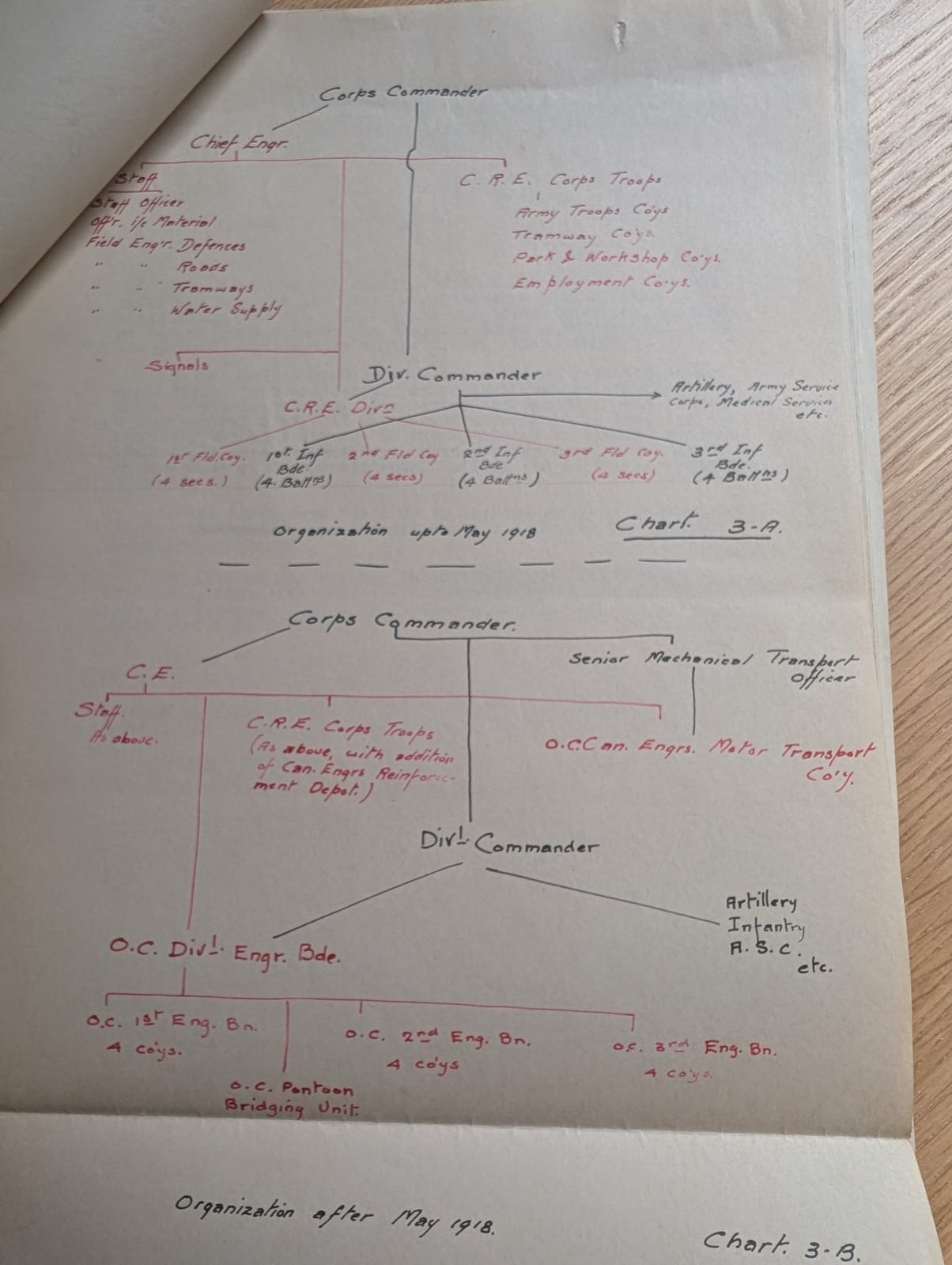
Chart 3-A and 3-B: divisional engineer organization before and after May 1918
Click to enlarge
Chart 3

Before and after May 1918

Two versions of the divisional engineers on one sheet. Chart 3-A, “up to May 1918,” shows three field companies of 217 men each, working alongside infantry brigades who supplied most of the labour. Chart 3-B, “after May 1918,” replaces those companies with an engineer brigade of three battalions (around 700 men apiece) plus a pontoon bridging unit assembled from the companies’ combined equipment, and a new Canadian Engineer Motor Transport unit of fifty lorries.

This is the reorganization that gave Robertson his 1918 command: the divisional bridging unit he called “the fleet,” and the captaincy that came with it. Page 9 is his account of why it was needed.

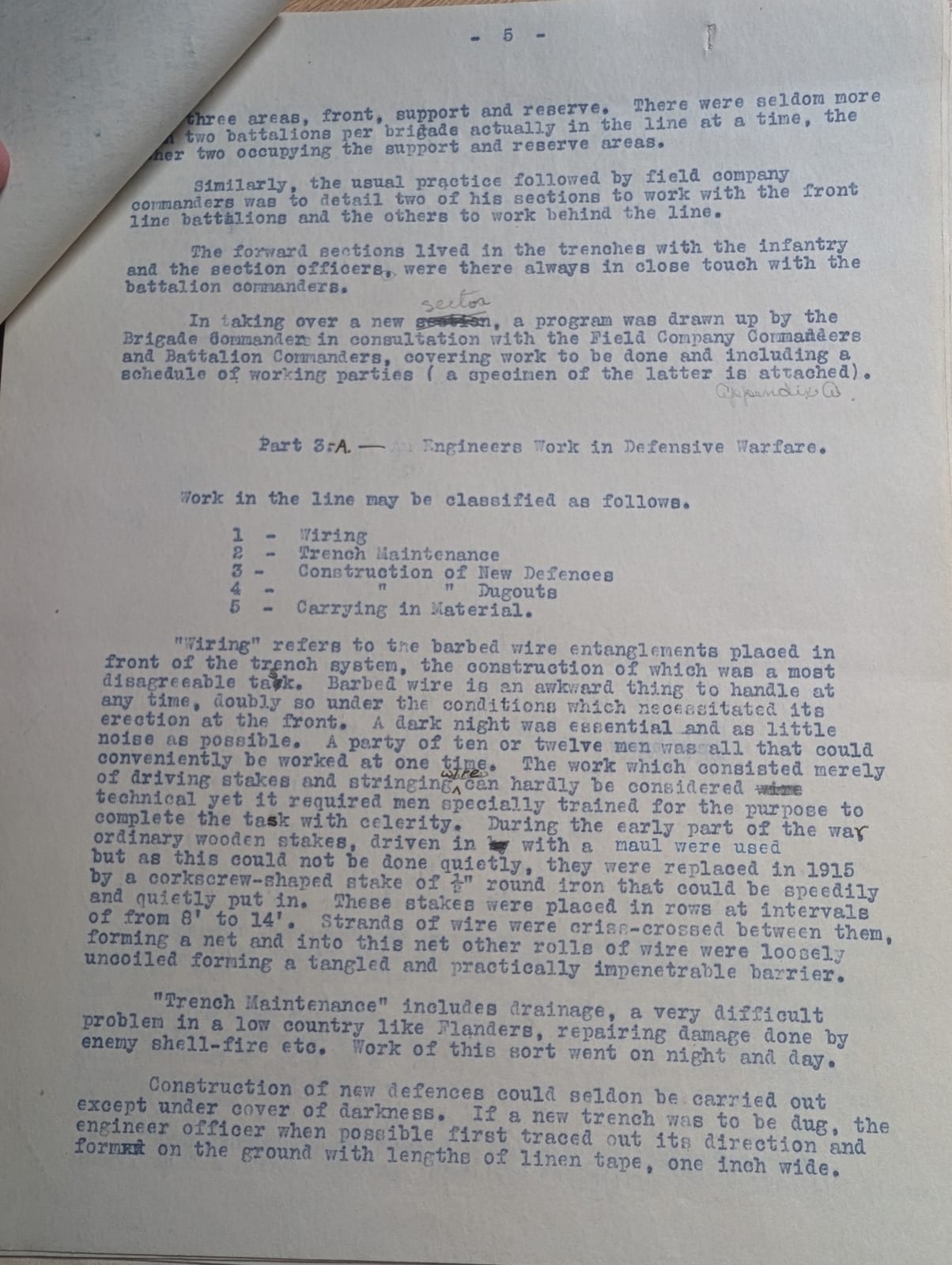
Page 5: Part 3-A, Engineers Work in Defensive Warfare
Click to enlarge
Page 5

Work in the line: wiring

Part 3-A turns to defensive warfare and the five kinds of work done in the line: wiring, trench maintenance, new defences, dugouts, and carrying in material. A programme for each new sector was drawn up jointly by the brigade, field company and battalion commanders.

Wiring gets the fullest treatment: “a most disagreeable task,” done at night, as quietly as possible, by parties of ten or twelve. Early in the war the pickets were wooden, driven with a maul; from 1915 a corkscrew-shaped iron picket that could be screwed in silently replaced them. Strands were criss-crossed between the pickets and loose coils thrown over the top to make “a tangled and practically impenetrable barrier.”

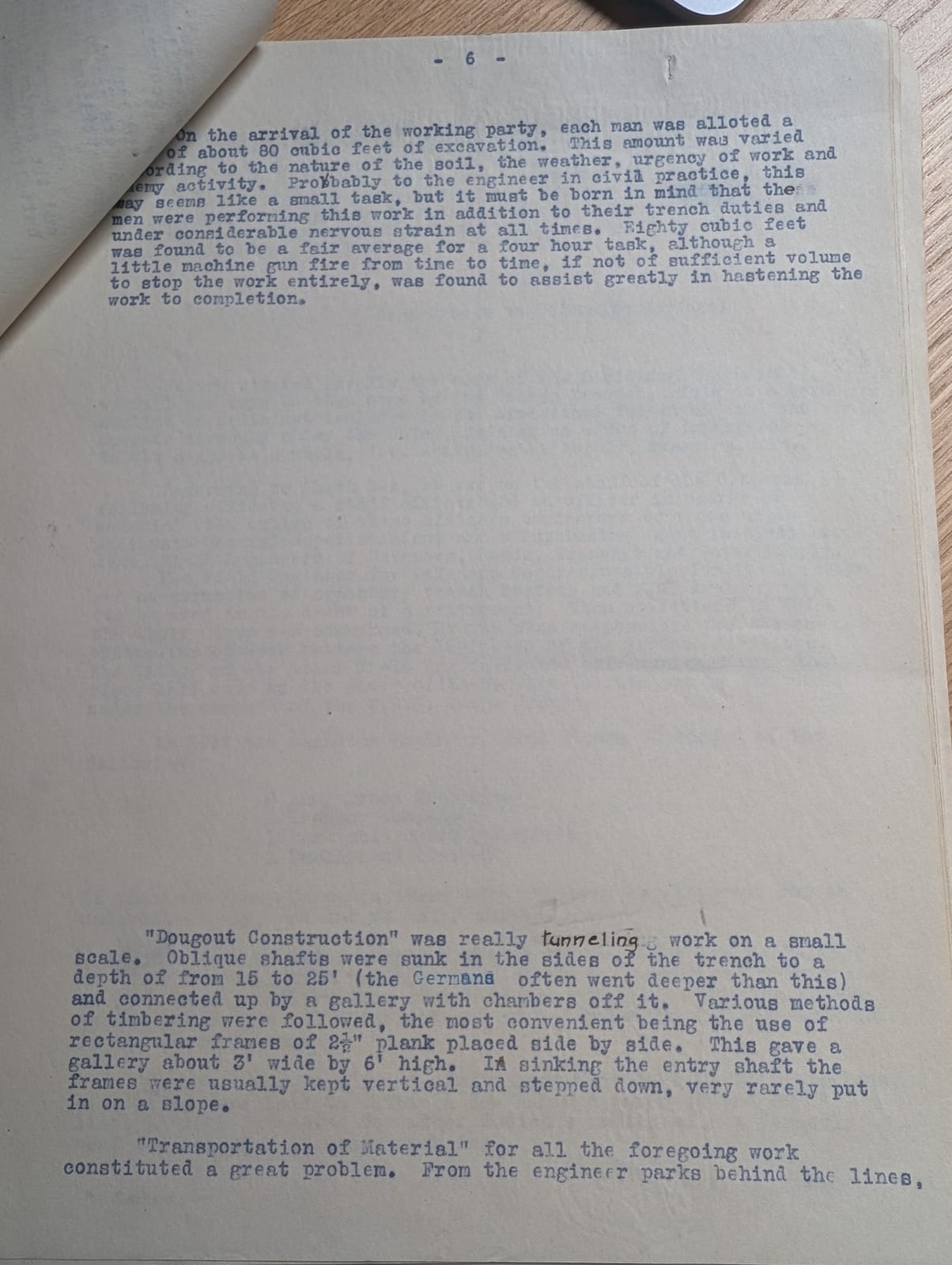
Page 6: dugout construction and transport of material
Click to enlarge
Page 6

Dugouts, and getting the material forward

Trench work was measured out by the “task”: a set volume of spoil per man, varied by soil, weather and urgency. Eighty cubic feet was a fair four-hour task, done, Robertson reminds the reader, on top of the men’s ordinary trench duties and “under considerable nervous strain at all times.”

Dugout construction was “really tunnelling work on a small scale”: inclined shafts 15 to 25 feet deep, timbered with 2½-inch plank frames set side by side. Behind all of it was the problem of transport: material hauled by horse from the parks to forward dumps sometimes a mile from the job, until the Corps tramways (a 60-cm railway) largely solved it by the end of 1917.

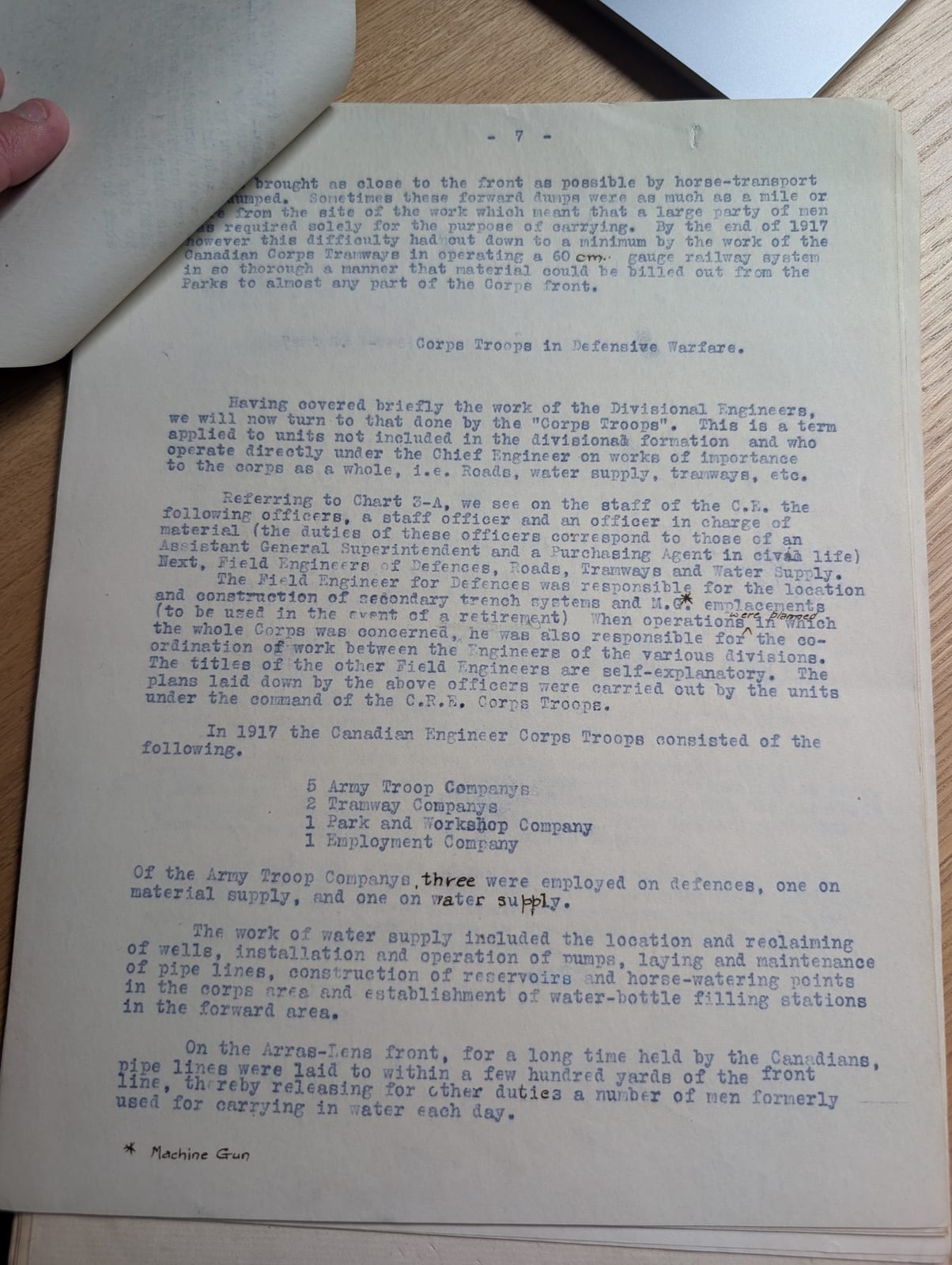
Page 7: the Corps Troops and their work
Click to enlarge
Page 7

Corps Troops, and the water supply

Above the divisional companies were the “Corps Troops”: units under the Chief Engineer serving the whole Corps rather than one division. In 1917 that meant five Army Troop companies, two tramway companies, a park and workshop company, and an employment company. On the Chief Engineer’s staff sat Field Engineers for defences, roads, tramways and water supply, whose plans these units carried out.

Water supply was among the largest of those jobs: locating and reclaiming wells, installing pumps, laying and maintaining pipe lines, building reservoirs and horse-watering points. On the Arras–Lens front the Canadians ran three pipe lines to within a few hundred yards of the front, freeing the men who had carried water up by hand each day.

Melville’s note · 1923

Melville, the adjutant to this headquarters, supplies a unit left off the list:

“In enumerating the Units which operated under the C.R.E. Corps Troops, you omitted to mention the A.A. Searchlight Company, C.E.”

Melville’s note · 1923

And a responsibility he thought worth stating plainly:

“You should make mention of the fact that the Engineers were responsible for the testing, marking and development of the water supply.”

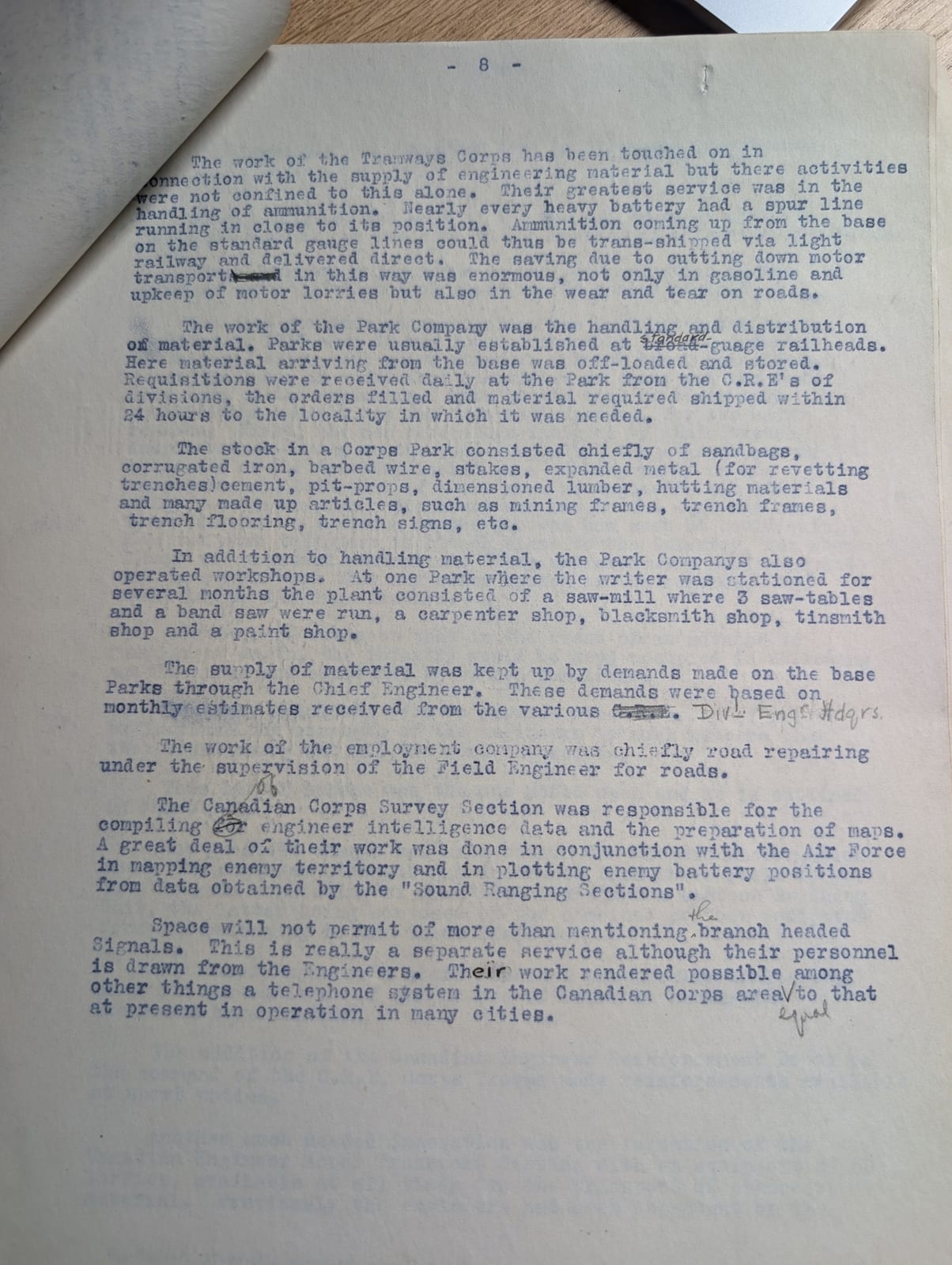
Page 8, Corps Troops: tramways, parks, the Survey Section, the Signals
Click to enlarge
Page 8

A Corps Park, and the work behind the lines

Page 8 continues through the Corps Troops. The tramways, besides moving engineer material, ran ammunition up spur lines to the heavy batteries; the parks stocked and made up the trench stores: “sandbags, corrugated iron, barbed wire, stakes … trench frames, trench flooring, trench signs.”

The park Robertson knew from the inside had its own saw-mill, carpenter, blacksmith, tinsmith and paint shops. He also sketches the Corps Survey Section (engineer intelligence and mapmaking, working with the Air Force to plot enemy battery positions) and the Signals, whose telephone network across the Corps area he compares to a city’s.

“At one Park where the writer was stationed for several months the plant consisted of a saw-mill where 3 saw-tables and a band saw were run, a carpenter shop, blacksmith shop, tinsmith shop and a paint shop.” · page 8, one of the few first-person asides in the paper
Melville’s note · 1923

Melville’s additions to this page:

“On page 8, where you mention the Corps Survey Section, you have not said anything of their Flash Spotting Section, which did a considerable amount of work for them. In your reference to the Signals, you should make short mention at least of their wireless work.”

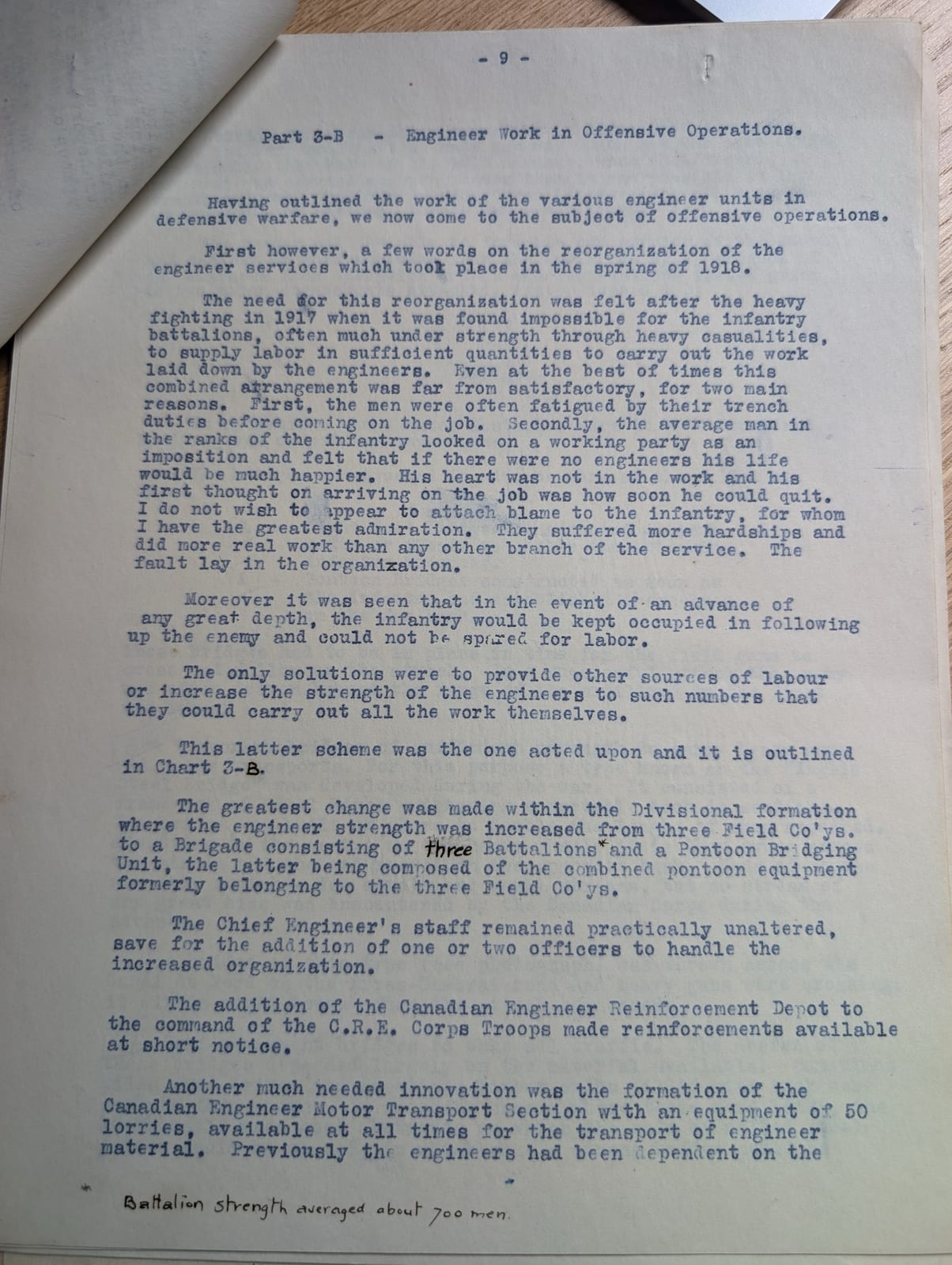
Page 9: Robertson’s reflection on the 1918 reorganization
Click to enlarge
Page 9

The reorganization, in his own words

The most personal page in the paper, and the pivot into Part 3-B, offensive operations. Robertson explains why the old arrangement had stopped working: infantry battalions “much under strength through heavy casualties” could no longer spare enough men for engineer labour, and the men who were sent resented it: “his first thought on arriving on the job was how soon he could quit.”

He is careful about where he lays the blame. The answer, he writes, was to make the engineers large enough to do all their own work: the scheme drawn in Chart 3-B.

“I do not wish to appear to attach blame to the infantry, for whom I have the greatest admiration. They suffered more hardships and did more real work than any other branch of the service. The fault lay in the organization.” · page 9
Melville’s note · 1923

Page 9 says only that the Chief Engineer’s staff came through the reorganization “practically unaltered.” Melville sets out what it actually was:

“The Chief Engineer’s staff, on re-organization, consisted of a Staff Officer, a Staff Captain, A. and Q., a Staff Captain, S. and T., and Field Engineers, as formerly.”

Page 10: bridging in the 1918 advance
Click to enlarge
Page 10

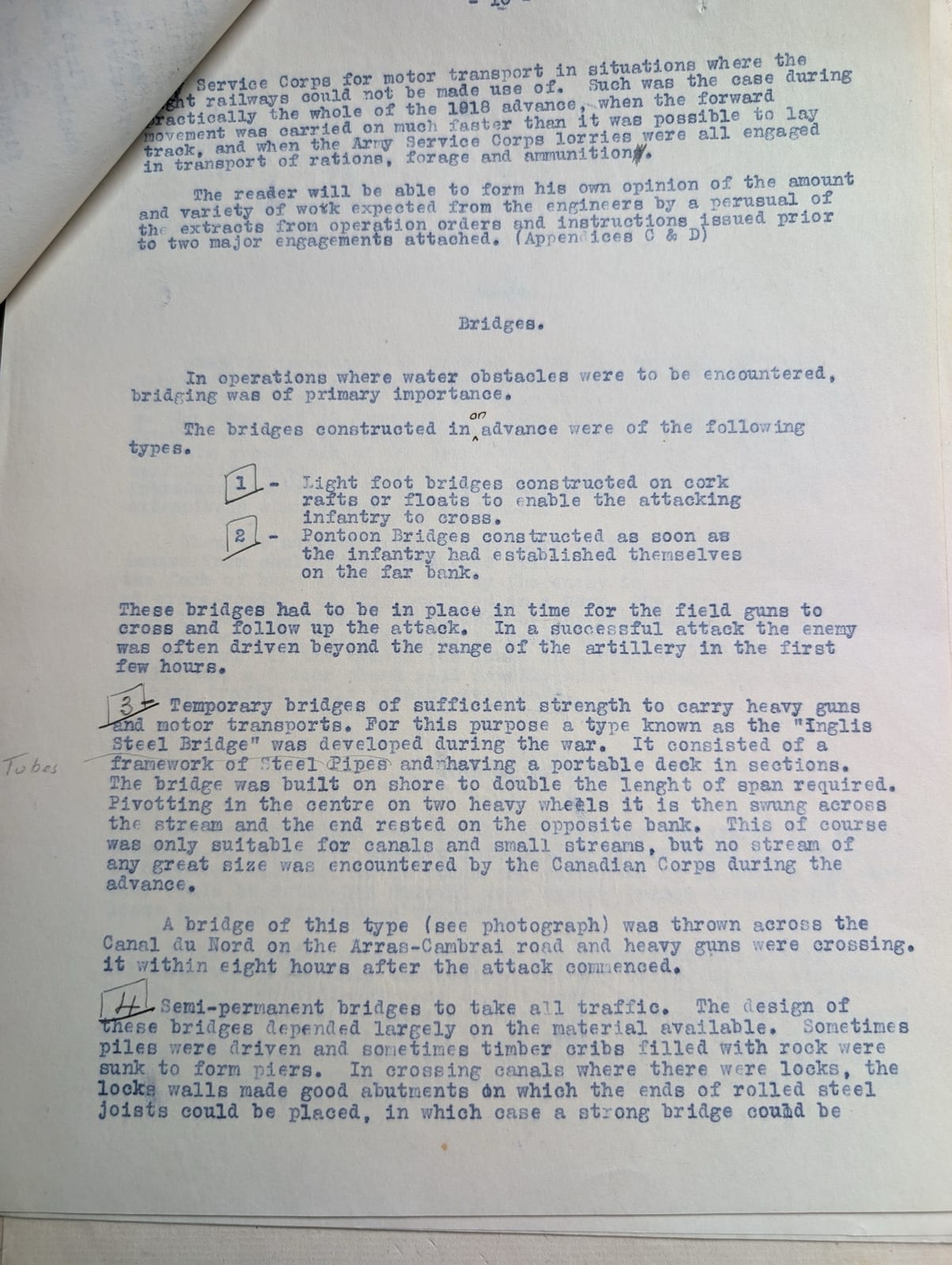
Bridges

In the open warfare of 1918, bridging was “of primary importance.” Robertson sorts the work into four kinds: light footbridges on cork floats for the attacking infantry; pontoon bridges once the far bank was held; temporary bridges strong enough for heavy guns and lorries; and semi-permanent bridges to take all traffic.

For the third kind the war produced the “Inglis” bridge, a demountable steel-tube span built on shore, pivoted on wheels, and swung across the gap. He cites the crossing of the Canal du Nord on the Arras–Cambrai road, where heavy guns were over the new bridge “within eight hours after the attack commenced.”

Melville’s note · 1923

Melville built those bridges. The Bar to his Military Cross was awarded for the Canal du Nord bridging. He adds the figures the paper leaves out:

“Each of the Inglis bridges at the Canal du Nord was 108 feet clear span, and the one on the Arras – Cambrai Road was completed in twelve and one-half hours after construction was commenced.”

Melville’s note · 1923

And a unit that belonged among the year’s new formations:

“On page 10, mention should be made of the Searchlight Company, Canadian Engineers, which was formed in 1918.”

Page 11: road work and booby-trap clearance
Click to enlarge
Page 11

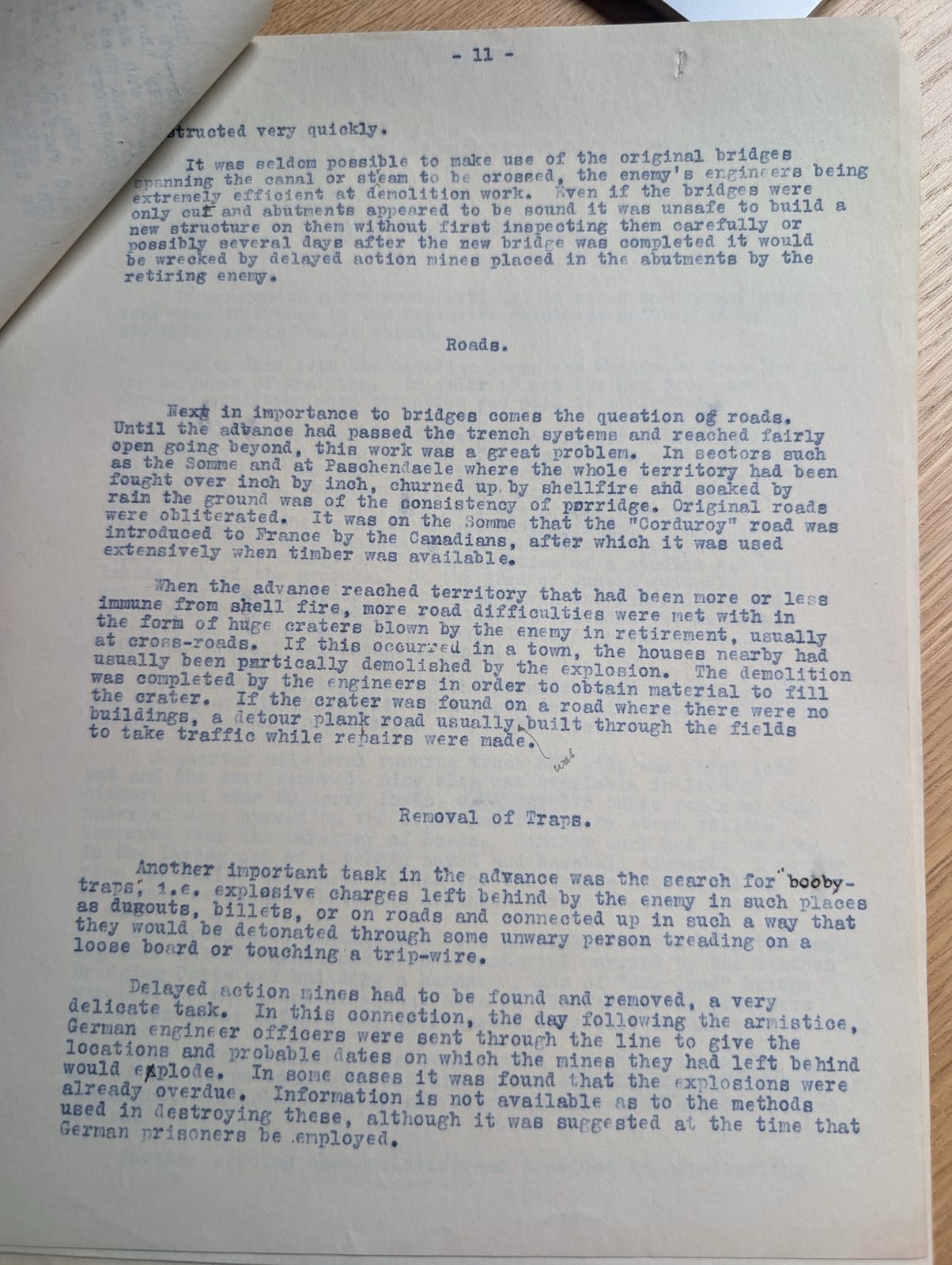
Roads, and the removal of traps

Roads came “next in importance to bridges.” Over old battlefields like the Somme and Passchendaele the ground was “of the consistency of porridge” and the original roads gone; it was there, he notes, that the Canadians introduced the corduroy road (logs laid crosswise) to France. Further on, in country the shelling had spared, the problem became huge craters the enemy had blown at crossroads in retreat.

The page ends with the search for “booby-traps” and delayed-action mines left in dugouts and abutments. One detail stands out: the day after the Armistice, German engineer officers were sent through the lines to give the locations and probable dates of the mines they had left behind, and in some cases the explosions “were already overdue.”

Melville’s note · 1923

Melville’s addition:

“No mention is made of the cross-country tracks which formed a valuable feature of the engineer work. Also … the proper marking of all roads and villages, this work being done by the Engineers.”

Page 12: the Dominion Day sports construction
Click to enlarge
Page 12

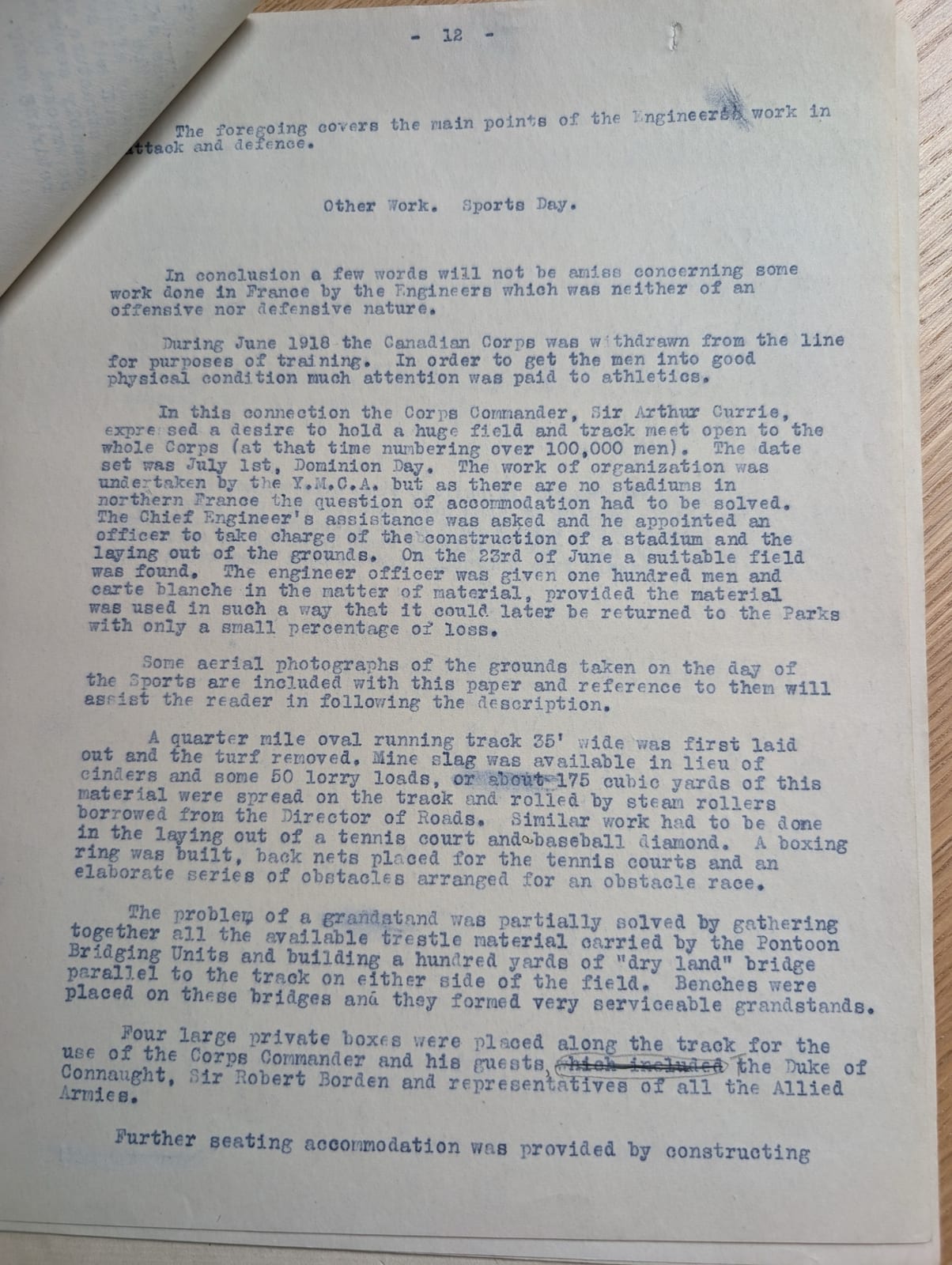
Building the Dominion Day ground

The paper closes with a job “neither of an offensive nor defensive nature.” In June 1918 Currie wanted a Corps-wide athletic meet for Dominion Day, July 1, and with no stadium in northern France, the Chief Engineer was asked to build one. An engineer officer got a hundred men, a suitable field found on June 23, and “carte blanche in the matter of material” so long as it could go back to the parks afterwards.

A quarter-mile cinder track was surfaced with 175 cubic yards of mine slag and rolled with borrowed steam rollers; then a tennis court, baseball diamond, boxing ring and obstacle course. The grandstands were improvised from “a hundred yards of ‘dry land’ bridge” (the pontoon unit’s trestle material) with benches on top, and four private boxes for Currie’s guests, the Duke of Connaught and Borden among them.

Melville’s note · 1923

Melville adds two features to the ground:

“In addition to the oval where most of the sporting events were carried out, there was the soccer field where the Corps championships were tried for, and also a model dressing station was erected which acted as a first aid post during the day.”

Page 13: Dominion Day, conclusion
Click to enlarge
Page 13

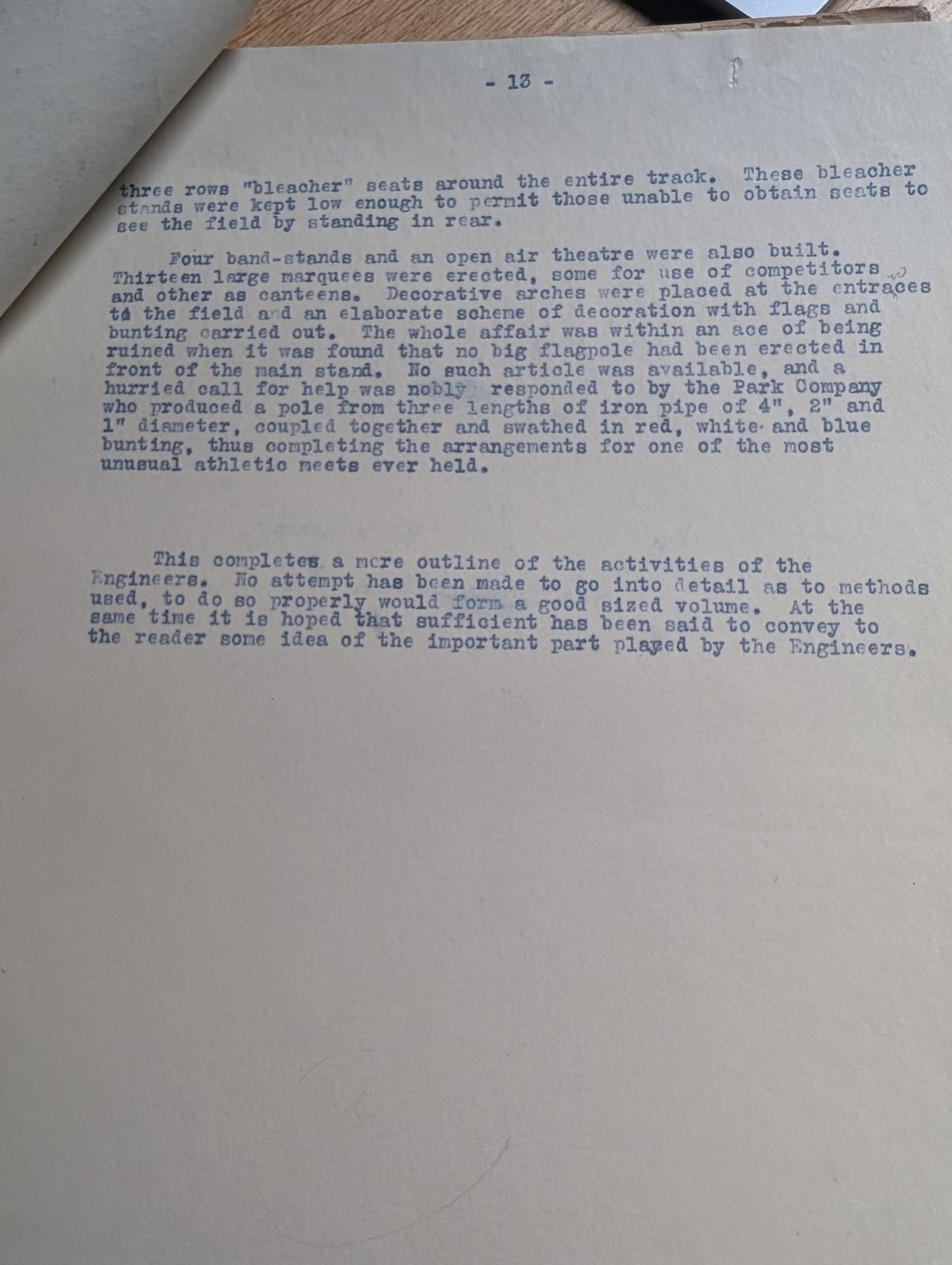
The finishing touches

Three rows of bleacher seats went round the entire track, kept low enough for those without seats to see over them. Then four bandstands, an open-air theatre, thirteen marquees, decorative arches, and “an elaborate scheme of decoration with flags and bunting.”

The whole thing was nearly ruined, he writes, when someone realised no big flagpole had been raised in front of the main stand and none was to be had, until the Park Company produced one from three lengths of iron pipe coupled together and “swathed in red, white and blue bunting.” He signs off that the paper is “a mere outline,” and that doing the subject properly “would form a good sized volume.”

“… thus completing the arrangements for one of the most unusual athletic meets ever held.” · page 13
Page 1
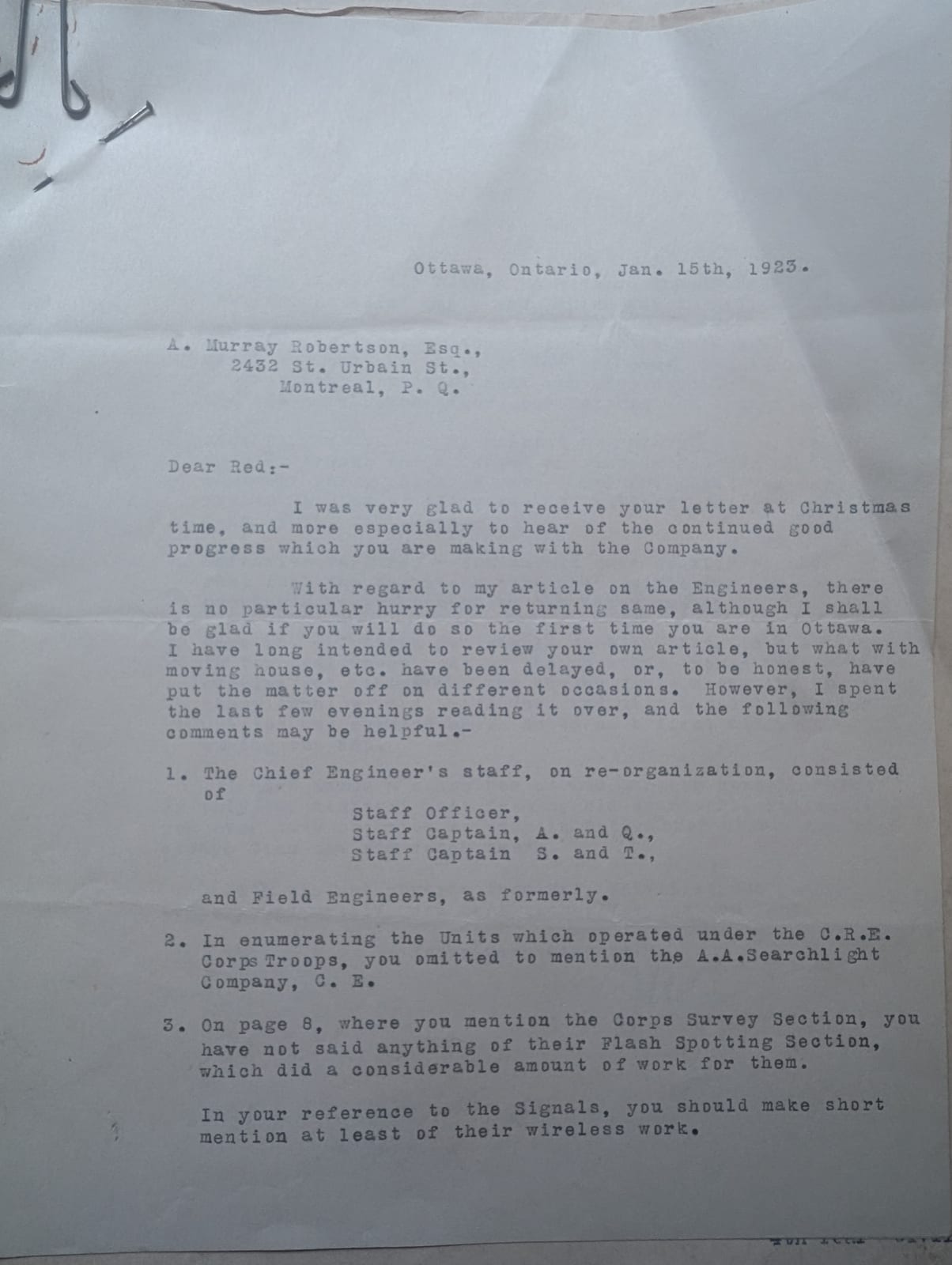
Letter from Mel, January 15, 1923, page 1
Page 2
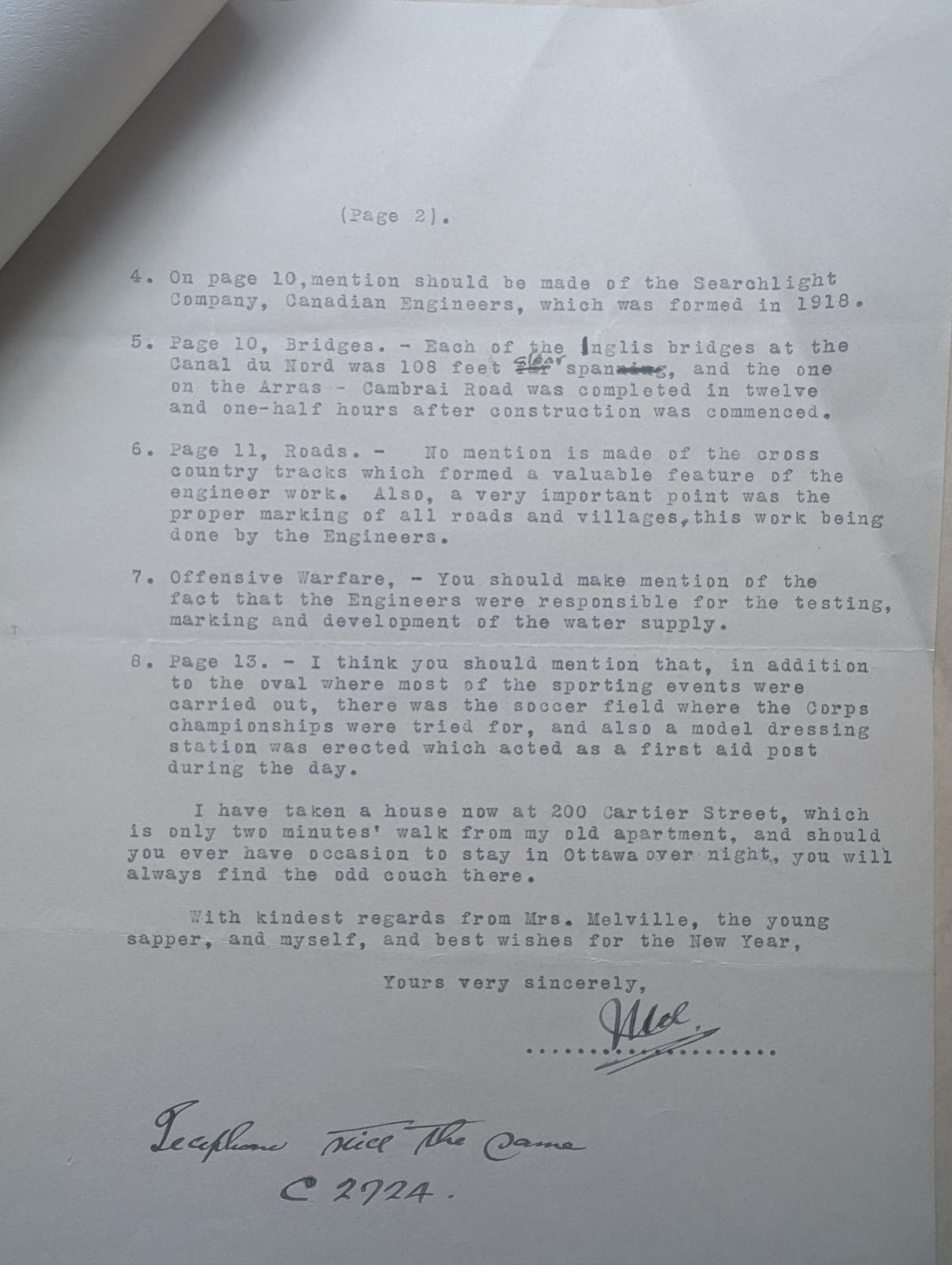
Letter from Mel, January 15, 1923, page 2
Click to enlarge
January 1923

A letter of corrections from “Mel”

On January 15, 1923, writing from Ottawa, a wartime friend replied to Robertson (then working for the Bell Telephone Company in Montreal), having “spent the last few evenings reading over” his paper. He returns it with eight numbered comments; each is set beside the page it speaks to, above.

The letter is signed only “Mel,” but its closing (“kindest regards from Mrs. Melville, the young sapper, and myself”) fixes the surname. This is the Melville who runs through the diary: a Canadian Engineer officer in a field company in 1916, on the staff at Canadian Corps headquarters by December 1917 (where Robertson goes “up to Corps” and “Saw Melville & got leave cheques”), a fixture at the Corps Engineers’ mess through 1918, one of the three who worked the luncheon tent as waiters on Dominion Day, and (six days after the Armistice) the man who showed Robertson round Mons and then visited him in hospital there.

That record matches Brigadier J.L. Melville, C.E. (1888–1980): adjutant to the C.R.E. Canadian Corps Troops and then the Corps’ officer in charge of bridge construction, awarded the Military Cross and a Bar (the Bar for the Canal du Nord bridging) and, after the war, settled in Ottawa and chosen to write the Canadian Engineers’ chapter of the official war history. The “article on the Engineers” he mentions lending Robertson is almost certainly that chapter. No other Melville appears anywhere in the diary or letters; the identification rests on converging detail rather than a document that names him, and is treated here as confirmed on the same basis as the site’s other cross-year identifications.

He ends with an offer: “should you ever have occasion to stay in Ottawa over night, you will always find the odd couch there.”
The paper and the 1923 letter are in the Treherne family collection. Quotations here are from Robertson’s and Melville’s own text; the surrounding commentary is editorial. Details of Melville’s wartime and later service are drawn from the biographical records of the Canadian Military Engineers Association.