The draft: September 17, p. 1
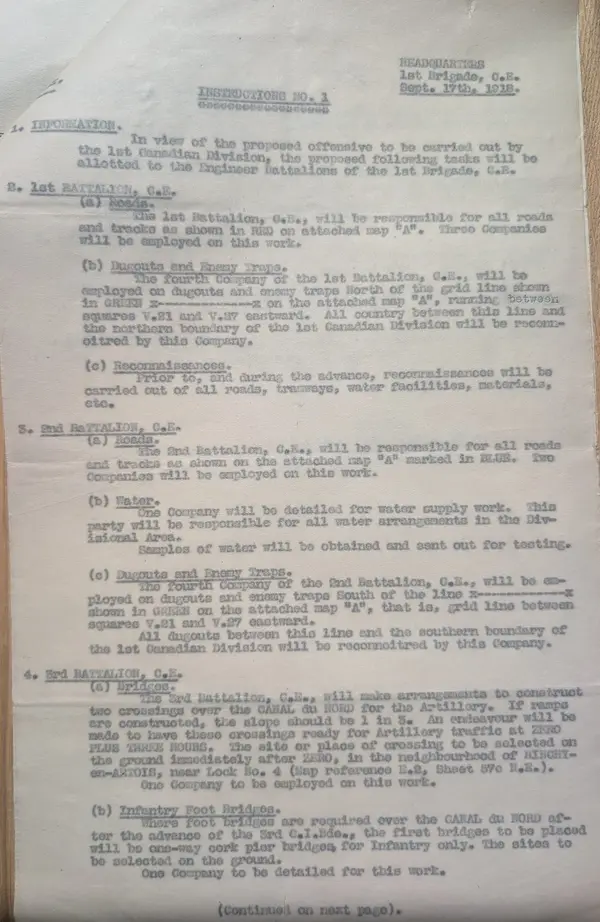
First page of “Instructions No. 1,” 1st Brigade Canadian Engineers, 17 September 1918: the preliminary engineer tasking for the proposed 1st Canadian Division offensive
The draft: September 17, p. 2
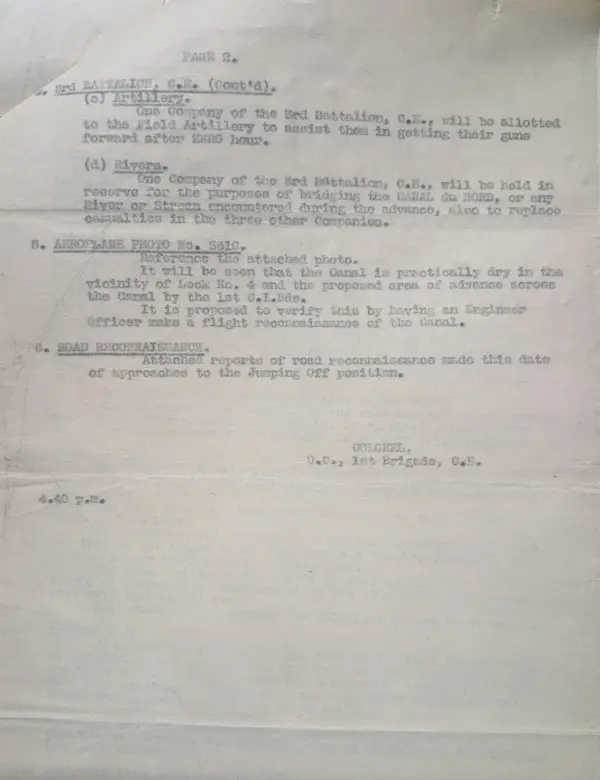
Second page of the 17 September 1918 draft instruction, covering the 3rd Battalion's bridging tasks and a note on aeroplane photograph No. 3810 showing the canal practically dry near Lock No. 4
The air-photo survey: September 18, with the unit's stamp
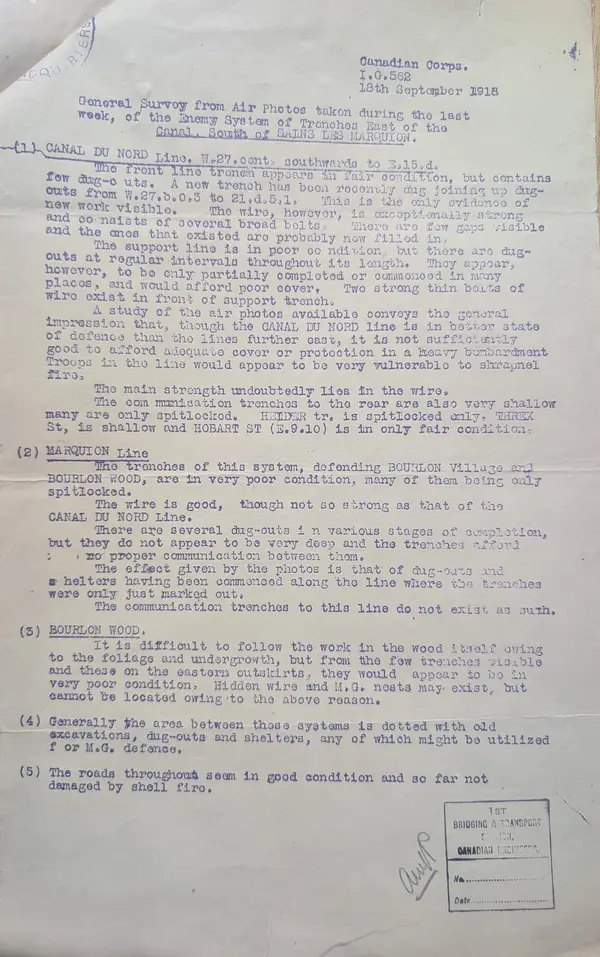
Canadian Corps “General Survey from Air Photos” of the enemy trench system east of the Canal du Nord, 18 September 1918, stamped with the 1st Bridging and Transport Section registry stamp
The instruction: September 21, p. 1
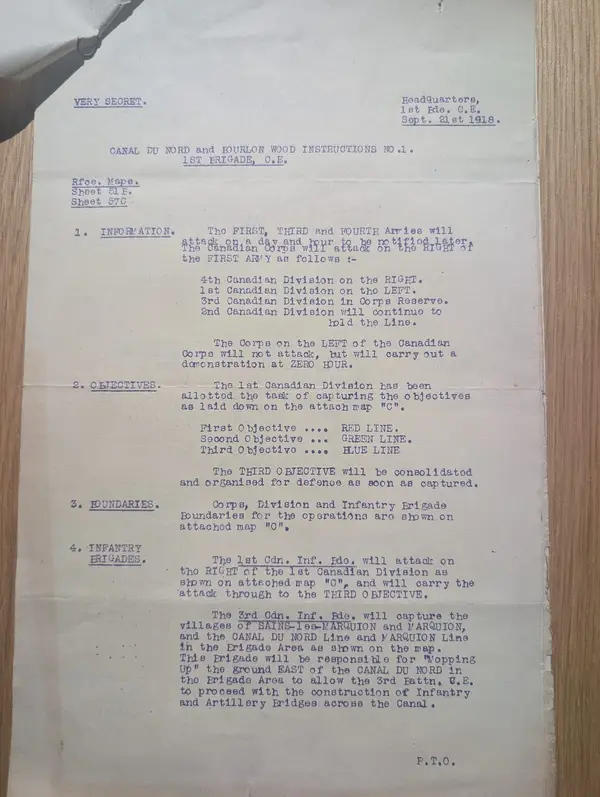
First page of “Canal du Nord and Bourlon Wood Instructions No. 1,” 1st Brigade Canadian Engineers, 21 September 1918, marked Very Secret
The instruction: September 21, p. 6 (signed)
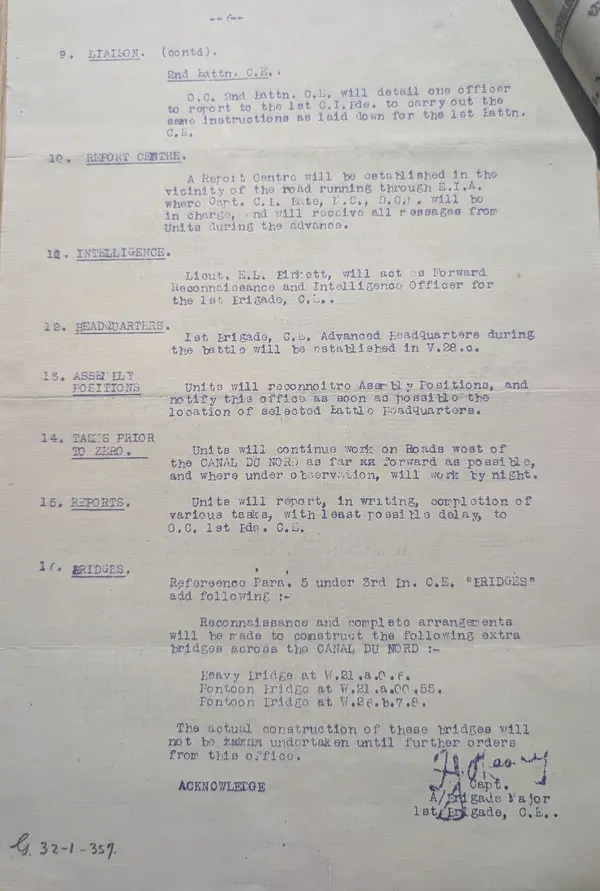
Last page of the 21 September 1918 instruction, listing three extra heavy and pontoon bridges to be prepared across the canal, signed by the acting Brigade Major
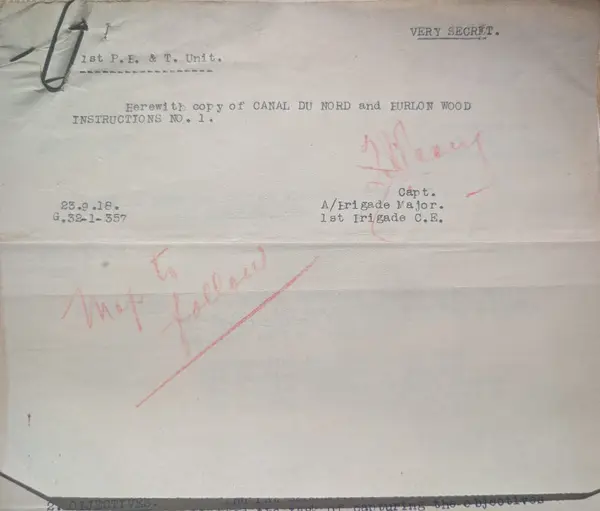
The covering note to Robertson's unit: September 23
Covering note of 23 September 1918 from 1st Brigade Canadian Engineers to the 1st Bridging and Transport Unit, forwarding a copy of the Canal du Nord and Bourlon Wood Instructions No. 1, with “Map to follow” written across it in red crayon
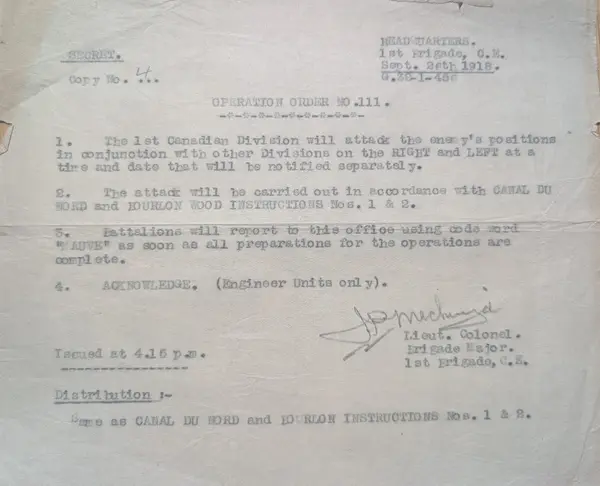
Operation Order No. 111: September 26, 4.15 p.m.
Operation Order No. 111, 1st Brigade Canadian Engineers, 26 September 1918, issued at 4.15 p.m.: a four-paragraph order for the attack, carrying the code word “Mauve” for reporting readiness
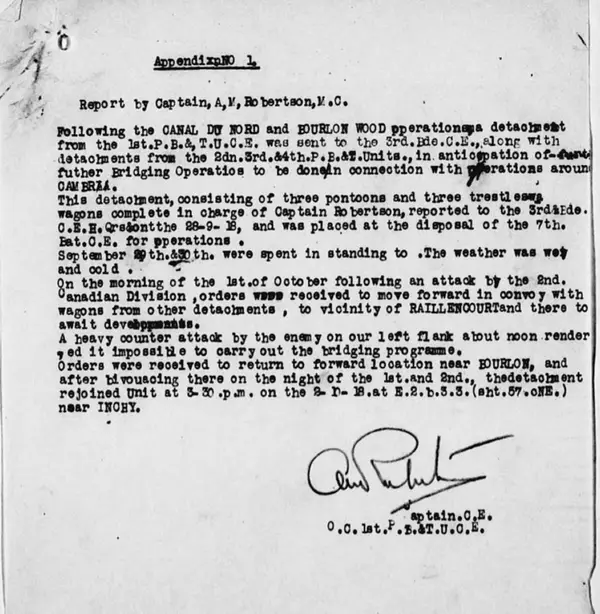
His report: October war diary, Appendix 1
Appendix No. 1 to the 1st Pontoon Bridging and Transport Unit's war diary for October 1918: Captain A. M. Robertson's signed typescript report on his detachment's part in the Canal du Nord and Bourlon Wood operations
The commendation: October 21, 1918
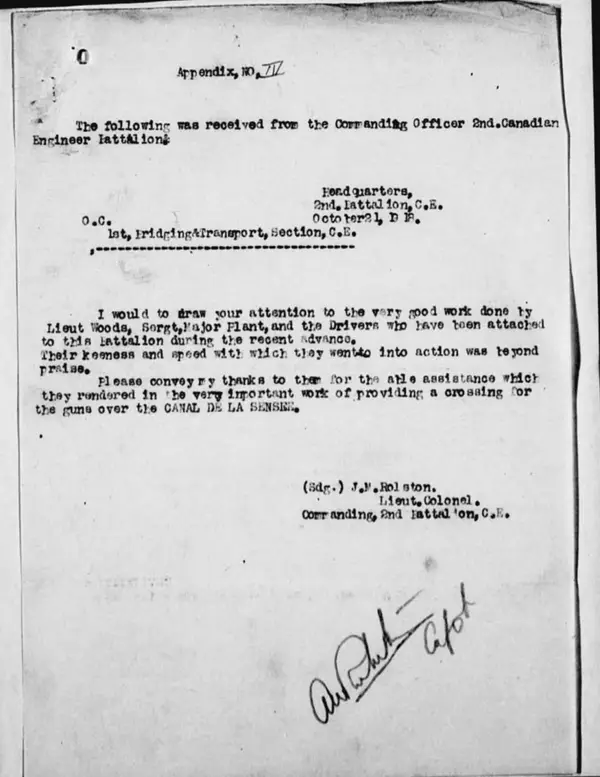
Appendix No. 4 to the October 1918 war diary: a message of 21 October 1918 from Lieutenant-Colonel Rolston, commanding the 2nd Battalion, Canadian Engineers, praising Lieut. Woods, Sergeant-Major Plant and the drivers
Click to enlarge
1st Brigade, Canadian Engineers · 17 September to 21 October 1918

The Canal du Nord Plan

Autumn 1918: the Canal du Nord

Robertson rejoined his unit on 9 September 1918, arriving in camp about seven in the evening after a stop at Savy. The next day the unit's lines were shelled and the officers' bivouac destroyed, and it pulled back that evening to 1st Brigade Canadian Engineers headquarters at Hendecourt. Then the diary stops. It stays stopped for thirty-five days: across the whole of the Battle of the Canal du Nord and the Hundred Days fighting that followed it. These three sheets, kept clipped together in his papers, are what his brigade was planning during that silence.

The Canal du Nord was an unfinished canal, dry along much of its length, that the Germans had built into their defensive line north-west of Cambrai. The Canadian Corps was to force it on a narrow frontage near Inchy-en-Artois, fan out behind it into open ground, and carry the advance through Bourlon Wood, the plan that opened at 5.20 a.m. on 27 September. The 1st Canadian Division attacked on the left, with the 1st Brigade, C.E. (its three Engineer Battalions and Robertson's Bridging and Transport Section) responsible for the roads forward, the water supply, the clearing of dugouts and booby-traps, and above all the bridges: hasty crossings for the guns within hours of zero, then heavier ones for two-way lorry traffic, and one-way cork-pier footbridges for the infantry.

The papers come in the order they were written. First a draft (“Instructions No. 1,” 17 September) setting out the battalions' tasks against a map and an aeroplane photograph that showed the canal “practically dry” near Lock No. 4, with a proposal to send an engineer officer up in an aircraft to confirm it. Then, on 18 September, a Canadian Corps intelligence sheet reading the German defences off a week's air photos: the front trench in fair order but thinly held, the rear trenches barely dug (many only spitlocked), the dugouts shallow, and the real strength lying in “several broad belts” of wire. That sheet carries the Bridging and Transport Section's own rubber registry stamp; it is his unit's copy.

Then the formal instruction, “Canal du Nord and Bourlon Wood Instructions No. 1,” 21 September, marked Very Secret and running to six pages: army and corps plan, the Red, Green and Blue objective lines, the infantry brigades' tasks, each Engineer Battalion's sector and roads and bridges, the water company, the reserve bridging company, the report centre, the liaison officers, the advanced brigade headquarters. Its last page names three further bridges (a heavy bridge and two pontoon bridges) to be reconnoitred and made ready but not built “until further orders.” It is signed not by the Brigade Major who signs the summer's move orders, Lieutenant-Colonel J. P. Mackenzie, but by an acting one (a Captain, whose signature is illegible) who signs the covering note two days later as well; Mackenzie was away for a stretch of the third week of September and back at the desk by the 24th.

Four more sheets from the same bundle carry the plan the rest of the way to zero hour. A covering note of 23 September (addressed to Robertson's Bridging and Transport Section by name, with “Map to follow” scrawled across it in red crayon) is the slip that sent his unit its copy of the instruction. On the 24th Mackenzie, back in the Brigade Major's chair, issued a “Continued” amendment: the canal crossings now lettered and timed (a horse bridge here by three hours after zero, a gun crossing there by four) and the roads behind them to be handed over to the other two engineer brigades once the advance had passed. The 1st Canadian Division's own administrative staff added their piece on the 22nd, a memo on lorry routes and water signed by the divisional “A and Q,” Lieutenant-Colonel J. Sutherland Brown. And at a quarter past four on the evening of the 26th the brigade issued Operation Order No. 111: four sentences, the whole plan compressed to a map reference and a code word, “Mauve,” to be wired back when each unit was ready. The attack opened thirteen hours later.

The attack went in on schedule. The division crossed the dry canal, the engineers threw the bridges in behind the infantry, and the Corps was into Bourlon Wood the same day and fighting towards Cambrai over the following week, at a cost of more than ten thousand Canadian casualties in five days. His private diary says nothing of it. The unit's own war diary for September and October, which he wrote and signed as its officer commanding, does (see below), and a letter to Doris weeks later has the mood: “For the last month or so have hardly been located in one place for any length of time … Things have been moving right along.”

The unit's war diary for September records his part in the attack itself. On 26 September wagons from four bridging units, the 1st, 2nd, 3rd and 4th, and the 1st Pontoon Park assembled at his unit's lines and moved forward in the afternoon, fifteen trestle wagons with their superstructure, twelve pontoon wagons and five empty ones in all. An appendix written in his hand describes what happened on the 27th. Two convoys were formed from the combined lot: one "in charge of Capt. A.M. Robertson and Capt. Niall" and one under his Lieutenant, C.J. Fox. Zero was at 5.20 a.m. The 3rd Battalion, C.E. was to build four light bridges for horse transport (the D, E, F and G crossings) and four infantry footbridges. Fox's convoy carried the material for D and E; "Capt. Robertson's convoy" carried the material for F and G and the footbridges. The first wagons off were four loaded with cork rafts for the infantry crossings, each in charge of an N.C.O. of the 3rd Battalion who was to build the footbridge, and the account singles out their drivers for "great commendation": the enemy had not yet been cleared from the east bank of the canal, and they delivered their loads on the west bank under heavy machine-gun fire. The wagons for the F and G crossings were held back "in Buissy until the eastern side of the canal had been mopped up." The next day, 28 September, his page of the diary records that the remaining wagons of the combined units "moved forward under Capt. A.M. Robertson, M.C. to vicinity of Bourlon, where they parked", and that the whole detachment was placed at the disposal of the 3rd Brigade, C.E. for further work on the Canal de l'Escaut, with "considerable bombing in vicinity." The 3rd Battalion, C.E., whose companies received these wagons and built the bridges, was commanded by October 1918 by Lieutenant-Colonel E. Pepler, Robertson's old company commander from the 3rd Field Company; its own war diary for October records his report on "Lessons learned during the recent advance." That detachment is the one described in his own report below.

The first appendix to the October volume of the war diary is his own typed report on the detachment he took forward. Three pontoons and three trestle wagons in his charge reported to the 3rd Brigade, C.E. on 28 September and were placed at the disposal of the 7th Battalion; the 29th and 30th were spent standing to, in wet and cold weather. On the morning of 1 October, after the 2nd Division's attack, the wagons moved forward in convoy to the Raillencourt area to await developments, but a heavy counter-attack on the left flank about noon made the bridging programme impossible. They went back to a forward location near Bourlon, bivouacked there on the night of 1 to 2 October, and rejoined the unit at 3.30 p.m. on the 2nd, near Inchy. A later sheet, dated 21 October, is a message from Lieutenant-Colonel Rolston, commanding the 2nd Battalion, C.E., thanking the unit's Lieut. Woods, Sergeant-Major Plant and the drivers attached to the battalion for the speed with which they went into action during the advance, and for the crossing they provided for the guns over the Canal de la Sensée.

Transcription
The documents in the bundle, in the order written. The road paragraphs of the 21 and 24 September instructions are long strings of six-figure map references, and the divisional administrative arrangements of the 22nd are given here in outline.
1. “Instructions No. 1,” Headquarters, 1st Brigade, C.E., 17 September 1918.
1. Information. — In view of the proposed offensive to be carried out by the 1st Canadian Division, the following tasks will be allotted to the Engineer Battalions of the 1st Brigade, C.E.
2. 1st Battalion, C.E. — (a) Roads. Responsible for all roads and tracks shown in red on attached map “A”; three Companies employed. (b) Dugouts and Enemy Traps. The Fourth Company employed on dugouts and enemy traps north of the grid line shown in green running between squares V.21 and V.27 eastward; all country between this line and the northern boundary of the Division to be reconnoitred by this Company. (c) Reconnaissances. Prior to, and during the advance — of all roads, tramways, water facilities, materials, etc.
3. 2nd Battalion, C.E. — (a) Roads. All roads and tracks shown in blue on map “A”; two Companies employed. (b) Water. One Company detailed for water supply work, responsible for all water arrangements in the Divisional Area; samples obtained and sent out for testing. (c) Dugouts and Enemy Traps. The Fourth Company employed south of the same green line, to the southern boundary of the Division.
4. 3rd Battalion, C.E. — (a) Bridges. Arrangements to construct two crossings over the Canal du Nord for the Artillery. If ramps are constructed, the slope should be 1 in 5. An endeavour will be made to have these crossings ready for Artillery traffic at Zero plus three hours. The site to be selected on the ground immediately after Zero, in the neighbourhood of Inchy-en-Artois, near Lock No. 4 (map reference E.2, Sheet 57c N.E.). One Company employed. (b) Infantry Foot Bridges. Where foot bridges are required over the Canal du Nord after the advance of the 3rd C.I. Bde., the first bridges placed will be one-way cork pier bridges for Infantry only; sites selected on the ground. One Company detailed. (c) Artillery. One Company allotted to the Field Artillery to assist getting their guns forward after Zero hour. (d) Rivers. One Company held in reserve for bridging the Canal du Nord, or any river or stream encountered during the advance; also to replace casualties in the three other Companies.
5. Aeroplane Photo No. 3810. — Reference the attached photo, it will be seen that the Canal is practically dry in the vicinity of Lock No. 4 and the proposed area of advance across the Canal by the 1st C.I. Bde. It is proposed to verify this by having an Engineer Officer make a flight reconnaissance of the Canal.
6. Road Reconnaissance. — Attached reports of road reconnaissance made this date of approaches to the Jumping Off position.
Colonel, O.C., 1st Brigade, C.E. — [A road-reconnaissance report is typed on the reverse of the second page; it is only partly legible.]
2. “General Survey from Air Photos taken during the last week, of the Enemy System of Trenches East of the Canal, South of Sains-lès-Marquion.” Canadian Corps, I.G.562, 18 September 1918.
(1) Canal du Nord Line. — The front line trench appears in fair condition but contains few dug-outs. A new trench has recently been dug joining up dug-outs — the only evidence of new work visible. The wire, however, is exceptionally strong and consists of several broad belts; few gaps visible, and the ones that existed are probably now filled in. The support line is in poor condition; there are dug-outs at regular intervals but they appear only partially completed and would afford poor cover. … Though the Canal du Nord line is in better state of defence than the lines further east, it is not sufficiently good to afford adequate cover in a heavy bombardment; troops in the line would appear very vulnerable to shrapnel fire. The main strength undoubtedly lies in the wire. The communication trenches to the rear are also very shallow; many are only spitlocked.
(2) Marquion Line. — The trenches of this system, defending Bourlon Village and Bourlon Wood, are in very poor condition, many being only spitlocked. The wire is good, though not so strong as that of the Canal du Nord Line. Several dug-outs in various stages of completion, but not very deep, and the trenches afford no proper communication between them. … The communication trenches to this line do not exist as such.
(3) Bourlon Wood. — It is difficult to follow the work in the wood itself owing to the foliage and undergrowth, but from the few trenches visible, and those on the eastern outskirts, they would appear to be in very poor condition. Hidden wire and M.G. nests may exist but cannot be located for the above reason.
(4) Generally the area between these systems is dotted with old excavations, dug-outs and shelters, any of which might be utilized for M.G. defence. (5) The roads throughout seem in good condition and so far not damaged by shell fire.
[Bears the “1st Bridging & Transport Section, Canadian Engineers” registry stamp.]
3. “Canal du Nord and Bourlon Wood Instructions No. 1 — 1st Brigade, C.E.” Very Secret. Headquarters, 1st Bde. C.E., 21 September 1918. Ref. Maps: Sheet 51 B, Sheet 57 C.
1. Information. — The First, Third and Fourth Armies will attack on a day and hour to be notified later. The Canadian Corps will attack on the right of the First Army: 4th Canadian Division on the right; 1st Canadian Division on the left; 3rd Canadian Division in Corps Reserve; 2nd Canadian Division will continue to hold the Line. The Corps on the left of the Canadian Corps will not attack, but will carry out a demonstration at Zero hour.
2. Objectives. — The 1st Canadian Division has been allotted the task of capturing the objectives laid down on attached map “C”: First Objective, Red Line; Second Objective, Green Line; Third Objective, Blue Line. The Third Objective will be consolidated and organised for defence as soon as captured.
3. Boundaries. — Corps, Division and Infantry Brigade boundaries are shown on attached map “C.”
4. Infantry Brigades. — The 1st Cdn. Inf. Bde. will attack on the right of the Division and carry the attack through to the Third Objective. The 3rd Cdn. Inf. Bde. will capture the villages of Sains-lès-Marquion and Marquion, and the Canal du Nord Line and Marquion Line in the Brigade Area, and will be responsible for “mopping up” the ground east of the Canal du Nord to allow the 3rd Battn. C.E. to proceed with the construction of Infantry and Artillery Bridges across the Canal. The 2nd Cdn. Inf. Bde. will attack from the vicinity of the Marquion Line after its capture and carry the advance through to the Third Objective.
5. Engineer Brigade. — For engineer purposes the area has been divided by a green line A–A–A; roads coloured red and blue on attached map “B.” 1st Battn. C.E. — responsible for the work in the left sector (north of the green line); repair and maintenance of Roads Nos. 1–3 (routed through Huissy, Sains-lès-Marquion, etc.), road parties to examine for mines; “D” Company to reconnoitre all dugouts and enemy traps, signs placed to show if safe or mined, no personnel but tunnellers admitted until examined; parties to assist the 2nd and 3rd C.I. Bde. with strong points. 2nd Battn. C.E. — responsible for the right sector (south of the green line); Roads Nos. 1–4 (through Cagnicourt, Inchy-en-Artois, etc.); dugouts and strong points as for the 1st Battn.; one Company detailed for water supply for the whole Divisional Area, samples sent out for testing. 3rd Battn. C.E. — responsible for bridging the Canal du Nord: a crossing at E.2.c.9.9 made good first for guns and later for two-way lorry traffic; a hasty crossing at W.26.d.6.8 for guns, later two-way lorry traffic; infantry foot-bridges (cork pier), or any suitable material found on the spot, at four points; one Company to the Field Artillery to get the guns forward after Zero; one Company held in reserve to bridge any river, stream or ditch met during the advance. Bridge material: instructions to be issued later.
6. Reconnaissance. — Prior to, and during the advance, reconnaissance by all Units of roads, tramways, dry-weather tracks, water facilities, materials, etc.; reports rendered throughout to this office. 7. Transport. — Reference lorries, trestle wagons and tip carts available for work; instructions to be issued later. 8. Signs. — Units to detail a party to erect signs in all villages, at cross roads, etc., and to have the signs made.
9. Liaison. — O.C. 1st Battn. C.E. to detail two officers, one to the 2nd and one to the 3rd C.I. Bde., to report at once, get acquainted with the operations, keep their Units in touch with the situation during the advance and wire requirements of material direct to O.C. 1st Brigade, C.E.; they should have a motor cyclist or runners with them. O.C. 2nd Battn. C.E. to detail one officer to the 1st C.I. Bde. on the same instructions.
10. Report Centre. — Established in the vicinity of the road running through E.1.A., where Capt. C. B. Bate, M.C., D.C.M. will be in charge and will receive all messages from Units during the advance. 11. Intelligence. — Lieut. E. L. Birkett will act as Forward Reconnaissance and Intelligence Officer for the 1st Brigade, C.E. 12. Headquarters. — 1st Brigade, C.E. Advanced Headquarters during the battle established in V.28.c.
13. Assembly Positions. — Units to reconnoitre Assembly Positions and notify this office of the location of selected Battle Headquarters. 14. Tasks Prior to Zero. — Units to continue work on roads west of the Canal du Nord as far forward as possible; where under observation, to work by night. 15. Reports. — Units to report completion of tasks in writing, with least possible delay, to O.C. 1st Bde. C.E.
16. Bridges. — Reference para. 5 under 3rd Bn. C.E. “Bridges,” add: reconnaissance and complete arrangements to be made to construct the following extra bridges across the Canal du Nord — a Heavy Bridge at W.21.a.0.6; a Pontoon Bridge at W.21.a.00.55; a Pontoon Bridge at W.26.b.7.8. The actual construction of these bridges will not be undertaken until further orders from this office. Acknowledge.
[Signature illegible], Capt., A/Brigade Major, 1st Brigade, C.E. — G.32-1-357.
4. “Administrative Arrangements,” Headquarters, 1st Canadian Division, 22 September 1918 (ref. SG.52/1328) — outline.
Lorry routes. Sets out the roads in the back area open to two-way and to one-way lorry traffic (with the compulsory direction of travel for the one-way roads), and how far forward lorries may go by day at present — Quéant–Riencourt, and Cagnicourt–Villers-lès-Cagnicourt. Beyond those points, or on the Quéant–Riencourt road, only with a pass signed by an A.P.M. Water. Capt. A. G. Riddell, 2nd Bn. C.E. has been appointed Divisional Forward Reconnaissance Officer for Water Supply — to make a rapid reconnaissance of the captured area for water, report to the Corps Water Engineer, and take samples of all such water and despatch them to the Forward Laboratory for testing.
SD/J. Sutherland Brown, Lieut.-Colonel, A.A. & Q.M.G., 1st Cdn. Divn.
5. Covering note, 1st Brigade, C.E. to the 1st (Pontoon) Bridging & Transport Unit, 23 September 1918 — G.32-1-357.
“Very Secret. 1st P.B. & T. Unit. Herewith copy of Canal du Nord and Bourlon Wood Instructions No. 1. 23.9.18. — G.32-1-357.” Signed [signature illegible], Capt., A/Brigade Major, 1st Brigade, C.E. Written across the foot in red crayon: “Map to follow.”
6. “Canal du Nord and Bourlon Wood Instructions No. 1 — Continued,” Headquarters, 1st Bde. C.E., 24 September 1918 — G.32-1-357. Very Secret — outline.
Para. 5, Engineer Brigade — additions. Extra roads are added to the 1st Battn. C.E. allotment (the Cambrai road eastward to the Cambrai–Douai road junction) and to the 2nd Battn. C.E. allotment (a dry-weather diversion round Inchy for horse transport, and three further cross-road links through Sains-lès-Marquion).
Para. 5, 3rd Battn. C.E., sub-para. (a) “Bridges” — cancelled, and the following substituted. The 3rd Battn. C.E. will be responsible for the bridging of the Canal du Nord at four crossings, now lettered: “H” (W.21.a.0.6) — a medium pontoon or trestle bridge for horse traffic by Zero plus 3 hours if possible, and a two-way bridge (except tanks) as soon as the situation permits; “F” (W.26.b.3.8) — a medium pontoon or trestle bridge for horse traffic by Zero plus 3 hours if possible; “E” (W.26.d.0.8) — a bridge repaired, or a medium pontoon or trestle bridge built, for horse traffic by Zero plus 4 hours if possible (the Artillery want Zero plus 3); “D” (E.2 central) — a crossing for guns by Zero plus 4 hours, to be made good for two-way lorry traffic as soon as possible. Sub-para. (e), Infantry Footbridges — four, at places to be selected by 1st Canadian Division, the locations numbered from south to north.
The 2nd and 3rd Brigades, C.E. will take over all roads, tracks and crossings as far as the east bank of the Canal du Nord at an hour to be notified later. Distribution: the three Engineer Battalions, the 1st P.B. & T. Unit, C.E. Canadian Corps, 1st Cdn. Division “G,” C.R.A. 1st Cdn. Division, the War Diary, and file. J. P. Mackenzie, Lieut. Colonel, Brigade Major, 1st Bde. C.E. “Acknowledge.”
7. “Addenda to Canal du Nord and Bourlon Wood Instructions No. 2,” Headquarters, 1st Bde. C.E., 26 September 1918 — G.32-1-458. Secret — outline.
Allotment of bridges over the canal. Until the bridges become available for traffic, the dry crossings are allotted A and B to the 3rd and 4th Canadian Divisions, C and D to the 1st Canadian and 11th Divisions. The ultimate allotment: 3rd Cdn. Division — A and B; 4th Cdn. Division — C and D; 1st Cdn. Division — E and F; 11th Division — G, H and K. Allotment of roads. Sets which of the Quéant–Pronville–Inchy, Quéant–Huissy and Cagnicourt–Inchy roads each division is to use before and after the bridges open; traffic is not to enter Inchy village but to be diverted round the dry-weather track to the south; the 4th Canadian Division and 11th Division are to keep clear of Sains-lès-Marquion once the bridges are open.
J. P. Mackenzie, Lieut. Colonel, Brigade Major, 1st Brigade, C.E. Issued to all recipients of Canal du Nord & Bourlon Wood Instructions No. 2.
8. “Operation Order No. 111,” Headquarters, 1st Bde. C.E., 26 September 1918 — G.32-1-456. Secret. Copy No. 4.
1. The 1st Canadian Division will attack the enemy's positions in conjunction with other Divisions on the right and left at a time and date that will be notified separately. 2. The attack will be carried out in accordance with Canal du Nord and Bourlon Wood Instructions Nos. 1 & 2. 3. Battalions will report to this office using code word “Mauve” as soon as all preparations for the operations are complete. 4. Acknowledge. (Engineer Units only.)
Issued at 4.15 p.m. — J. P. Mackenzie, Lieut. Colonel, Brigade Major, 1st Brigade, C.E. Distribution: same as Canal du Nord and Bourlon Wood Instructions Nos. 1 & 2.
Appendix No. 1 to the War Diary of the 1st Pontoon Bridging & Transport Unit, C.E., October 1918. Report by Captain A. M. Robertson, M.C.
Following the CANAL DU NORD and BOURLON WOOD operations a detachment from the 1st P.B. & T.U. C.E. was sent to the 3rd Bde. C.E., along with detachments from the 2nd, 3rd & 4th P.B. & T. Units, in anticipation of further Bridging Operations to be done in connection with operations around CAMBRAI.

This detachment, consisting of three pontoons and three trestle wagons complete in charge of Captain Robertson, reported to the 3rd Bde. C.E. H.Qrs. on the 28-9-18, and was placed at the disposal of the 7th Bat. C.E. for operations.

September 29th & 30th were spent in standing to. The weather was wet and cold.

On the morning of the 1st of October following an attack by the 2nd Canadian Division, orders were received to move forward in convoy with wagons from other detachments, to vicinity of RAILLENCOURT and there to await developments.

A heavy counter attack by the enemy on our left flank about noon rendered it impossible to carry out the bridging programme.

Orders were received to return to forward location near BOURLON, and after bivouacing there on the night of the 1st and 2nd, the detachment rejoined Unit at 3-30 p.m. on the 2-10-18 at E.2.b.3.3 (sht. 57c NE) near INCHY.
[signed] Captain, C.E., O.C. 1st P.B. & T.U. C.E.
Appendix No. 4. A message from the Commanding Officer, 2nd Canadian Engineer Battalion. Headquarters, 2nd Battalion, C.E., October 21, 1918. To the O.C. 1st Bridging & Transport Section, C.E.
I would like to draw your attention to the very good work done by Lieut. Woods, Sergt.-Major Plant, and the Drivers who have been attached to this Battalion during the recent advance. Their keenness and speed with which they went into action was beyond praise.

Please convey my thanks to them for the able assistance which they rendered in the very important work of providing a crossing for the guns over the CANAL DE LA SENSÉE.
[signed] J. M. Rolston, Lieut. Colonel, Commanding 2nd Battalion, C.E. [initialled and signed by Robertson, Capt.]

The originals are in the Treherne family collection, kept as one clipped bundle. At its centre is the six-page instruction of 21 September 1918, with its two-page draft of the 17th and the Canadian Corps air-photo appreciation of the 18th behind it: the air-photo sheet carrying the rubber registry stamp of the 1st Bridging and Transport Section, Canadian Engineers, Robertson's command, with an inked initial beside it. The instruction reached his unit under a covering note of 23 September (office reference G.32-1-357, addressed to the “1st P.B. & T. Unit”), which is in the bundle, along with the “Continued” amendment of the 24th, the 1st Canadian Division's administrative arrangements of the 22nd, the addenda of the 26th, and Operation Order No. 111, the unit's Copy No. 4. The attached maps “A,” “B” and “C,” Aeroplane Photograph No. 3810, and the “Instructions No. 2” referred to by the last two sheets are not in the bundle. Operational paper of this kind is held openly at Library and Archives Canada in the war diaries of the Canadian Engineer units concerned; the “Very Secret” and “Secret” markings are historical, and the records have long been open. The last two sheets, his typed report (Appendix 1) and Lieutenant-Colonel Rolston's message of 21 October (Appendix 4), come from the unit's war diary for October 1918 (Army Form C.2118, written and signed by Robertson as its officer commanding), held at Library and Archives Canada (item 2004916, the 1st Pontoon Bridging and Transport Unit, Canadian Engineers, war diary; also published by the Canadian Great War Project). The typescript of the report carries some overtyping; the words are given as they read. The September war diary account (the convoys of 26 to 28 September and Lieut. Fox's report) is given in words only here; the pages themselves are not reproduced.