The Situation Reports from Amiens
Summer 1918: the move to AmiensBy the second week of August 1918 the Battle of Amiens had run its course. The great advance of the 8th had carried the Canadian Corps eight miles in a day; a week later it was grinding forward yard by yard through the old, cratered Somme battlefield of 1916, against wire that had stood for two years and a stiffening German defence. The Corps' last actions in the battle were the attacks on Parvillers, Damery and Fouquescourt, 13–17 August, before it was pulled out of the line to move north again for the next offensive at Arras.
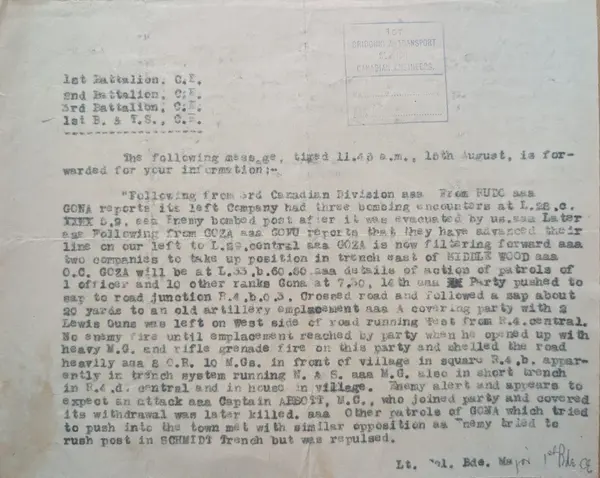
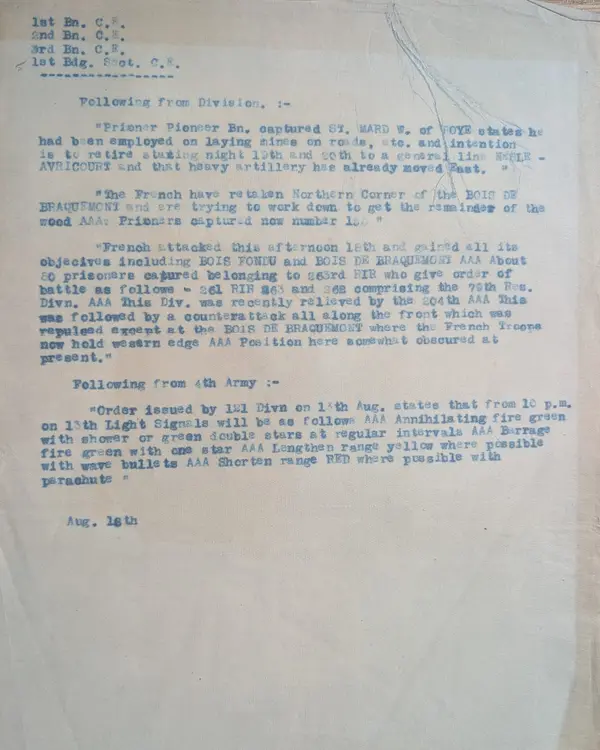
Robertson kept a run of the 1st Canadian Division's daily situation summaries through these days: the divisional and brigade paper that came down to units, telling each one where the line stood and what the neighbours were doing. Most of the sheets are addressed to all four engineer units of the division after the May reorganisation: the three Engineer Battalions and the Bridging and Transport Section, his own command. One carries his pencil filing mark, “1st B.T.S. C.E.,” across the top; another the Section's rubber registry stamp. His diary keeps the same days from the inside, and they are quiet ones for him: the Section is out of the fighting, camped back at Aubercourt and then in the wood, its battalions “down training on trestles” and “training on Pontoons,” while he is “busy on the War Diary since organization” and nursing “a cold + a touch of dysentry.”
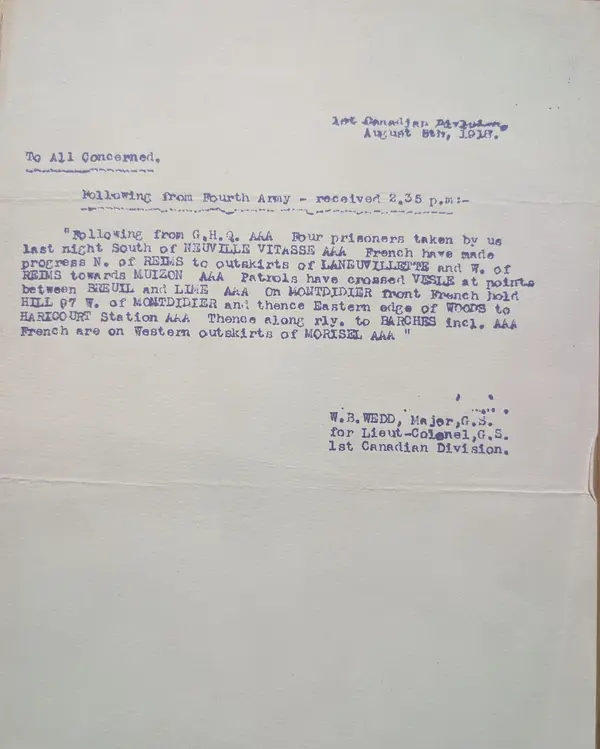
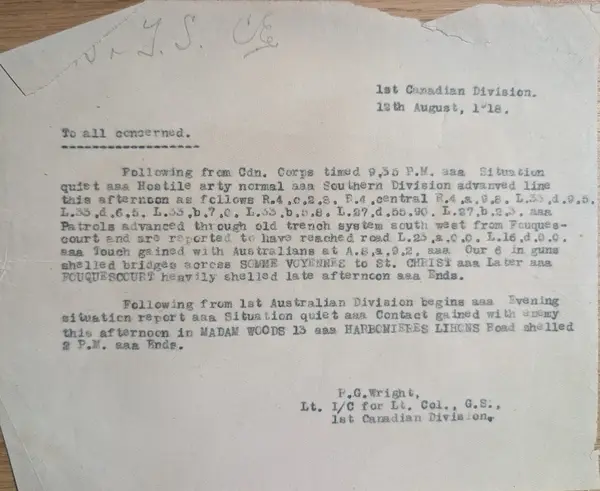
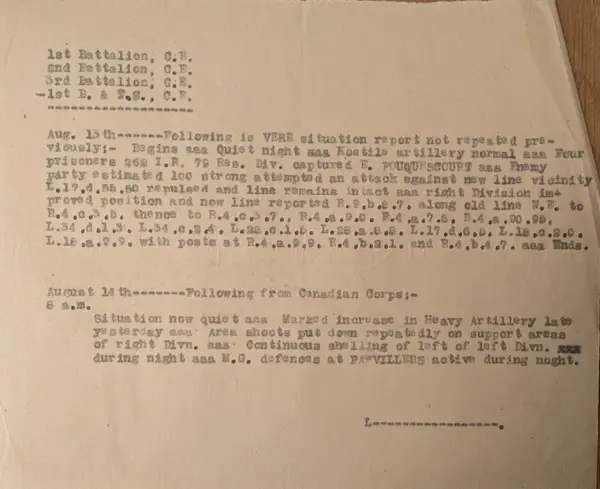
The fullest single sheet is the one for the 13th and 14th: a quiet night, a German raiding party of about a hundred beaten off, four prisoners of the 79th Reserve Division taken near Fouquescourt, and the right-hand division's new line traced out map-square by map-square. The others run lighter: a G.H.Q. summary relayed down on the opening day, the Corps stalled east of Fouquescourt on the 12th, the 3rd Division's costly push into Damery on the 15th, and, on the 16th, a captured German pioneer's statement that his side meant “to retire starting night 19th and 20th” from the Roye salient.
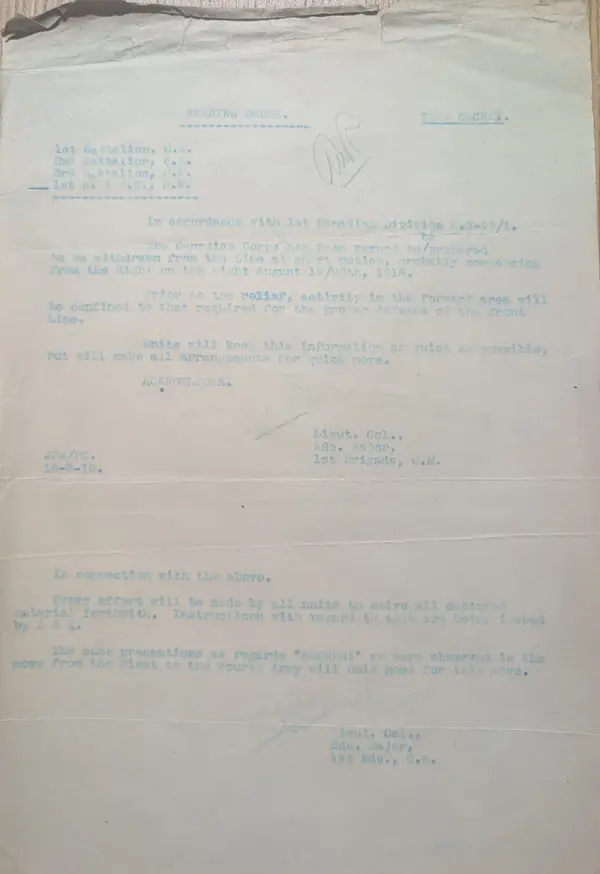
The last sheet in the run is not a situation report but a warning order, marked Very Secret and issued by the 1st Brigade C.E. on 18 August: the Canadian Corps “has been warned to be prepared to be withdrawn from the Line at short notice, probably commencing … on the night August 19/20th.” Units were to keep it quiet, salve all captured material first, and observe “the same precautions as regards ‘SECRECY’ as were observed in the move from the First to the Fourth Army”: the move south that had brought them to Amiens a fortnight before, now to be run in reverse. Robertson's diary, 19 August: “Warning order for move. Leave warrant arrived.” The Corps went back north to the Arras front, where it attacked astride the Scarpe on 26 August and broke the Drocourt–Quéant Line the following week.
The originals are in the Treherne family collection: a consecutive run of sheets for 8–18 August 1918, kept by Robertson as second-in-command of the Bridging and Transport Section (one carries his pencil filing mark, one the Section's registry stamp). Paper of this kind (daily situation summaries and warning orders passed from division and brigade down to units) is held openly at Library and Archives Canada in the war diaries of the formations concerned. None of the sheets carries a year; it is fixed by the distribution to the “1st, 2nd and 3rd Battalion, C.E.,” a structure that existed only after the May 1918 reorganisation of the Canadian Engineers, and by the place names (Fouquescourt, Parvillers, Damery) which place it at the close of the Battle of Amiens.