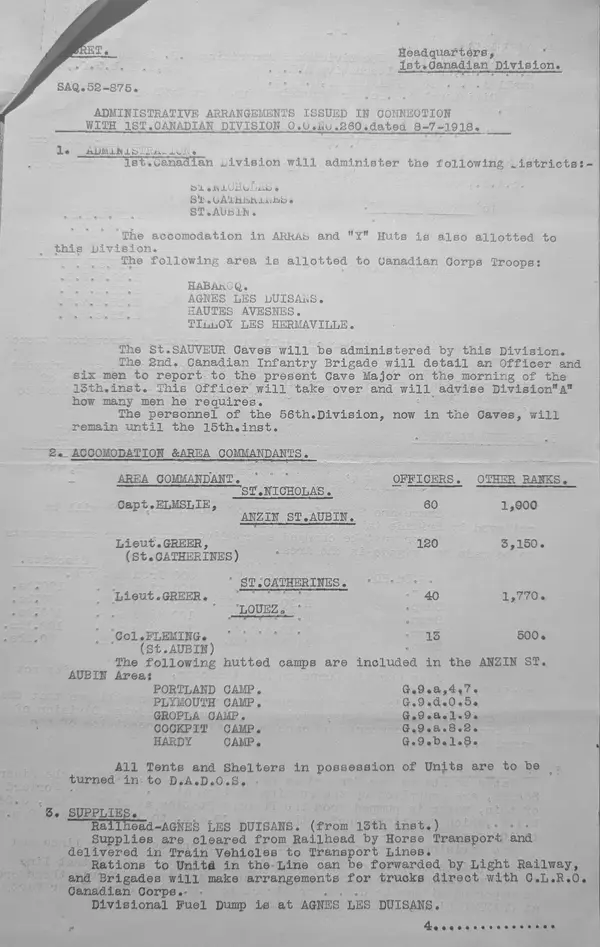
SECRET. Headquarters, 1st Canadian Division. SAQ.52-875.
Administrative Arrangements issued in connection with 1st Canadian Division O.O. No. 260, dated 8-7-1918.
1. Administration. 1st Canadian Division will administer the districts of St Nicholas, St Catherines and St Aubin. The accommodation in Arras and “Y” Huts is also allotted to this Division. The area allotted to Canadian Corps Troops: Habarcq, Agnez-les-Duisans, Hautes Avesnes, Tilloy-les-Hermaville. The St Sauveur Caves will be administered by this Division; the 2nd Canadian Infantry Brigade will detail an officer and six men to report to the present Cave Major on the morning of the 15th. The personnel of the 56th Division now in the Caves will remain until the 15th.
2. Accommodation & Area Commandants. St Nicholas — Capt. Elmslie (60 officers, 1,900 other ranks). Anzin St Aubin — Lieut. Greer (120 / 3,150). St Catherines — Lieut. Greer (40 / 1,770). Louez — Col. Fleming (13 / 500). Hutted camps in the Anzin St Aubin area: Portland, Plymouth, Gropla, Cockpit, Hardy. All tents and shelters in possession of units are to be turned in to D.A.D.O.S.
3. Supplies. Railhead — Agnez-les-Duisans (from the 13th). Supplies cleared from railhead by horse transport and delivered in train vehicles to transport lines; rations to units in the line forwarded by light railway. Divisional Fuel Dump at Agnez-les-Duisans.
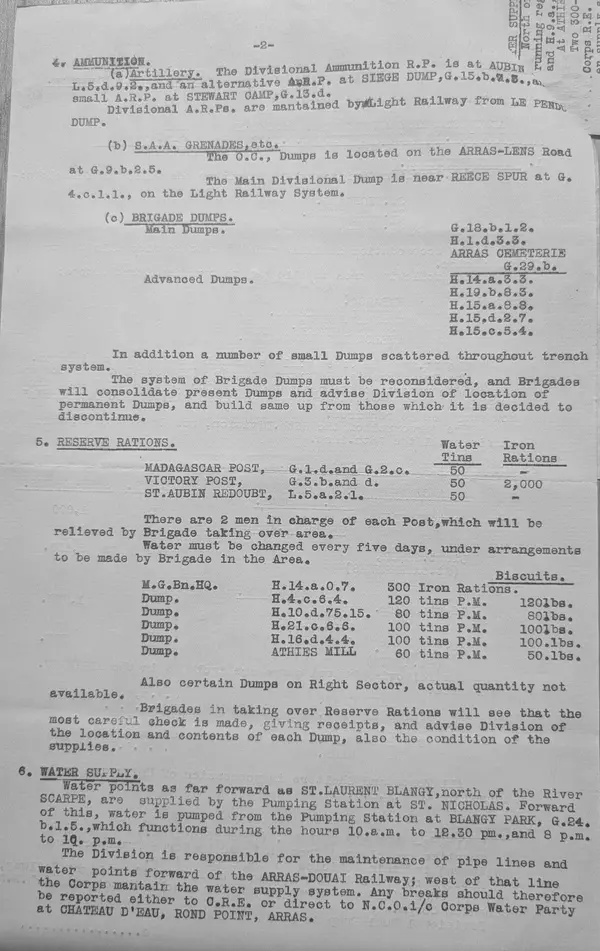
4. Ammunition. Divisional Ammunition Refilling Point at Aubin, an alternative at Siege Dump, a small A.R.P. at Stewart Camp; maintained by light railway from Le Pendu Dump. The O.C. Dumps (S.A.A., grenades) is on the Arras–Lens road; the Main Divisional Dump is near Reece Spur on the light railway. A number of brigade dumps, main and advanced, are listed by map square — “the system of Brigade Dumps must be reconsidered, and Brigades will consolidate present Dumps.”
5. Reserve Rations. Water tins and iron rations held at Madagascar Post, Victory Post and St Aubin Redoubt, and at a string of dumps listed by map square. Two men in charge of each post, relieved by the Brigade taking over the area; water must be changed every five days.
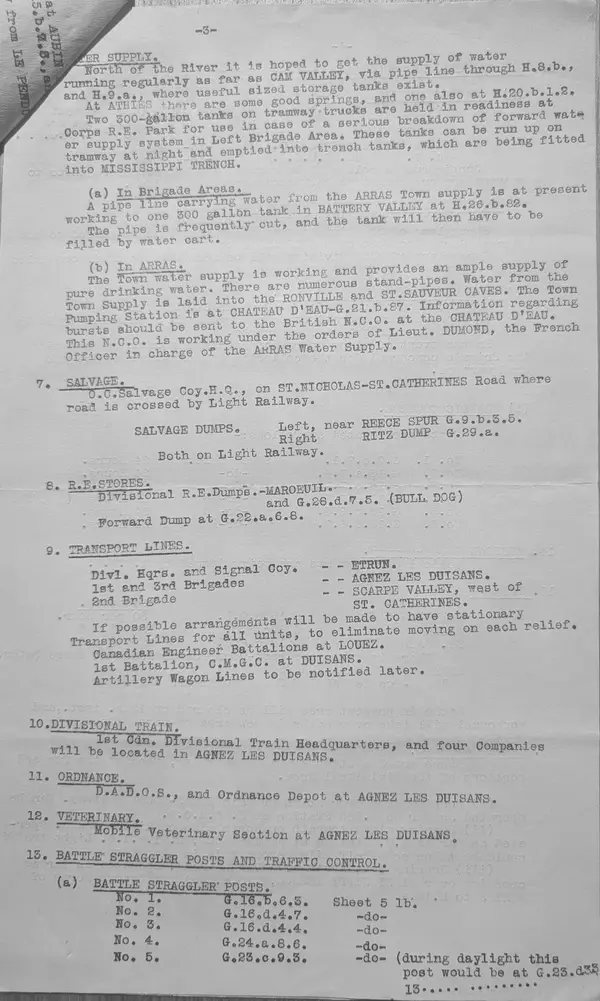
6. Water Supply. Water points as far forward as St Laurent Blangy, north of the Scarpe, are supplied by the pumping station at St Nicholas; forward of that, water is pumped from Blangy Park during 10 a.m.–12.30 p.m. and 8–10 p.m. The Division maintains pipe lines and water points forward of the Arras–Douai railway, the Corps west of it — breaks to be reported to the C.R.E. or direct to the N.C.O. i/c Corps Water Party at the Château d'Eau, Rond Point, Arras. Two 300-gallon tanks on tramway trucks are held at the Corps R.E. Park against a serious breakdown. In Arras the town water supply is working and provides ample pure drinking water, laid into the Ronville and St Sauveur caves, under Lieut. Dumond, the French officer in charge of the Arras water supply.
7. Salvage. O.C. Salvage Company headquarters on the St Nicholas–St Catherines road at the light-railway crossing. Salvage dumps: left, near Reece Spur; right, Ritz Dump.
8. R.E. Stores. Divisional R.E. Dumps at Maroeuil and at G.28.d.7.5. (“Bull Dog”). Forward Dump at G.22.a.6.8.
9. Transport Lines. Divisional Headquarters and Signal Company — Étrun. 1st and 3rd Brigades — Agnez-les-Duisans. 2nd Brigade — Scarpe Valley, west of St Catherines. Canadian Engineer Battalions at Louez. 1st Battalion C.M.G.C. at Duisans. “If possible, arrangements will be made to have stationary Transport Lines for all units, to eliminate moving on each relief.”
10–12. Divisional Train headquarters and four companies at Agnez-les-Duisans. D.A.D.O.S. and the Ordnance Depot at Agnez-les-Duisans. Mobile Veterinary Section at Agnez-les-Duisans.
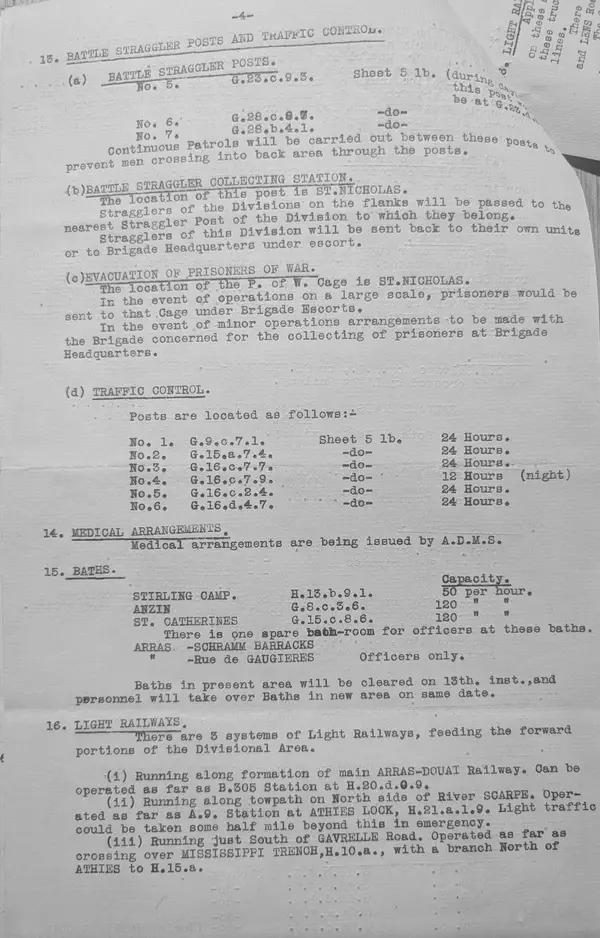
13. Battle Straggler Posts and Traffic Control. Seven battle straggler posts, sited by map square; “continuous patrols will be carried out between these posts to prevent men crossing into back area through the posts.” Battle Straggler Collecting Station at St Nicholas. Prisoner-of-war cage at St Nicholas — in large-scale operations prisoners are sent there under Brigade escorts; in minor operations, collected at Brigade headquarters. Six traffic-control posts, most manned 24 hours.
14. Medical. Arrangements being issued by the A.D.M.S.
15. Baths. Stirling Camp (50 per hour), Anzin (120), St Catherines (120), each with one spare bath-room for officers. Officers only: Arras — Schramm Barracks, and Rue de Gaugières. Baths in the present area cleared on the 13th; personnel take over the baths in the new area the same day.
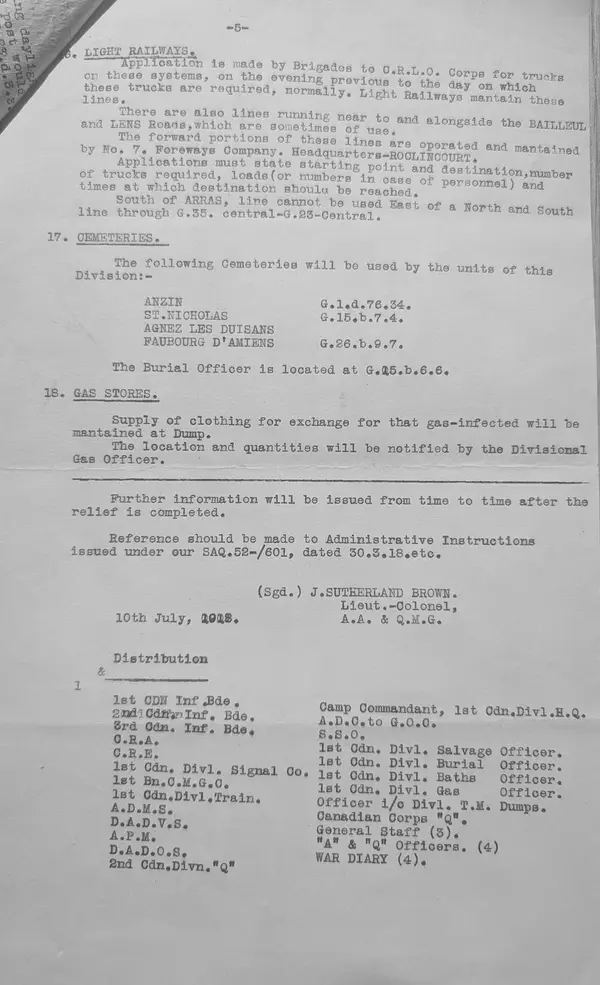
16. Light Railways. Three systems feed the forward divisional area: along the Arras–Douai railway formation (worked to B.305 Station); along the towpath on the north side of the Scarpe (to Athies Lock); and south of the Gavrelle road (to the Mississippi Trench crossing). Trucks are applied for through C.R.L.O. Canadian Corps the evening before they are wanted; forward portions are operated by No. 7 Foreways Company (headquarters Roclincourt).
17. Cemeteries. Anzin, St Nicholas, Agnez-les-Duisans, and Faubourg d'Amiens [Arras]. The Burial Officer is at G.15.b.6.6.
18. Gas Stores. Clothing for exchange for gas-infected clothing is maintained at a Dump; the location and quantities are notified by the Divisional Gas Officer.
Further information will be issued from time to time after the relief is completed. Reference should be made to the Administrative Instructions issued under our SAQ.52-/601, dated 30.3.18.
(Sgd.) J. Sutherland Brown, Lieut.-Colonel, A.A. & Q.M.G. 10th July 1918.
Distribution — the three Canadian Infantry Brigades, C.R.A., C.R.E., 1st Divisional Signal Company, 1st Battalion C.M.G.C., 1st Divisional Train, A.D.M.S., D.A.D.V.S., A.P.M., D.A.D.O.S., 2nd Canadian Division “Q”, Camp Commandant, A.D.C. to G.O.C., S.S.O., the Divisional Salvage / Burial / Baths / Gas Officers, Officer i/c Divisional T.M. Dumps, Canadian Corps “Q”, General Staff (3), “A” & “Q” Officers (4), War Diary (4).
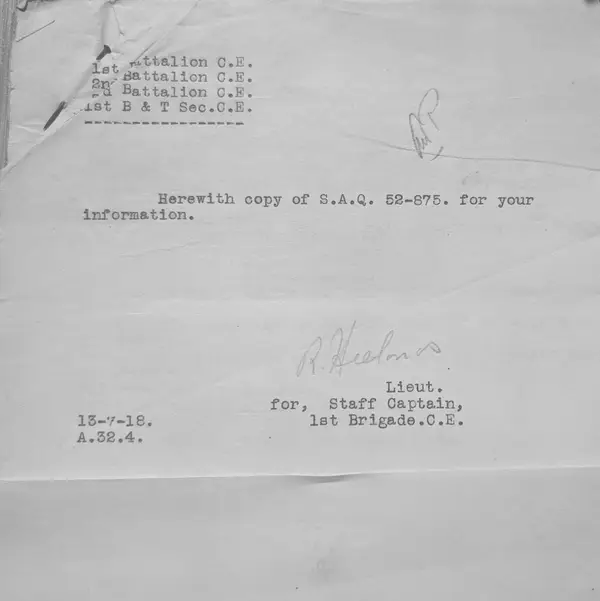
Covering note. To: 1st Battalion C.E. / 2nd Battalion C.E. / 3rd Battalion C.E. / 1st B & T Section C.E. — “Herewith copy of S.A.Q. 52-875 for your information.” [signature] Lieut., for Staff Captain, 1st Brigade C.E. 13-7-18. A.32.4.