The Move South
Summer 1918: the move to AmiensThe Move to Amiens got the 1st Canadian Division's engineers out of the line and into billets around St-Pol under a training-area cover story. These are the two orders that carried them the rest of the way (Operation Orders 95 and 96, Robertson's own unit's copies) covering the four days from the trains at Frévent to Boves Wood, the wood south-east of Amiens where the attack of 8 August was mounted.
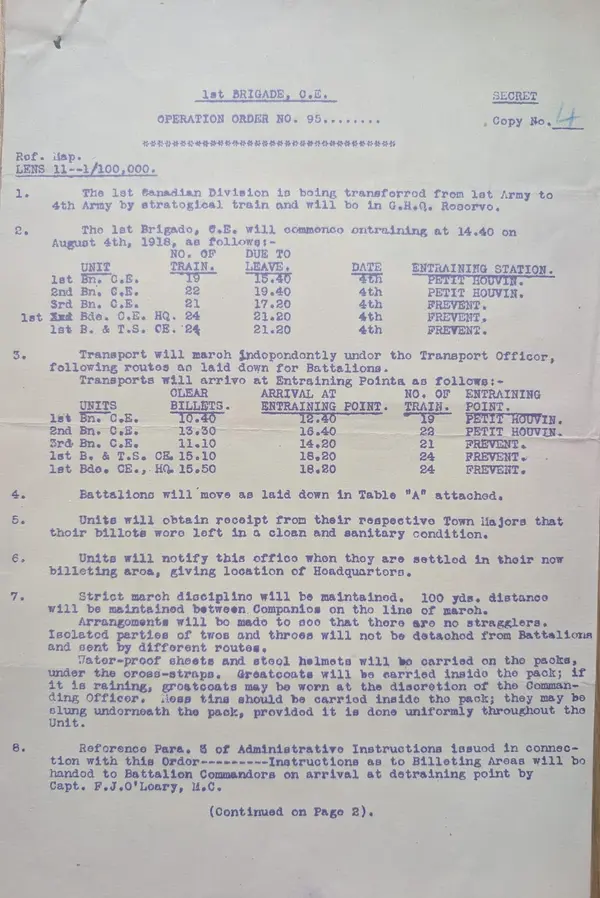
Operation Order No. 95 and its administrative instructions are the entrainment. The division was being shifted from First Army to Fourth Army by strategical train; the B & T Section drew Train 24, out of Frévent at 21.20 on 4 August. The detraining station was issued under sealed orders “not to be opened prior to departure of trains,” and there would be a one-hour halte repas somewhere on the way. Robertson's diary keeps step: entrained at Frévent at 6 p.m. on the 4th, “all on board in an hour,” then “Train pulled out at 9.45 for unknown destination”; halte repas at Noyelles-sur-Mer at 6 a.m. the next morning; detrained at Vieux-Rouen at noon.
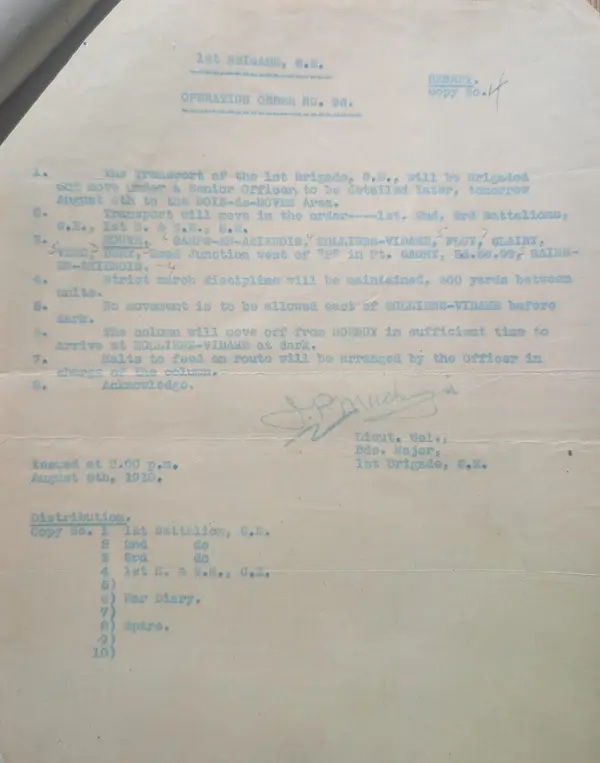
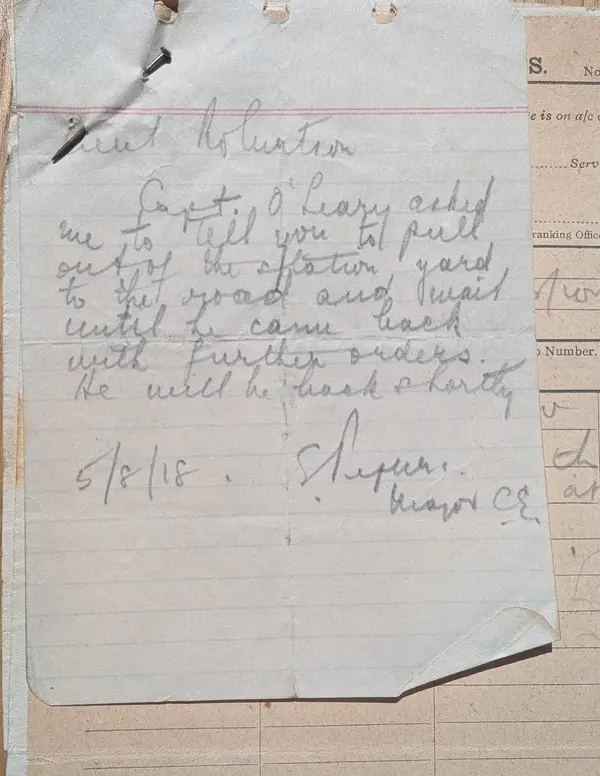
Operation Order No. 96, issued the afternoon of 5 August, is the approach march. The brigade's transport was to be pooled under one senior officer and moved to the Bois-de-Boves on the 6th; no movement forward of Molliens-Vidame before dark; everything kept under the trees by day, fires and lights down at night; all units ready to start work in the forward area on the night of the 6th/7th. A typed slip added that Capt. F. J. O'Leary (the transport officer who was meant to guide the route) “has gone forward,” and a pencil note reached Robertson at the station yard: O'Leary “asked me to tell you to pull out of the station yard to the road and wait until he came back with further orders.” It is signed, in a hand that is hard to read, by Major Pepler, his old company commander. The diary has the rest: the 44-kilometre trek to Boves Wood he got the C.R.E.'s leave to break at Vers, the troops brought in on the night of the 6th/7th, and (on the 8th) watching “the flood of the barrage” break at zero.
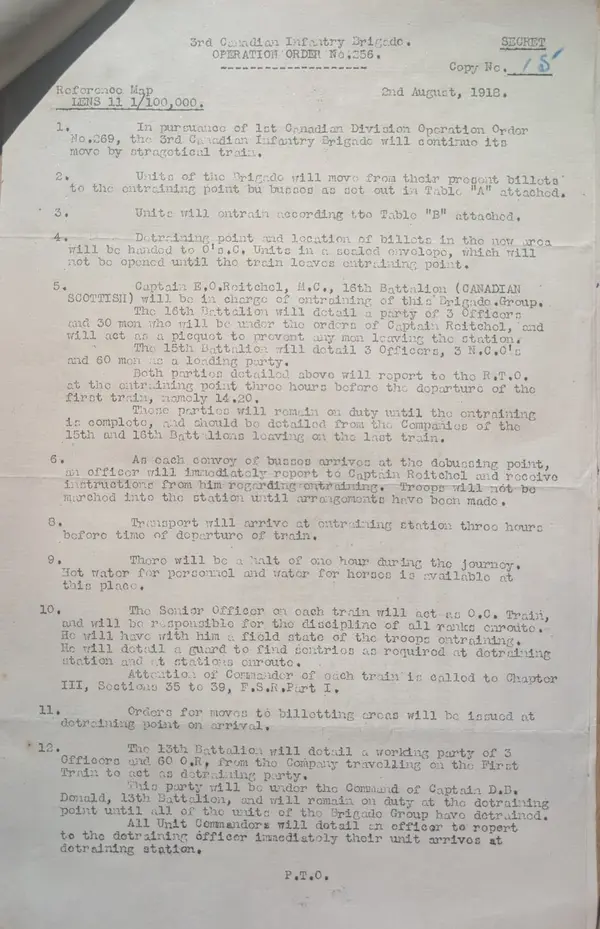
The fourth document is the odd one in the set: an operation order of the 3rd Canadian Infantry Brigade, not the engineers. It is here because its distribution list runs a copy (No. 15, the one that survives) to the “P.B. & T. Unit, 1st Cdn. Div.” Robertson's small specialist section had been bracketed onto the tail of an infantry brigade group for the move, on the same Train 24 out of Frévent.
Ref. map: Lens 11, 1/100,000. Issued at 6.30 p.m., August 2nd, 1918.
| Unit | Train | Due to leave | Entraining station |
|---|---|---|---|
| 1st Bn. C.E. | 19 | 15.40, 4th | Petit Houvin |
| 2nd Bn. C.E. | 22 | 19.40, 4th | Petit Houvin |
| 3rd Bn. C.E. | 21 | 17.20, 4th | Frévent |
| 1st Bde. C.E. H.Q. | 24 | 21.20, 4th | Frévent |
| 1st B. & T. S. C.E. | 24 | 21.20, 4th | Frévent |
Ref. map: Lens 11, 1/100,000. Issued at 9.00 p.m., 2nd August, 1918.
The originals are in the Treherne family collection. “SECRET” is the 1918 marking; records of this kind are held openly at Library and Archives Canada today. The pencil note to Robertson is signed “Major, C.E.” over the surname Pepler (Robertson’s company commander in 1916–17), in a hand that is hard to read.