Roads, Bridges and Tracks
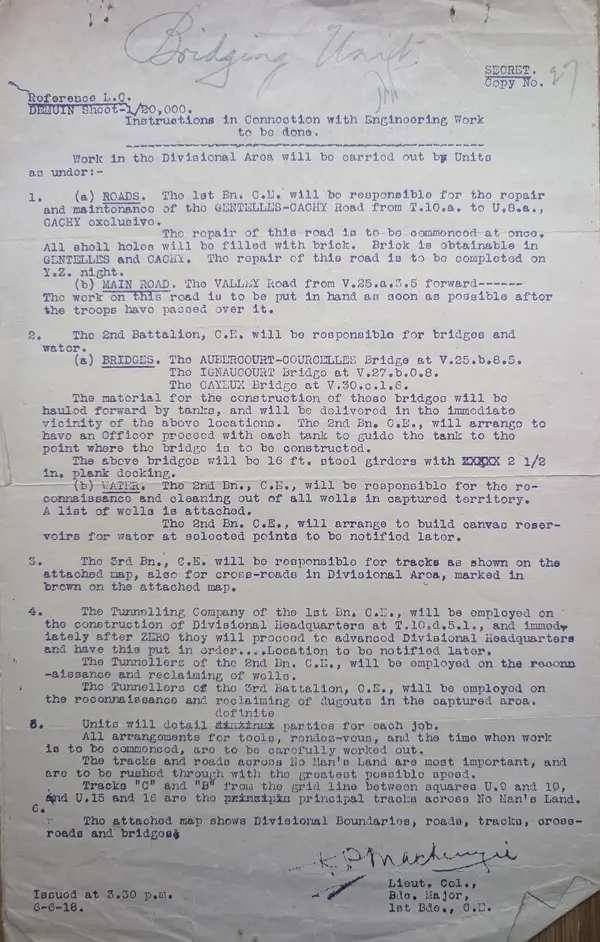
Summer 1918: the move to AmiensThis is the engineer plan for the Battle of Amiens, 8 August 1918: the day Ludendorff called “the black day of the German Army.” It divides the work of the 1st Canadian Division's three Engineer Battalions across the ground the attack would cross: roads (fill every shell hole with brick, finish by “Y.Z. night”), water (reconnoitre and clean out every well “in captured territory”), tracks pushed across No Man's Land “with the greatest possible speed,” and three bridges over the Luce (at Aubercourt, Ignaucourt and Caylux) whose 16-foot steel girders “will be hauled forward by tanks,” an officer walking with each tank to guide it to the bridging site.
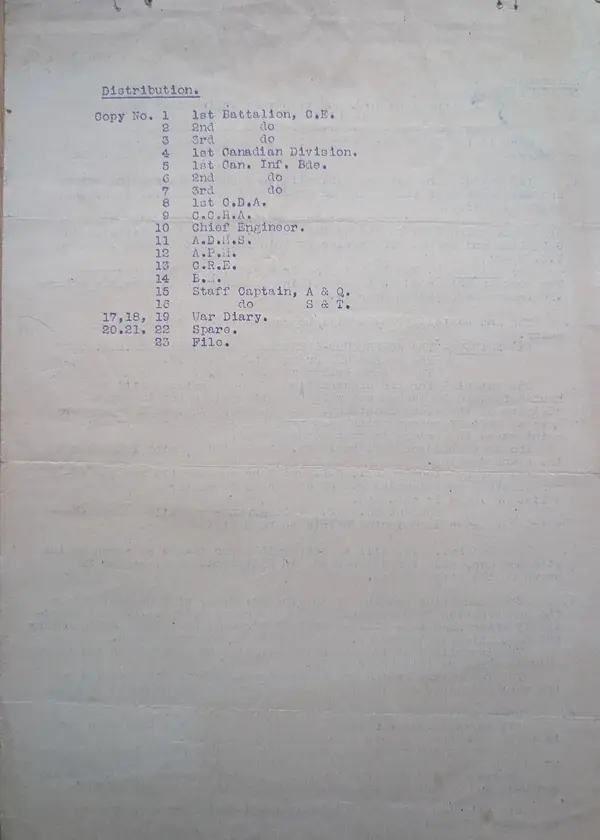
The sheet is headed, in Robertson's hand, “Bridging Unit,” with his initials: his copy, No. 27, though the printed distribution list on the back runs only to 23 (his unit, formed that June, was not yet on it). His own diary tracks the same days from inside: the long night trek to Boves Wood on 6–7 August, watching “the flood of the barrage” break at zero on the 8th, hauling shovels forward on the 9th, and pulling out for Aubercourt at daylight on the 10th.
Reference L.C. Demuin, sheet 1/20,000.
(b) MAIN ROAD. The Valley road from V.25.a.3.5 forward — the work on this road is to be put in hand as soon as possible after the troops have passed over it.
(a) BRIDGES. The Aubercourt–Courcelles bridge at V.25.b.8.5. The Ignaucourt bridge at V.27.b.0.8. The Caylux bridge at V.30.c.1.6. The material for the construction of these bridges will be hauled forward by tanks, and will be delivered in the immediate vicinity of the above locations. The 2nd Bn. C.E. will arrange to have an Officer proceed with each tank to guide the tank to the point where the bridge is to be constructed. The above bridges will be 16 ft. steel girders with 2½ in. plank decking.
(b) WATER. The 2nd Bn. C.E. will be responsible for the reconnaissance and cleaning out of all wells in captured territory. A list of wells is attached. The 2nd Bn. C.E. will arrange to build canvas reservoirs for water at selected points to be notified later.
[signed] J. P. Mackenzie, Lieut.-Col., Brigade Major, 1st Bde., C.E.
The originals are in the Treherne family collection. “SECRET” is the 1918 security marking; operational records of this kind are held openly at Library and Archives Canada today. The issue date reads “6-8-18”: the middle figure is indistinct, and could be a 6; the ground and the tank-hauled bridging place it firmly at the 8 August 1918 attack. It is the hand of Lieutenant-Colonel J. P. Mackenzie, Brigade Major of the 1st Brigade, C.E.: the same post, rank and hand behind the brigade’s other 1918 move orders in this collection, and a warning order from the same fortnight (18 August) carries his reference initials, “JPM,” in the typist’s sign-off block.