A Wiring Party
1916–1917On page 5 of his 1921 paper Robertson calls wiring “a most disagreeable task,” done at night, as quietly as possible, by parties of ten or twelve. This is the same thing from the other end: his own working sheet for actually building one, in his hand, on lined paper.
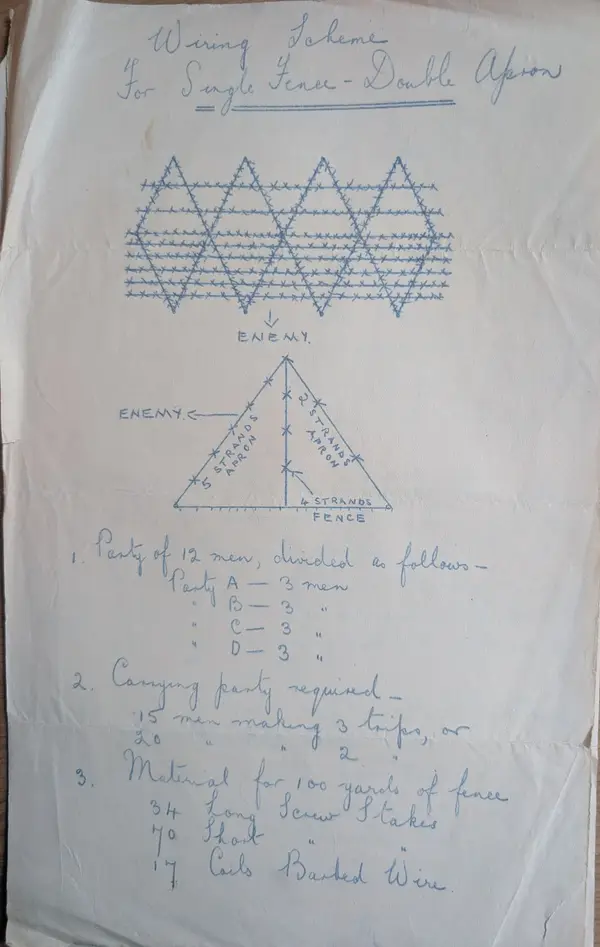
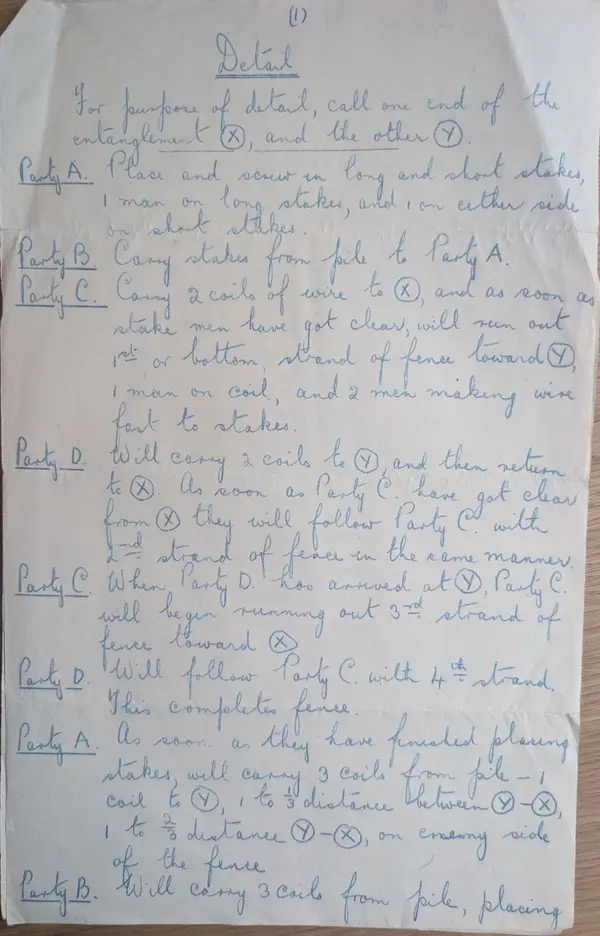
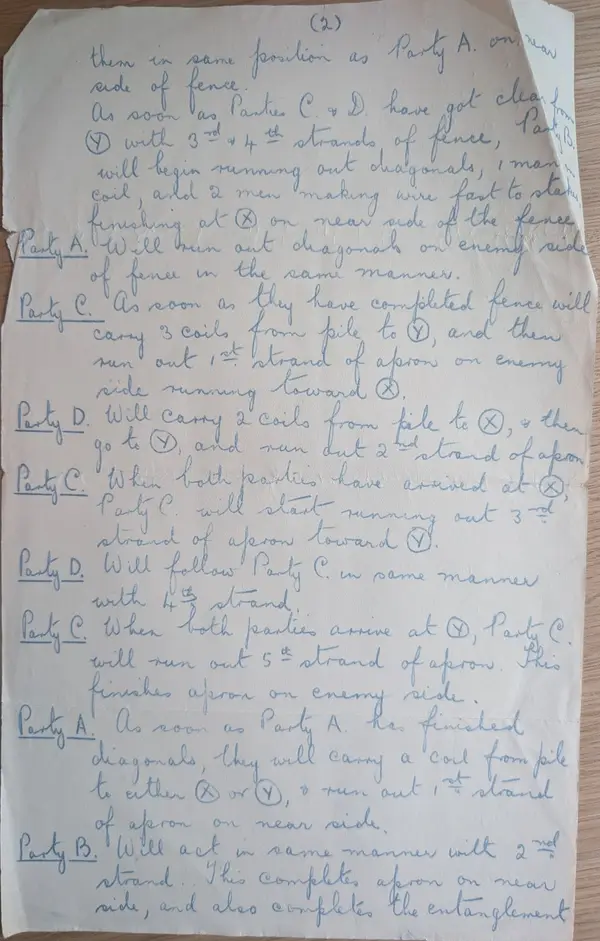
It sets out a single fence, double apron entanglement: a plan and a cross-section marked “ENEMY,” a party of twelve split into four groups of three, a carrying party of fifteen to twenty men, and the exact material for a hundred yards: 34 long screw pickets, 70 short, 17 coils of barbed wire. The two “Detail” pages then choreograph it minute by minute: which group carries what to which end, who runs out which strand and in what order, so that a dozen men working in the dark, most of them never standing upright, put up a hundred yards of impassable wire and are gone before first light.
The back of the sheet carries study notes on the alternatives: high wire and low trip wire, and the ready-made expedients for when there was no time to build properly: “gooseberries,” “knife rests,” and French concertina wire.
2. Carrying party required — 15 men making 3 trips, or 20 making 2.
3. Material for 100 yards of fence — 34 long screw stakes, 70 short, 17 coils barbed wire.
Party B. Carry stakes from pile to Party A.
Party C. Carry 2 coils of wire to X, and as soon as the stake men have got clear, run out the 1st, or bottom, strand of fence toward Y — 1 man on the coil, 2 men making wire fast to stakes.
Party D. Carry 2 coils to Y, then return to X; as soon as Party C have got clear from X, follow Party C with the 2nd strand of fence in the same manner.
Party C. When Party D has arrived at Y, begin running out the 3rd strand toward X.
Party D. Follow Party C with the 4th strand. This completes the fence.
Party B. Carry 3 coils from the pile, placing them in the same position as Party A on the near side of the fence.
As soon as Parties C and D have got clear from Y with the 3rd and 4th strands of fence, Party B begin running out diagonals — 1 man on the coil, 2 making wire fast to stakes, finishing at X on the near side. Party A run out diagonals on the enemy side in the same manner.
Party D. Carry 2 coils from the pile to X, then go to Y and run out the 2nd strand of apron.
Party C. When both parties have arrived at X, start the 3rd strand of apron toward Y.
Party D. Follow Party C with the 4th strand.
Party C. When both parties arrive at Y, run out the 5th strand of apron. This finishes the apron on the enemy side.
Party A. As soon as Party A has finished diagonals, carry a coil from the pile to either X or Y and run out the 1st strand of apron on the near side.
Party B. Act in the same manner with the 2nd strand. This completes the apron on the near side, and also completes the entanglement.
In Robertson's hand, in the Treherne family collection. Undated; the “single fence, double apron” was the standard British entanglement from about 1915, and the sheet sits with his 1916–17 field papers.