Instructions for a Crater
1916–1917Through the summer of 1916 the Canadian Corps held the southern edge of the Ypres salient, a stretch of front where much of the fighting had gone underground. Both sides tunnelled beneath the other’s line and fired charges; each “blow” left a crater that then had to be seized, drained and fortified before the enemy could do the same. The trench maps carried the larger craters as numbered features: here, 39, 40 and 42.
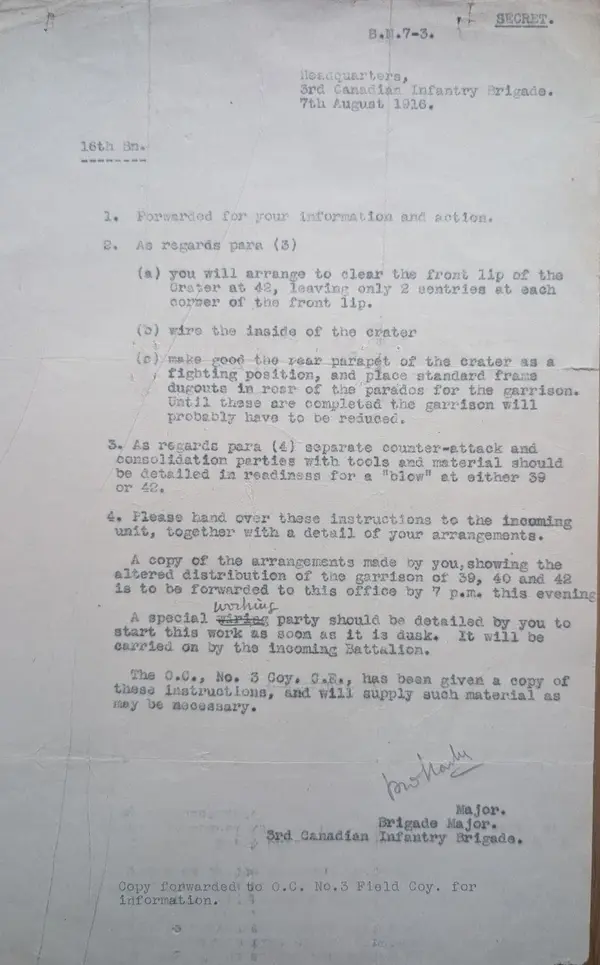
This is the brigade’s instruction to the 16th Battalion, holding those craters, with a copy sent to the officer commanding No. 3 Field Company, Canadian Engineers (Robertson’s company) because the engineers found the material and the men for the work it orders: clear the front lip of the crater at 42, wire its inside, build the rear parapet up into a fighting position, and keep counter-attack and consolidation parties standing by for the next blow at 39 or 42. The working party was to start at dusk and be carried on by the incoming battalion. The brigade was being relieved. Within days Robertson’s company had left the salient for the Somme; the diary picks the move up on 11 August.
Headquarters, 3rd Canadian Infantry Brigade.
7th August 1916.
(a) you will arrange to clear the front lip of the Crater at 42, leaving only 2 sentries at each corner of the front lip.
(b) wire the inside of the crater.
(c) make good the rear parapet of the crater as a fighting position, and place standard frame dugouts in rear of the parados for the garrison. Until these are completed the garrison will probably have to be reduced.
The original is in the Treherne family collection. It is the brigade’s covering instruction, passed between the relieved and relieving units; the underlying scheme for craters 39, 40 and 42, to which its paragraphs refer, is not among the papers. “SECRET” markings on operational papers of this period are historical. Records of this kind are held openly at Library and Archives Canada.