13 Apr · Wilkes / Pepler
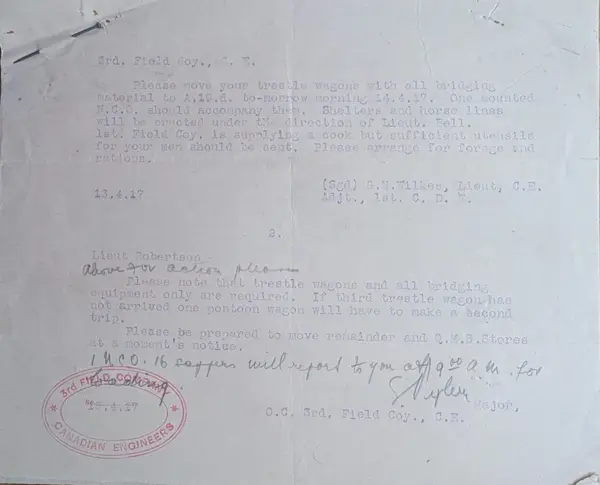
Order of 13 April 1917 from the Divisional Engineers, with Major Pepler's note to Robertson
13 Apr · Pepler to HQ
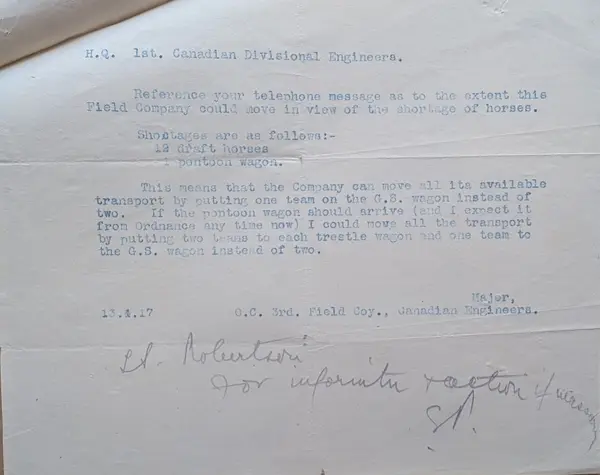
Pepler's reply to headquarters about the horse shortage, forwarded to Robertson
15 Apr · Ordnance
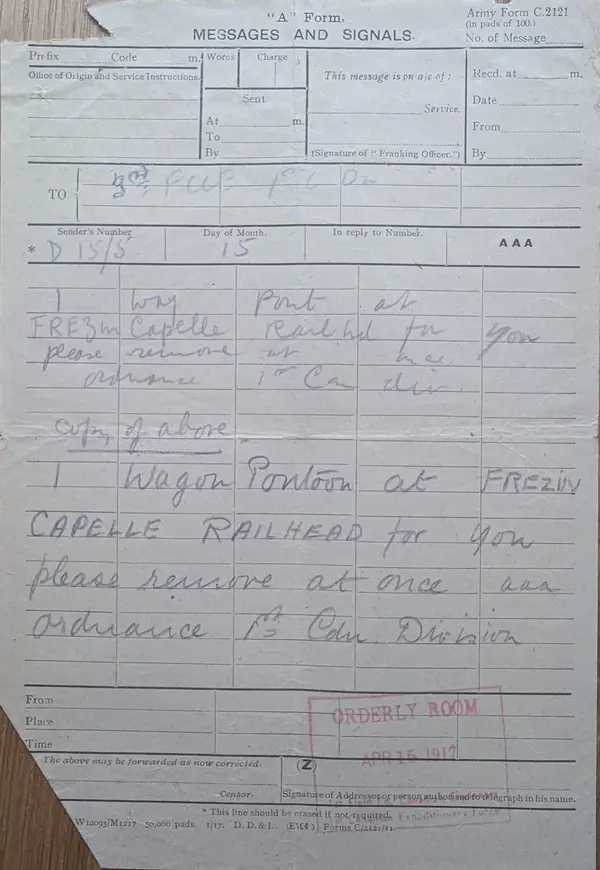
Message form, 15 April 1917: pontoon wagon at Frévin-Capelle railhead
15 Apr · Boswell
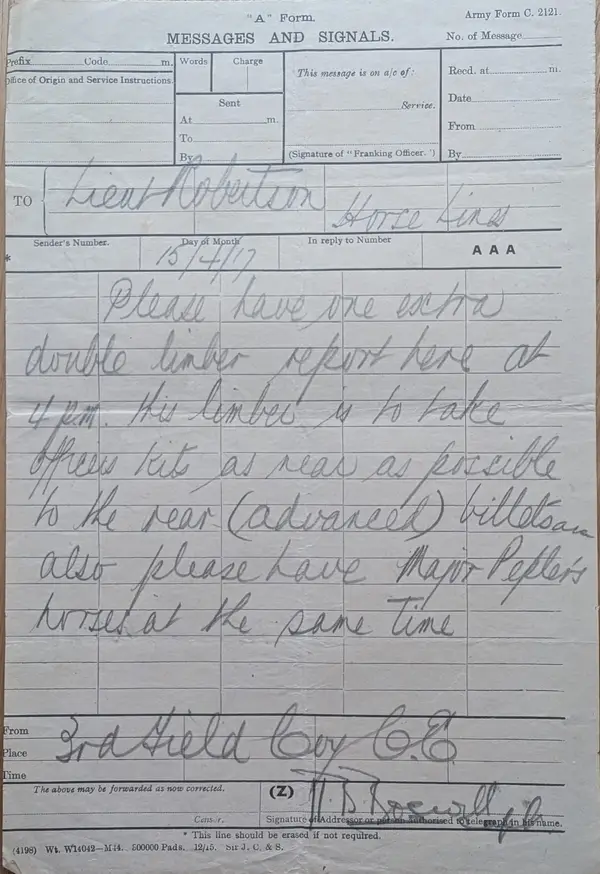
Message form from Boswell, 15 April 1917
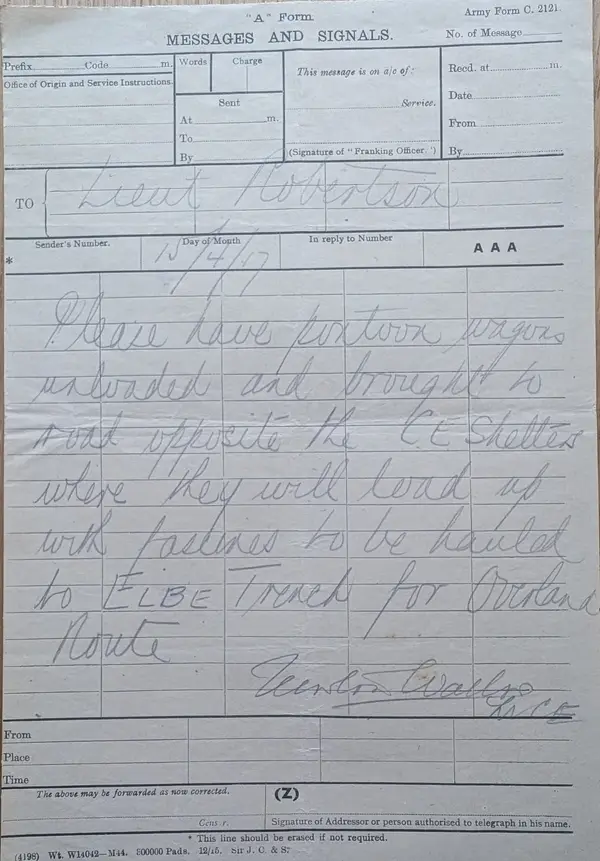
15 Apr · Wallace
Message form from Lieut. Newton Wallace, 15 April 1917
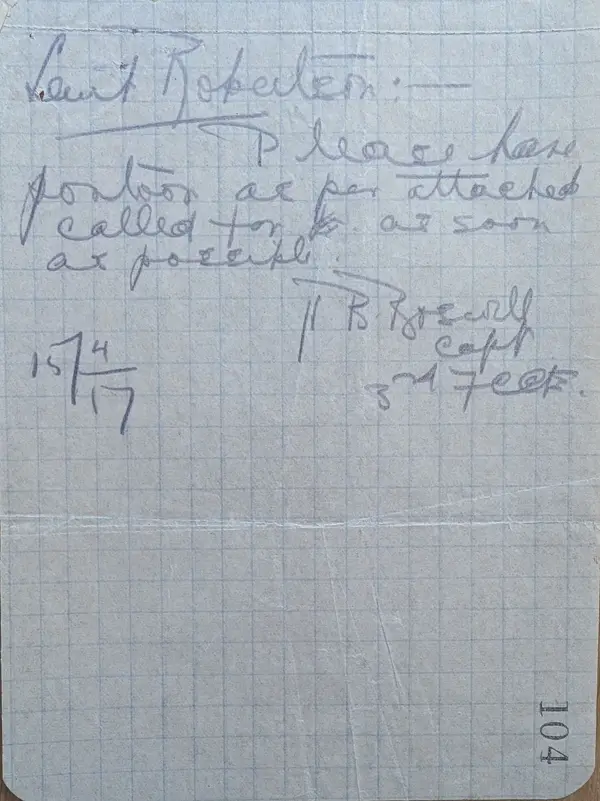
15 Apr · Boswell (note)
Pencil note from Capt. Boswell to Robertson, 15 April 1917: have the pontoon called for
Click to enlarge
3rd Field Company, Canadian Engineers · April 1917

Bridging Orders After Vimy

1916–1917

Robertson’s work in April 1917 was transport and bridging: the trestle and pontoon wagons that carried the material for dry-land trestle bridges and floating pontoon bridges, and the horse lines that moved them. In the days after the Vimy Ridge attack of 9 April, the front moved east faster than the roads behind it could be rebuilt, and getting the bridging forward across the old shell-torn ground became urgent.

These orders were kept together. On 13 April the Divisional Engineers tell the 3rd Field Company to move its trestle wagons up to a map square near the new line; Major Pepler forwards it to Robertson “for action,” then writes back to headquarters that the company is twelve draft horses and one pontoon wagon short and will have to double up teams to move at all. Two days later the missing pontoon wagon turns up at the Frévin-Capelle railhead, and Robertson (running the horse lines) is told to clear it “at once,” send a limber back for the officers’ kit, and have the pontoon wagons unloaded and reloaded with fascines for the overland route being pushed across no-man’s-land. A pencilled note from Boswell chases the same wagon: have the pontoon called for as soon as possible.

Transcription
1 — Adjutant, 1st Canadian Divisional Engineers, to the 3rd Field Company. 13 April 1917.
Please move your trestle wagons with all bridging material to A.19.d. tomorrow morning, 14.4.17. One mounted N.C.O. should accompany them. Shelters and horse lines will be erected under the direction of Lieut. Bell. 1st Field Company is supplying a cook, but sufficient utensils for your men should be sent. Please arrange for forage and rations. — G. H. Wilkes, Lieut., C.E., Adjutant, 1st C.D.E.
Forwarded to Robertson by Major Pepler (“Above for action please”): Please note that trestle wagons and all bridging equipment only are required. If the third trestle wagon has not arrived, one pontoon wagon will have to make a second trip. Please be prepared to move the remainder and the Q.M.S. stores at a moment’s notice. One N.C.O. and 16 sappers will report to you at 9 a.m.
2 — Major Pepler to Headquarters, 1st Canadian Divisional Engineers. 13 April 1917. (Forwarded to Robertson: “for information and action if necessary.”)
Reference your telephone message as to the extent this Field Company could move in view of the shortage of horses. Shortages are: 12 draft horses, 1 pontoon wagon. This means the company can move all its available transport by putting one team on the G.S. wagon instead of two. If the pontoon wagon should arrive — and I expect it from Ordnance any time now — I could move all the transport by putting two teams to each trestle wagon and one team to the G.S. wagon instead of two.
3 — Ordnance, 1st Canadian Division, to the 3rd Field Company. 15 April 1917.
One pontoon wagon at Frévin-Capelle railhead for you. Please remove at once.
4 — Boswell to Robertson, at the Horse Lines. 15 April 1917.
Please have one extra double limber report here at 4 p.m. The limber is to take officers’ kits as near as possible to the rear (advanced) billets. Also please have Major Pepler’s horses at the same time.
5 — Lieut. Newton Wallace, C.E., to Robertson. 15 April 1917.
Please have the pontoon wagons unloaded and brought to the road opposite the C.E. shelters, where they will load up with fascines to be hauled to Elbe Trench for the overland route.
6 — Capt. Boswell to Robertson. 15 April 1917.
Please have pontoon, as per attached, called for and as soon as possible.

The originals are in the Treherne family collection.