First diary
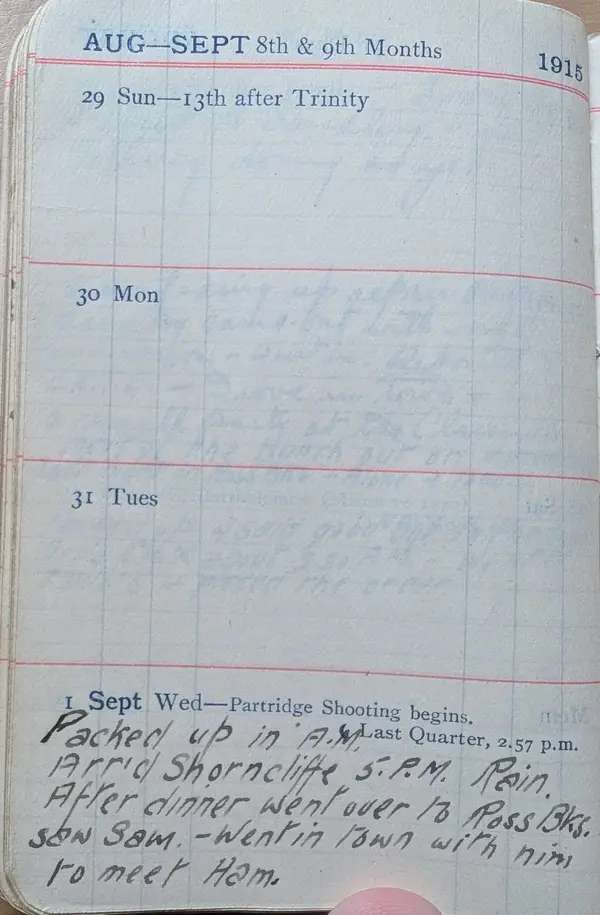
September 1, 1915 (Wednesday)
Packed up in A.M.
Arr'd Shorncliffe 5 P.M. Rain. After dinner went over to Ross Bks. Saw Sam. - Went in town with him to meet Ham.
Second Diary
Reported C.E.T.D.
Packed up in A.M.
Arr'd Shorncliffe 5 P.M. Rain. After dinner went over to Ross Bks. Saw Sam. - Went in town with him to meet Ham.
Reported C.E.T.D.
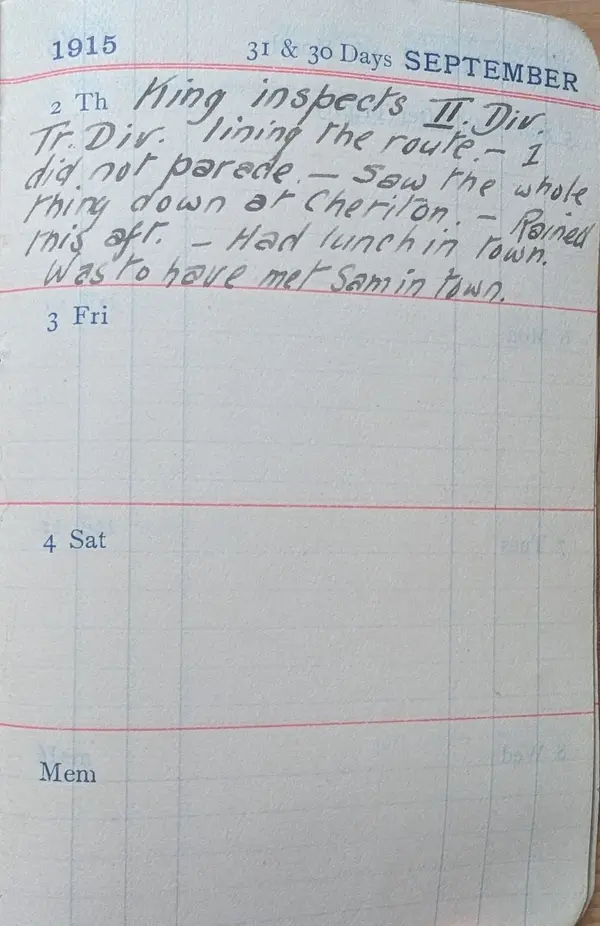
King Inspects II Div.Tr. Div lining the route. - I did not parade. - Saw the whole thing down at Cheriton. - Rained this aft. - Had lunch in town. Was to have met Sam in town.
King's Inspection
George V personally reviewed the 2nd Canadian Division today at Cheriton, not a local formality but a genuine send-off ritual, the kind of royal inspection that traditionally preceded a division's move overseas. Robertson doesn't parade himself; commissioned only about two weeks earlier, he watches from the crowd rather than standing in the review line. It's the last and grandest in a run of official inspections during 1915 (Sam Hughes and Prime Minister Borden in July, Bonar Law in August, now the King himself) as Canada's divisions in England prepared to cross to France.
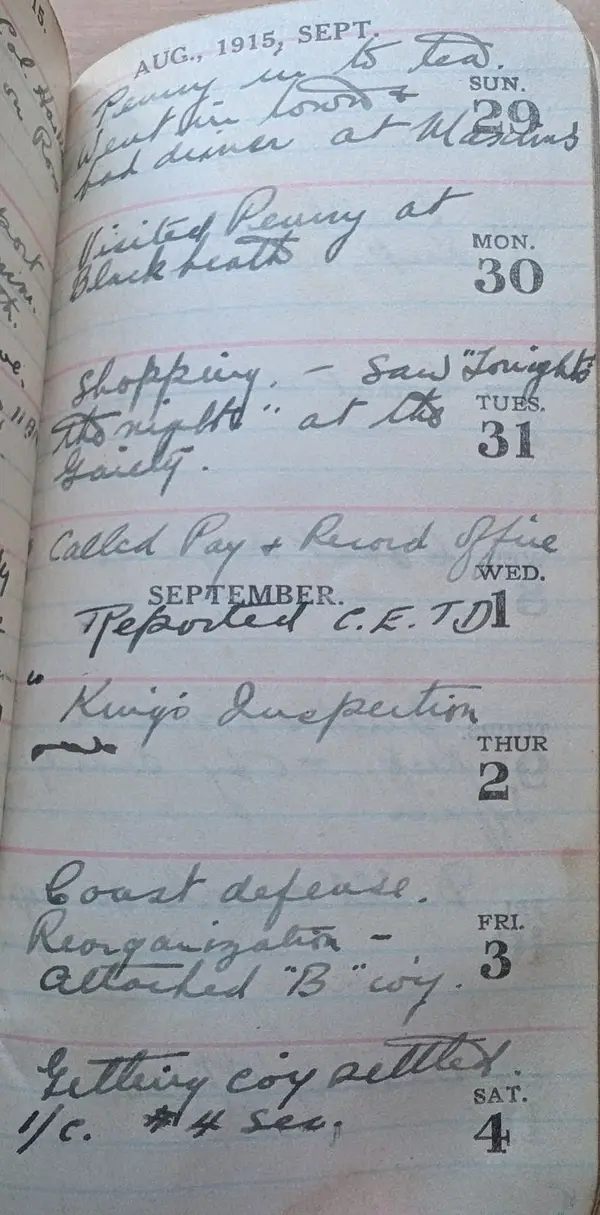
Coast defense. Reorganization - attached "B" co'y
Getting co'y settled. I/C. #4 sec.
Robertson records this only in the second, shorter notebook: "Getting co'y settled. – I/C. #4 sec.," made permanent two days later: "Keep #4 sec. permanently." After a year of training, socializing, and angling for a commission, this is the point he starts running something: a real command, however small. A Canadian field company was organized into several numbered sections like this one, each led by a single subaltern, so #4 Section put several dozen men under Robertson's direct charge. And they weren't general infantry: a field company's other ranks were overwhelmingly tradesmen, recruited specifically for civilian skills that translated directly to engineer work, carpenters, blacksmiths, electricians, plumbers, and other skilled hands, alongside the general-duty sappers and drivers. It's a reminder that "sapper" didn't mean unskilled labour; it meant a small, self-contained construction crew, which is exactly the kind of unit that spends its war building bridges, laying wire, and digging tunnels rather than manning a firing line.
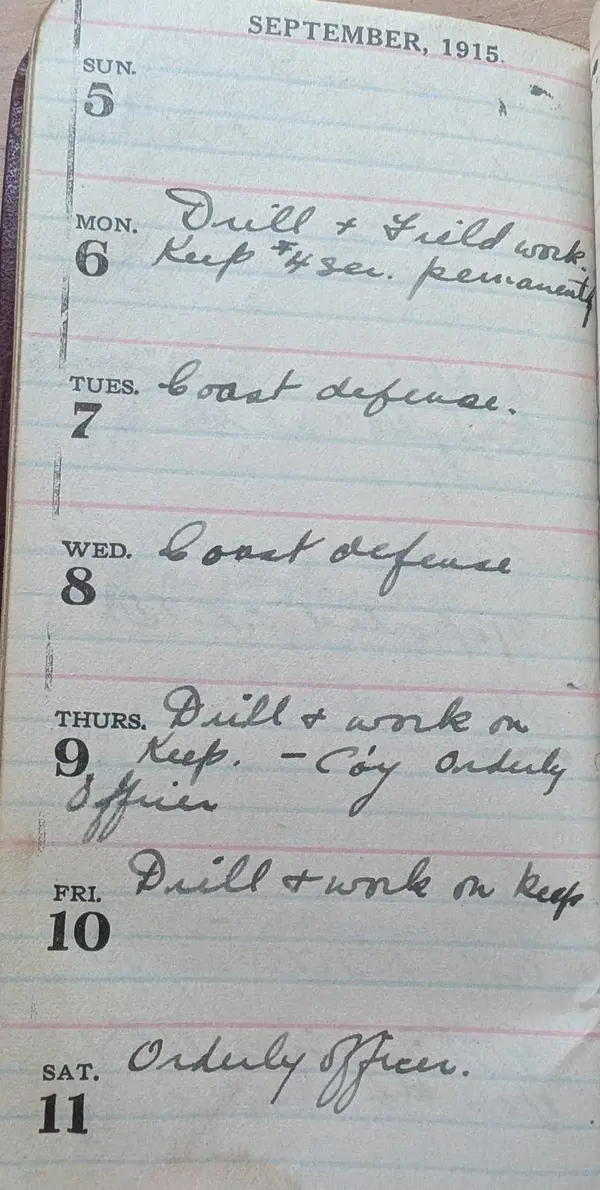
Drill + Field work. Keep #4 sec. permanently
Coast defense.
Coast defense
Drill + work on keep. - Co'y orderly officer
Drill + work on keep
Orderly officer.
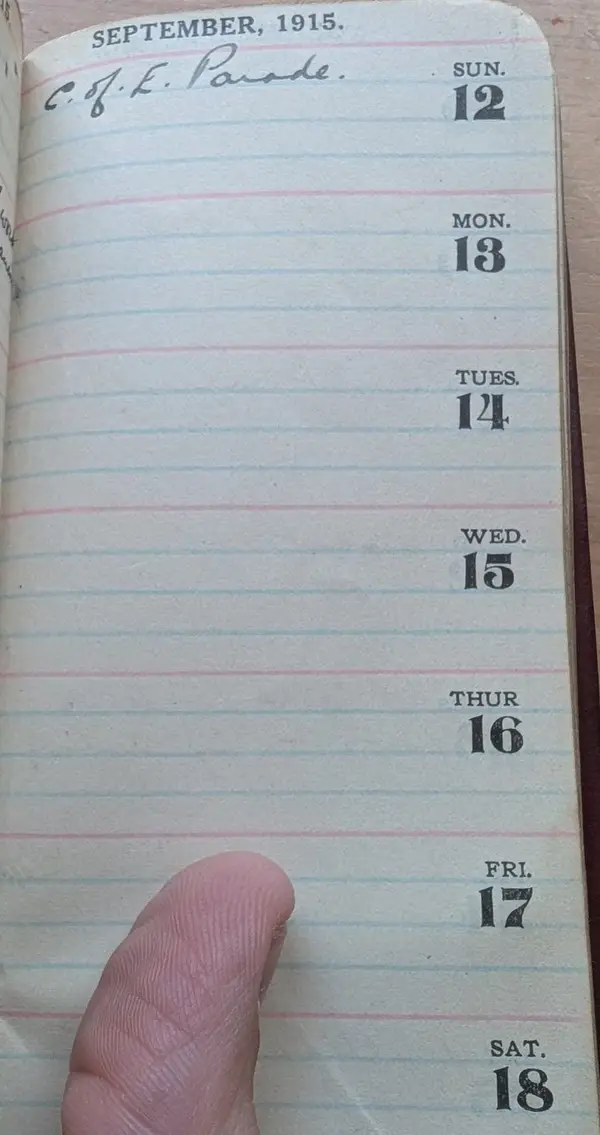
C. of E. Parade
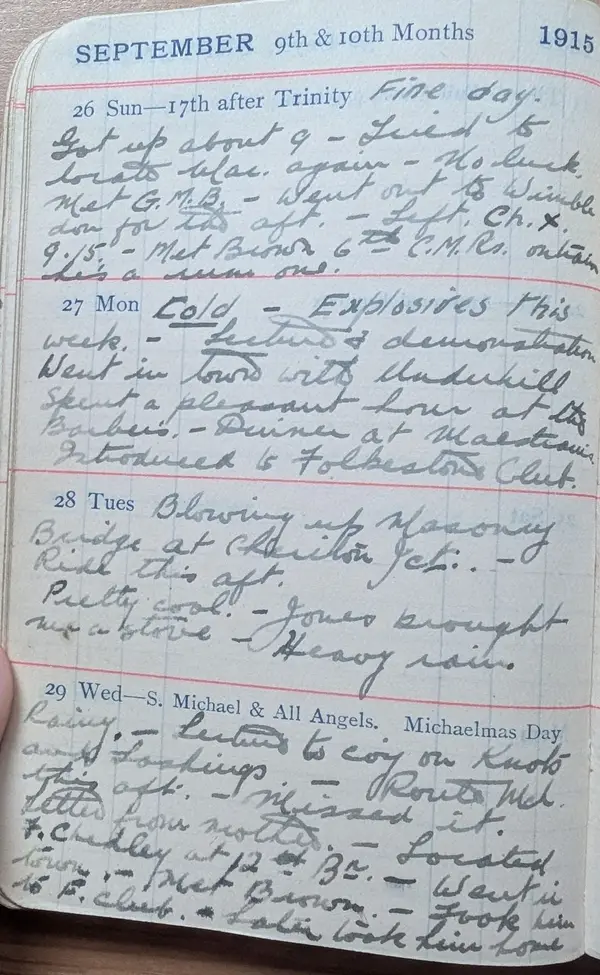
Fine day. Got up about 9. - Tried to locate Mac. again. - No luck. Met G.M.B. - Went out to Wimbledon for the aft. - Left Ch. X. 9.15 - Met Brown 6th C.M.R. on train. He's a rum one.
The day before this entry, Britain launched its largest offensive of 1915 near Loos, France, the first time the British Army used poison gas of its own, and the first major battle for its newly raised "New Army" divisions of volunteers. It was a costly failure, with over 50,000 British casualties for minimal ground gained, and it contributed to a change in command that December, see the entry for December 23.
Cold. Explosives this week. Lecture + demonstration. Went in town with Underhill. Spent a pleasant hour at the Barbers. - Dinner at Maestriani's. Introduced to Folkestone Club.
Blowing up Masonry Bridge at Cheriton Jct. - Ride this aft.
Pretty cool. - Jones brought me a stove - Heavy rain.
Rainy. - Lecture to co'y on Knots and lashings - Route Mch. this aft. - Missed it. Letter from mother. - Located F. Chidley at 12th Bn. - Went in town. - Met Brown. - Took him to F. Club + later took him home.
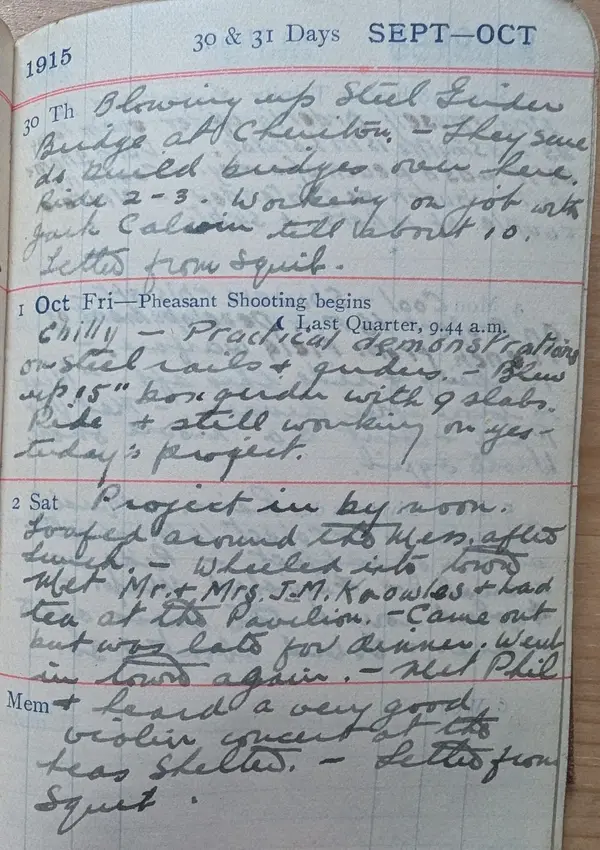
Blowing up Steel Girder Bridge at Cheriton. - They sure do build bridges over here. Ride 2-3. Working on job with Jack Calwin till about 10. Letter from Squib.
This week is the clearest look yet at what a Field Company engineer actually did day to day: lectures and hands-on demolition of a masonry bridge at Cheriton Junction, then a steel girder bridge, on top of instruction in knots and lashings. Robertson's unit, the Canadian Engineers, wasn't infantry. A field company's job was construction, demolition, and the practical, technical work of keeping an army moving, or stopping the enemy from doing the same: building bridges, laying wire, digging trenches and tunnels, blowing up whatever needed blowing up. The wiring parties, tunnel work, and bridge-building scattered through his time in France all draw on this.